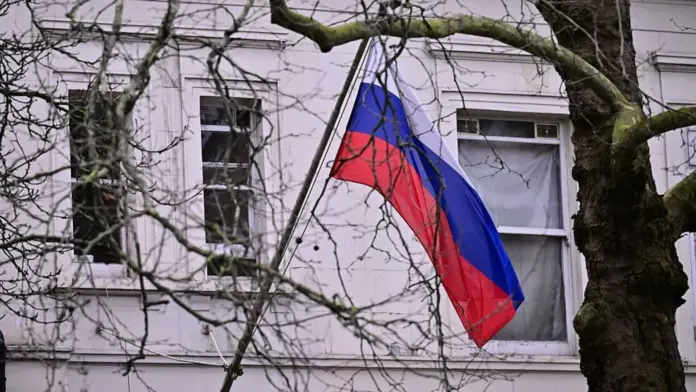
Russia Hybrid War — The director of Britain’s largest intelligence agency has issued a stark warning that Russia is waging an undeclared hybrid war against the United Kingdom and its NATO allies, targeting critical infrastructure, supply chains, democratic institutions and public trust in a sustained campaign of destabilisation.
Anne Keast-Butler, director of GCHQ, delivered the warning in her inaugural public speech — a significant moment for the head of an agency that has historically operated in near-total secrecy. The address was delivered from Bletchley Park, the Buckinghamshire estate that served as GCHQ’s original wartime home and the legendary birthplace of Allied codebreaking during the Second World War.
Keast-Butler’s remarks represent the most direct public accusation yet from the agency’s leadership that Moscow has moved beyond conventional espionage into a broader, more disruptive form of conflict. The Kremlin has denied allegations of targeting critical infrastructure or interfering in democratic processes.
Recommended Reading
The speech arrives against a well-documented history of Russian aggression on British soil. In 2006, former KGB officer Alexander Litvinenko was murdered in a London hotel after radioactive Polonium was slipped into his tea — an assassination for which the Kremlin has been held responsible. Twelve years later, former Russian military intelligence officer Sergei Skripal narrowly survived an attempt on his life in Salisbury, where the nerve agent Novichok was smeared onto his front door handle. Both cases remain defining episodes in the deterioration of UK-Russia relations.
Tensions have intensified further since Russia launched its full-scale invasion of Ukraine in 2022. The UK has provided sustained military and financial support to Kyiv throughout the conflict. More recently, hundreds of Russian shadow fleet vessels — tankers used to circumvent Western sanctions — have entered UK waters following a threat by the prime minister to intercept them, underscoring the breadth of the confrontation between London and Moscow.
Beyond Russia, Keast-Butler identified China as a formidable intelligence challenge, describing it as a science and technology superpower with sophisticated capabilities spanning cyber operations, intelligence gathering and military agencies. The characterisation reflects a growing consensus within Western intelligence communities that Beijing represents a long-term strategic competitor of a different order to traditional state adversaries.
GCHQ, which is based in Cheltenham and housed in a circular structure known informally as the Doughnut, is the largest of the UK’s three spy agencies, consuming the greatest share of the national intelligence budget. It operates alongside the Security Service (MI5) and the Secret Intelligence Service (MI6), with a primary focus on signals intelligence and cyber security.
Russia Hybrid War: The Cyber Warfare Dimension
A significant portion of the agency’s day-to-day work involves combating organised criminal networks that target British businesses with phishing attacks and ransomware campaigns — threats that have grown in scale and sophistication alongside the expansion of digital infrastructure. In a practical appeal to the public, Keast-Butler urged individuals to replace traditional passwords with passkeys, a more secure authentication method, as part of broader efforts to harden the UK’s cyber defences from the ground up.
The choice of Bletchley Park as the venue for the speech carried deliberate symbolic weight. The site, where mathematicians and linguists once cracked Nazi Germany’s Enigma codes, represents the intellectual heritage from which GCHQ draws its identity. Delivering her first public address there, Keast-Butler appeared to draw a direct line between the existential intelligence challenges of the 1940s and those confronting Britain today.
The cumulative picture painted by the GCHQ director is one of a United Kingdom operating in an increasingly contested security environment — one in which the boundaries between peacetime competition and active conflict have become deliberately blurred by adversaries unwilling to engage through conventional means. Russia’s strategy of plausible deniability, long a feature of its intelligence operations, has evolved into something more brazen: a pattern of behaviour that Western governments are now openly labelling as hybrid warfare, even as Moscow continues to reject the designation.