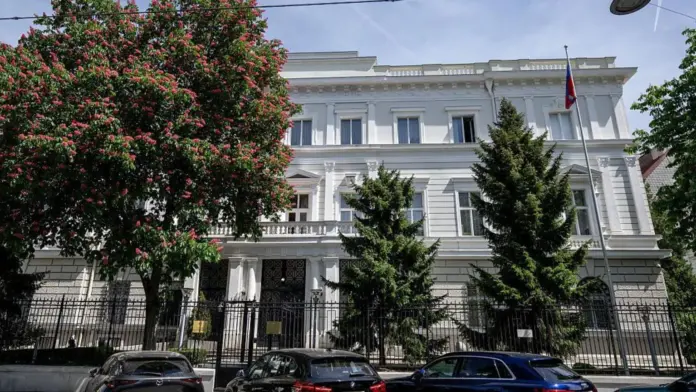
Vienna — Austria has expelled three Russian diplomats accused of running a covert signals intelligence operation from the rooftops of Moscow’s diplomatic premises in the Austrian capital, Foreign Minister Beate Meinl-Reisinger announced, escalating tensions between the two countries over espionage on European soil.
Austria Expels Russian Diplomats — The three diplomats had already departed Austria by the time the expulsion was formally declared. At the centre of the allegations are antenna installations discovered on the roof of the Russian embassy in Vienna and at a separate Russian diplomatic compound. The Austrian Broadcasting Corporation (ORF) reported that the equipment enabled Russian operatives to intercept data transmitted via satellite internet by organisations operating in the city — a significant capability given Vienna’s unique status as a hub for international institutions.
The Russian embassy rejected the accusations outright, describing the expulsions as unjustified and politically motivated, and warning that Moscow would respond harshly to Austria’s actions.
Recommended Reading

Vienna’s importance as an intelligence target is difficult to overstate. The city hosts one of the headquarters of the United Nations and serves as the seat of the Organization for Security and Cooperation in Europe (OSCE). The concentration of multilateral institutions means many countries maintain up to two separate diplomatic missions in the city in addition to a standard bilateral embassy — creating a dense environment of sensitive communications that intelligence services worldwide regard as a prime collection opportunity.
Austria’s own Report on the Protection of the Constitution had already identified Vienna as one of the last remaining locations in Europe where Russian signals intelligence operations remain active. Approximately 220 individuals are currently accredited to Russian diplomatic missions across Austria. Since the start of the war in Ukraine, Austria has expelled a total of 14 Russian embassy staff — the three latest diplomats bringing renewed attention to the scale of Moscow’s presence in the neutral Alpine republic.
The expulsion does not occur in isolation. Austria is simultaneously grappling with a high-profile domestic espionage case that has drawn direct lines between Russian intelligence and figures at the heart of European finance. Egisto Ott, a former Austrian intelligence official, went on trial in Vienna in January, charged with passing classified information to Russian intelligence officers and to Jan Marsalek — the fugitive Austrian-born executive of the collapsed German payments company Wirecard.
Marsalek, who fled to Moscow in 2020, is accused of functioning as an intelligence asset for Russia’s FSB security service. He remains the subject of an Interpol Red Notice and is wanted by German police on allegations of fraud connected to the Wirecard scandal, one of the largest corporate collapses in German history.
Austria Expels Russian Diplomats: The Cyber Warfare Dimension
The case underscores a pattern of Russian intelligence recruitment that extends well beyond traditional diplomatic channels. Germany also expelled an individual accused of spying for Russia in January and summoned its ambassador over separate espionage concerns — reflecting a continent-wide effort to confront what Western governments describe as an intensifying Russian intelligence campaign.
Austria’s historical role in this landscape stretches back decades. During the Cold War, the country’s constitutionally enshrined neutrality and its geographic position on the edge of the Iron Curtain made Vienna a natural listening post for both Eastern and Western intelligence services. That legacy has persisted long after the fall of the Berlin Wall, with the city retaining a reputation as one of Europe’s most active arenas for covert operations.
The discovery of rooftop antenna arrays represents a technically sophisticated dimension of that tradition — one that exploits the legal protections afforded to diplomatic premises to conduct surveillance that would be impossible from any other vantage point in the city. With Russian diplomatic staff numbers in Austria remaining substantial despite years of expulsions, and with the Ott trial continuing to expose the depth of Moscow’s domestic penetration, Vienna’s intelligence problem shows little sign of resolution.