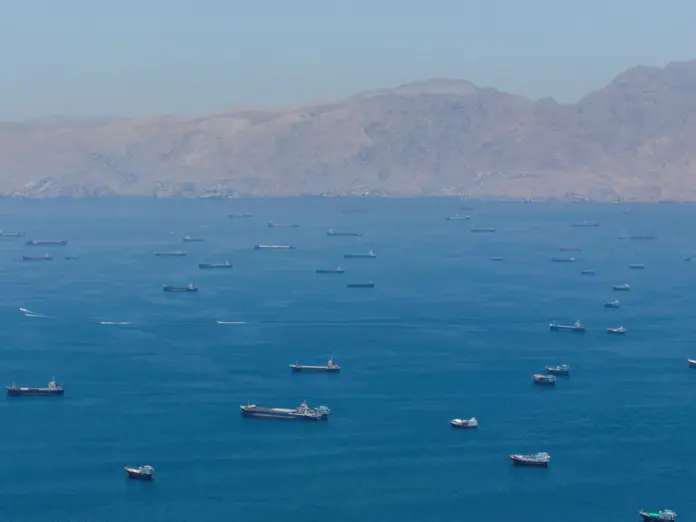
Iran Hormuz Blockade — A geopolitical contest over one of the world’s most critical energy corridors is entering a new and potentially permanent phase, as Iran pursues formal governance authority over the Strait of Hormuz and US President Donald Trump claims a deal to reopen the waterway is largely negotiated.
Tehran’s ambitions go well beyond the immediate crisis. Iran is working to establish a dedicated authority to manage the strait and exert greater influence over routing decisions — a move that would convert temporary leverage into an enduring institutional role. The shift represents a fundamental reframing of the strategic question surrounding the waterway: no longer simply whether ships can pass, but who sets the rules, prices the risks, controls the exceptions, and decides when normal commerce becomes conditional.
The strait sits at the centre of global energy flows, and the commercial consequences of uncertainty there are transmitted rapidly and disproportionately eastward. China, India, Japan and South Korea are among the principal end users of Gulf energy, and each faces compounding exposure as geopolitical instability reshapes the cost and reliability of supply. Refiners must plan procurement against shifting risk premiums. Manufacturers must price energy and transport volatility into their margins. The ripple effects reach every tier of industrial production across the Asia-Pacific region.
Recommended Reading
The burden falls unevenly. Many developing economies remain highly exposed to energy volatility and shipping disruptions while possessing little influence over the geopolitical contest that generates them. They are, in effect, price-takers in a market increasingly shaped by naval power, sanctions pressure, and crisis diplomacy conducted by larger states.
For the private sector, the implications are structural rather than episodic. Insurers must reassess their exposure to a waterway whose legal and political status is in flux. Shipping firms must make routing decisions under conditions of sustained political uncertainty. Banks and traders must account for sanctions risks, payment disruptions, and compliance costs that were not priced into contracts written under assumptions of frictionless commerce. The Strait of Hormuz is not an isolated vulnerability — it is one chokepoint among multiple strategic infrastructure points now subject to geopolitical pressure — but its centrality to global energy markets makes it uniquely consequential.
The deeper transformation underway is one that extends well beyond any single waterway or negotiation. The model of globalisation built on predictable, politically neutral infrastructure is giving way to something more conditional. Passage, payments, insurance, ports, and suppliers are all increasingly vulnerable to geopolitical leverage. Modern trade depends on predictability, legal clarity, naval confidence, and the belief that today’s route will still be viable tomorrow. Each of those foundations is now subject to contest.
States that depend heavily on maritime trade now face a structural reality in which commercial access is shaped not by neutral international law alone, but by the interplay of sanctions regimes, naval deployments, and bilateral crisis diplomacy. Strategic infrastructure can no longer be treated as politically neutral, and geopolitical risk can no longer sit outside procurement, logistics, treasury, and insurance decisions.
Iran Hormuz Blockade: Regional Implications
Trump’s claim that a deal is largely in place offers a potential near-term resolution to the immediate crisis of access. But Iran’s parallel push for a formal governance role suggests that even a successful negotiation may leave the deeper question — of who ultimately controls the conditions of passage — unresolved. The strategic contest over the Strait of Hormuz is shifting from a crisis to be managed into an institutional arrangement to be negotiated, and the terms of that arrangement will shape global energy markets and supply chains for years to come.
Globalisation is not ending, but it is becoming more politically exposed and strategically conditional. Companies and governments that built their operating assumptions around the frictionless movement of goods are now confronting a world in which the infrastructure of trade is itself a site of geopolitical competition.