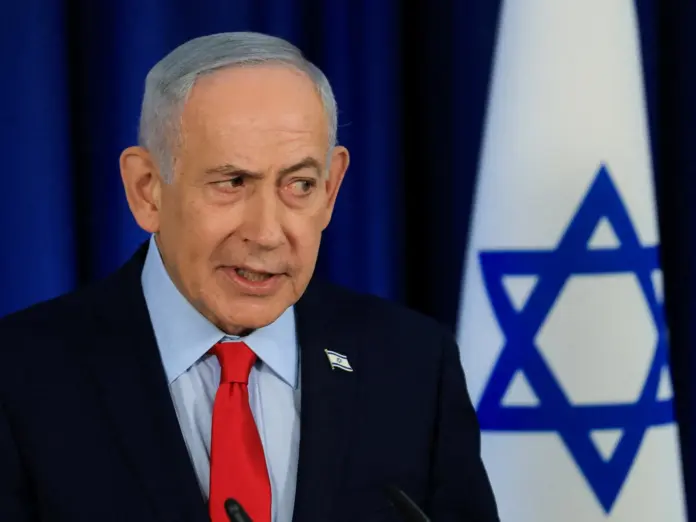
Gaza Strip — Israeli Prime Minister Benjamin Netanyahu has ordered the military to seize control of 70 percent of the Gaza Strip, escalating a campaign of territorial expansion that has already pushed Israeli forces well beyond boundaries established under a US-brokered ceasefire agreement. The directive, recorded by Channel 12 and broadcast on Thursday, came as an Israeli air strike killed at least 10 people — among them four children — and wounded 20 others in yet another day of violence nominally covered by a truce.
Gaza Ceasefire Collapse — Netanyahu stated that Israeli forces currently hold 60 percent of Gaza’s territory, a figure that itself reflects a dramatic expansion beyond what was agreed when the ceasefire was reached in October 2025. That agreement established a boundary known as the ‘Yellow Line’, demarcating areas under Israeli military occupation. In mid-March, the army pushed 11 percent beyond that line, lifting its footprint from 53 percent to 64 percent of Palestinian territory. The prime minister’s latest instruction would extend that hold still further.
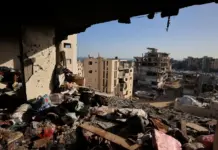
The consequences for Gaza’s civilian population are severe. Approximately two million Palestinians remain trapped in the territory under what humanitarian agencies describe as catastrophic conditions. Roughly two-thirds of Gaza is now inaccessible to its own residents due to Israeli military presence. The UN Office for Humanitarian Affairs reports that displaced families are sheltering in overcrowded tents, damaged buildings, and converted schools. Clean water is scarce, waste collection has broken down, and the resulting sanitation crisis is fuelling the spread of disease, rats, and insects.
Recommended Reading
The ceasefire, brokered by Washington, has existed largely on paper. A tally compiled between October and April recorded at least 2,400 Israeli violations of the truce. Israeli bombardment has intensified since February, when a broader US-Israel military campaign against Iran began, with conflict monitors noting a direct correlation between that escalation and the pace of strikes on Gaza.
The human toll of the war, which Israel launched following the October 7, 2023 attacks by Hamas and allied armed groups on southern Israel, now exceeds 72,775 Palestinian deaths. Many hundreds more have been killed in the seven months since the ceasefire nominally took effect.
Nickolay Mladenov, the high representative overseeing the US-founded Board of Peace for Gaza, delivered a stark warning to the UN Security Council, cautioning that the deteriorating status quo risks solidifying into something permanent. Mladenov urged the council to press Hamas to disarm and simultaneously compel Israel to honour its October ceasefire commitments — a dual demand that reflects the depth of the diplomatic impasse.
‘Permanent’ is a word that carries particular weight in a conflict now entering its third year. The combination of territorial seizure, near-daily bombardment, and systematic restriction of civilian movement suggests a strategic objective that extends well beyond temporary military control. International observers and humanitarian organisations have repeatedly called for enforceable mechanisms to halt the violence, but no such framework has materialised.
Gaza Ceasefire Collapse: Regional Implications
The expansion order places Israel on a collision course with international law and the terms of its own ceasefire agreement. The Yellow Line was not merely a military convenience — it was a negotiated boundary underwritten by United States diplomacy. Netanyahu’s instruction to push beyond it, and beyond the territory already seized in violation of that line, signals that the ceasefire framework is effectively defunct as a restraining mechanism.
For the people of Gaza, the arithmetic of territorial control translates directly into survival. Each percentage point of additional Israeli military presence means more land from which civilians are barred, more supply routes severed, and more of the already-diminished humanitarian space eliminated. With the war now compounded by the regional escalation involving Iran, and with no credible diplomatic process to halt the fighting, the prospect of relief for Gaza’s two million residents remains distant.