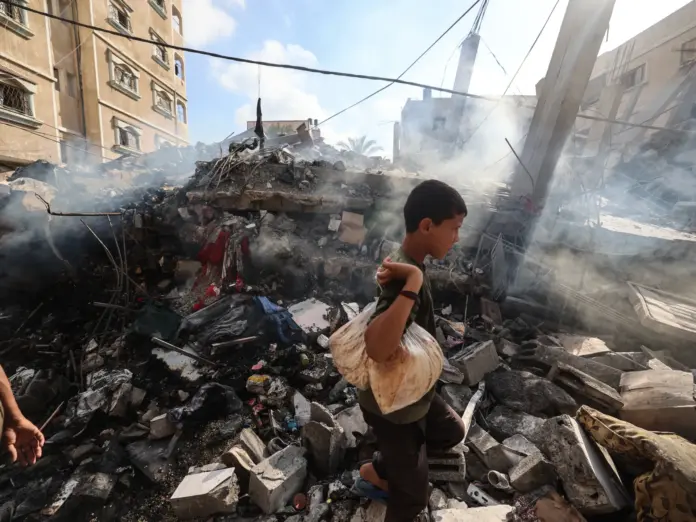
Nuseirat refugee camp, Gaza — An Israeli air strike tore through an apartment in the Nuseirat refugee camp in the early hours of Sunday, killing a family of three: Mohammad Abu Mallouh, his wife Alaa Zaqlan, and their six-month-old son Osama. Around ten other people sustained wounds in the attack. The bodies of the three family members were received at Al-Aqsa Martyrs Hospital in Deir el-Balah.
Gaza Ceasefire Violations — The strike came as Israeli forces continued demolishing homes and civilian infrastructure in eastern Gaza on Sunday, and as Israeli jets carried out additional air raids on Deir el-Balah in central Gaza, causing extensive damage in the vicinity of a hospital. Separately, Israeli bombing began Sunday morning as Palestinians fled their homes following forced displacement orders issued by Israeli authorities.
The deaths of the Abu Mallouh family are part of a broader pattern of violence that has persisted since a ceasefire brokered by the United States came into effect in October. Gaza health authorities report that nearly 900 people have been killed since the truce began — a toll that underscores how fragile the agreement has proven in practice. The day before Sunday’s strike, five police officers and a 13-year-old boy were killed in a separate Israeli attack.
Recommended Reading
The Gaza Government Media Office has documented at least 2,400 Israeli violations during the ceasefire’s first six months. Those violations include more than 1,100 air raids and at least 921 shootings targeting civilians — a catalogue of incidents that human rights organisations say reflects a systematic disregard for the terms of the truce.
Human Rights Watch warned that the territory’s humanitarian infrastructure remains in peril more than six months after the ceasefire took hold. Hospitals, water systems, and residential areas have continued to sustain damage, leaving Gaza’s civilian population with diminishing access to basic services even as diplomatic efforts to end the war have stalled.
Negotiations between Israel and Hamas aimed at reaching a permanent end to the conflict have hit an impasse. Israeli officials point to Hamas’s refusal to disarm as the central obstacle to any lasting agreement. Hamas, for its part, says talks have been suspended because of continued Israeli violations and severe restrictions on the flow of humanitarian aid into Gaza.
The broader war, which Israel launched in October 2023, has now claimed the lives of more than 72,000 Palestinians, according to Gaza health authorities — figures that Israeli officials acknowledged as broadly accurate as recently as January. The staggering death toll has drawn sustained international condemnation, though it has not produced a binding halt to hostilities.
Gaza Ceasefire Violations: Regional Implications
Sunday’s events illustrate the gap between the formal existence of a ceasefire and conditions on the ground. For the family in Nuseirat — a densely populated camp in central Gaza that has been struck repeatedly throughout the conflict — the truce offered no protection. Osama Abu Mallouh, six months old, did not survive to see his first birthday.
With diplomatic channels effectively frozen and Israeli military operations continuing at near-daily frequency, there is little immediate prospect of relief for Gaza’s remaining civilian population. The international community has largely been unable to translate expressions of concern into enforceable constraints on the conduct of the war.