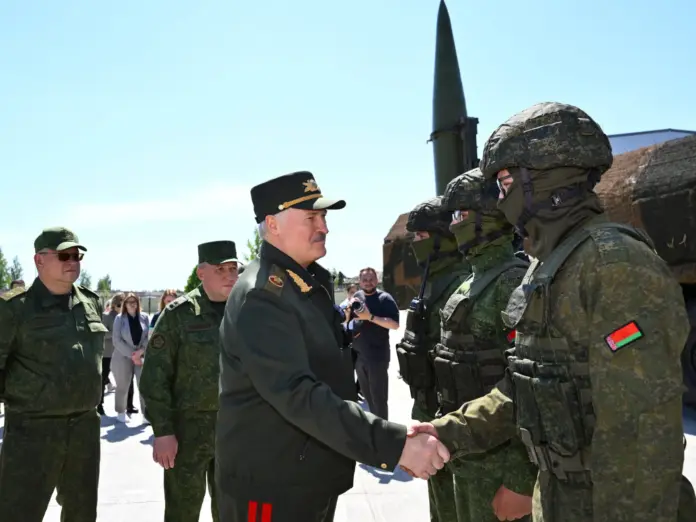
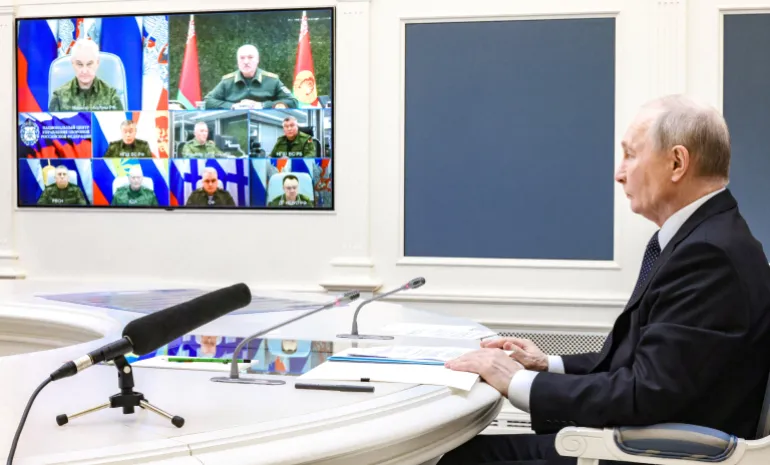
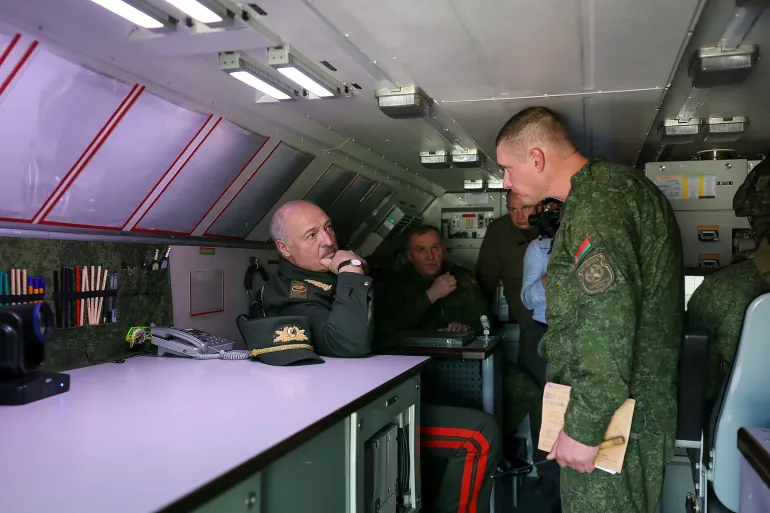
MINSK/KYIV — Belarusian President Alexander Lukashenko joined Vladimir Putin in commanding Russia’s nuclear forces for the first time this week, participating in a sweeping three-day exercise that stretched from Eastern Europe to the Pacific and involved 64,000 personnel, more than 200 missile launchers, 140 aircraft, 73 surface ships and 13 submarines.
Lukashenko Russia Nuclear Drills — The drills, conducted between Tuesday and Thursday, culminated in the launch of a Yars intercontinental hypersonic missile — capable of delivering three independently targetable nuclear warheads — from the Plesetsk Cosmodrome in Russia’s Arkhangelsk region. The missile covered 5,750 kilometres to the Kamchatka Peninsula on the Pacific coast in under 20 minutes. Both leaders jointly ordered the launch.
The exercise carried immediate practical dimensions beyond its symbolic weight. Moscow transferred modified Su-25 fighter jets and Iskander-M ballistic missiles, with a range of up to 500 kilometres, to Minsk as part of the drills. Additional warheads for the Iskander-M system were also moved to Belarusian territory. Russia had already stationed its Oreshnik tactical nuclear missile in Belarus last year, following Putin’s announcement in June 2023 that tactical nuclear arms would be deployed there — a deployment made legally possible after Lukashenko engineered a constitutional referendum in February 2022 to permit nuclear weapons on Belarusian soil.
Recommended Reading
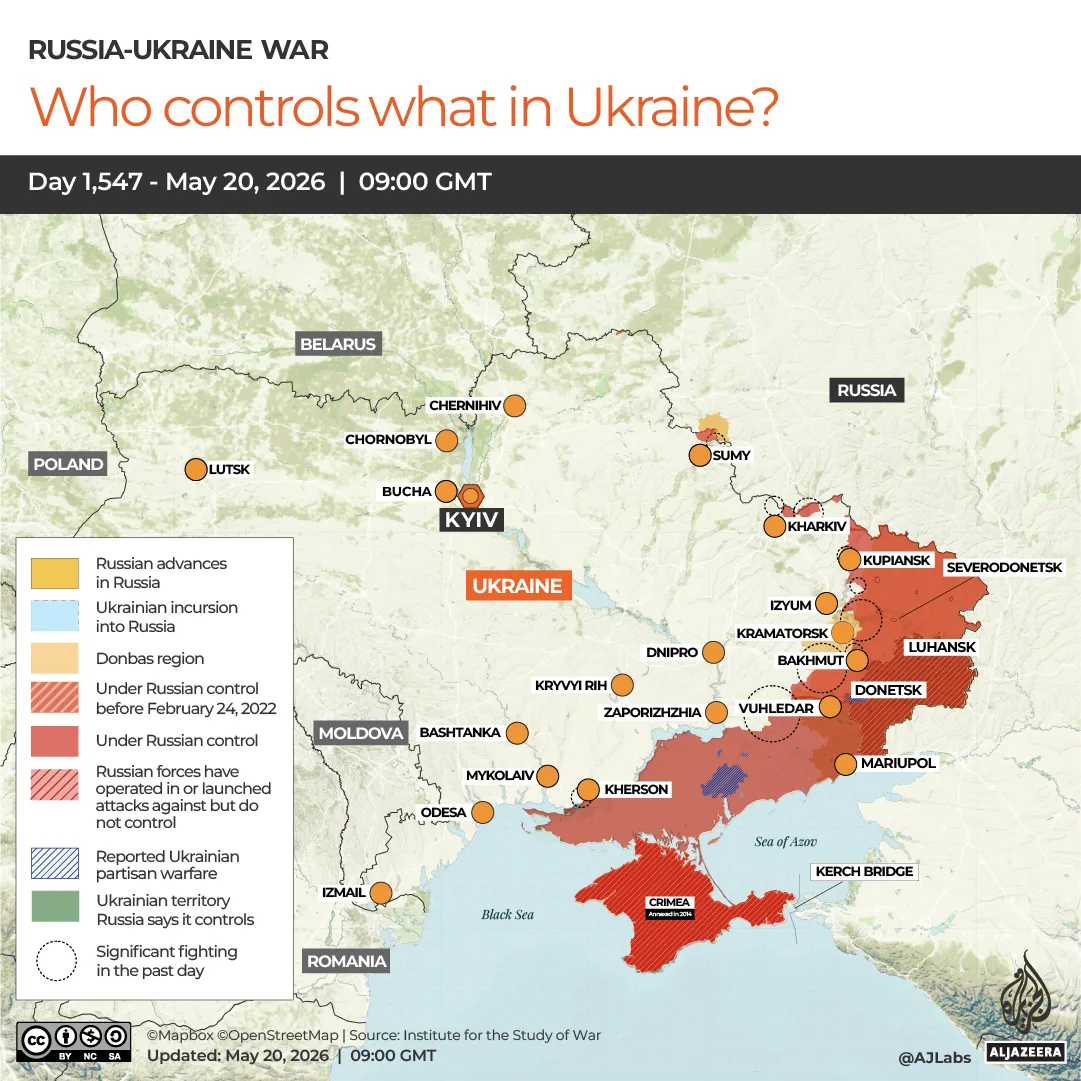
Nuclear warheads are believed to be stored at the Asipovichi military range, fewer than 200 kilometres north of the Ukrainian border.
Ukrainian President Volodymyr Zelenskyy warned on May 21 that the exercises may signal preparations for a fresh offensive against northern Ukraine and Kyiv. The concern is grounded in recent history: in early 2022, Lukashenko allowed Russian forces to use Belarus as a staging ground for the initial assault on the Ukrainian capital. The shared border stretches 1,084 kilometres through some of Europe’s densest forests and wetlands, with portions falling within the exclusion zone surrounding the Chornobyl nuclear plant.
Lukashenko, 71, who has governed Belarus since 1994 after a career as a collective farm director, struck a conciliatory tone on Thursday, declaring his country would not be drawn into the war and expressing readiness to meet Zelenskyy anywhere in Ukraine or Belarus. Zelenskyy had said on May 15 that Russia was pulling Belarus toward ‘new acts of aggression.’
NATO Secretary-General Mark Rutte responded to the nuclear posturing on Wednesday, warning that any use of nuclear weapons against Ukraine would bring a ‘devastating’ response from the alliance. NATO foreign ministers are scheduled to convene Friday in Helsingborg, Sweden — a country that joined the alliance following Russia’s full-scale invasion of Ukraine.
The nuclear theatre unfolded against a backdrop of accelerating Ukrainian strikes on Russian industrial infrastructure. Between May 15 and May 22, Ukrainian forces hit the Ryazan refinery, the Azot chemical plant in Stavropol Krai, the Yaroslavl refinery, the Lukoil refinery in Kstovo and the Sizran refinery. On May 17, Ukraine struck targets within a 100-kilometre radius of Moscow, including the Angstrem semiconductor plant, the Solnechnogorsk oil pumping station and the Moscow Refinery. Satellite imagery confirmed four destroyed storage tanks at Solnechnogorsk.
Lukashenko Russia Nuclear Drills: The Nuclear Dimension
The campaign against Russian energy infrastructure is exacting a measurable toll. Ukrainian drone attacks knocked out roughly 700,000 barrels per day of refining capacity across 16 facilities between January and May 2026 — equivalent to a quarter of Russia’s total refining capacity. The International Energy Agency reported that Russian oil production fell by 460,000 barrels per day in April 2026 compared with the same month a year earlier. Russia imposed an export ban on petroleum products from April through July, and in the first month alone, oil product exports dropped by 340,000 barrels per day.
The financial strain is compounding. Russia’s budget deficit reached $78.4 billion in the first four months of 2026, already surpassing the government’s full-year target of $50.5 billion. Hydrocarbon revenues fell 38.3 percent over the same period.
On the battlefield, Ukrainian Commander-in-Chief Oleksandr Syrskii stated that Ukraine has seized the tactical initiative, with Ukrainian offensive operations now outnumbering Russian assaults. Russian total losses since the start of 2026 have exceeded 141,500 personnel, of which more than 83,000 are classified as irreversible. Ukraine’s Foreign Intelligence Service estimates Russia is recruiting between 800 and 930 soldiers per day — a rate that falls short of daily losses exceeding 1,000. To attract recruits, 40 Russian regions have raised enlistment bonuses by between 30 and 100 percent, and Putin has simplified citizenship procedures for Russian-speaking residents of Transnistria, Moldova’s breakaway region, to widen the recruitment pool. Zelenskyy said Russia is attempting to mobilise an additional 100,000 soldiers.
Russia’s attacks on Kyiv on May 13 and 14 killed 52 people. Belarus, a United Kingdom-sized nation of 10 million, has faced severe economic consequences for its alignment with Moscow: Ukraine has halted all purchases of Belarusian goods, and the European Union has cut imports by more than two-thirds. The country’s state-controlled economy relies heavily on exports of potassium fertiliser, refined petroleum products, foodstuffs and timber.