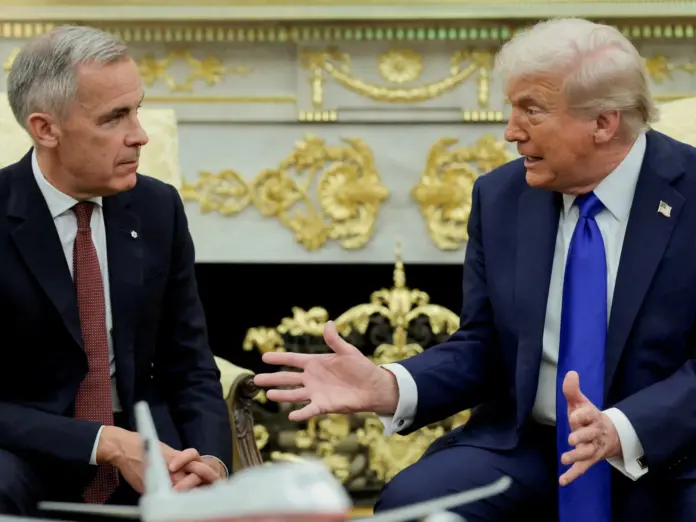
Us Canada Defence Rift — The United States has suspended its participation in the Permanent Joint Board on Defense, severing a cornerstone of North American security cooperation that has linked Washington and Ottawa since the Second World War. The announcement, made by US Undersecretary of Defense Elbridge Colby via social media on Monday, signals a dramatic deterioration in relations between the two countries under President Donald Trump.
Colby framed the decision in blunt terms, stating that Canada had failed to make credible progress on its defence spending obligations. The charge carries particular weight given that, at a NATO summit in The Hague, nearly all member states — Canada among them — committed to raising defence expenditure to 5 percent of GDP, with 3.5 percent of that figure earmarked specifically for bolstering core military capabilities. Spain was the sole country to petition for an exemption from the agreement.
The board, established during World War II, has for decades served as the primary institutional forum for regional security dialogue between the two neighbours. Its suspension leaves a significant gap in the architecture of continental defence at a moment when both countries face mounting geopolitical pressures.
Recommended Reading
The breakdown did not occur in isolation. Since Trump’s return to the White House in January 2025, the US-Canada relationship has been subjected to sustained strain across multiple fronts. Trump has levelled accusations at Ottawa over what he characterises as unfair trade practices and an inadequate response to the illicit cross-border movement of people and narcotics. His administration has imposed an aggressive tariff regime on Canadian imports, and Trump himself has repeatedly floated the incendiary suggestion that Canada should consider becoming the 51st US state — a remark widely condemned in Ottawa as an affront to Canadian sovereignty.
Canadian Prime Minister Mark Carney, who assumed office in March 2025, has responded by positioning himself as a champion of Canadian economic and strategic independence. Carney has been an outspoken advocate for reducing Canada’s reliance on the United States, both militarily and economically — a posture that has done little to ease friction with the Trump White House.
The decision to exit the defence board has not been universally welcomed within the United States itself. Republican Representative Don Bacon publicly criticised the move, placing responsibility squarely on Trump’s own conduct. Bacon argued that the current tensions were ignited by the president’s taunts about annexing Canada, suggesting the administration had manufactured a crisis with one of its closest allies.
The Trump administration has made a pattern of pressuring allied nations over what it regards as insufficient contributions to collective defence, frequently accusing partners of free-riding on American military guarantees. Allied governments, for their part, have pushed back, pointing to accelerating increases in defence budgets and a growing willingness to assume greater responsibility for regional security.
Us Canada Defence Rift: The Diplomatic Context
The timing of the suspension adds further complexity to an already fraught diplomatic landscape. The United States, Canada and Mexico are scheduled to negotiate an updated version of the USMCA free trade agreement later in 2025. With the defence relationship now openly fractured, analysts warn that the trade talks could become even more contentious, as Ottawa enters negotiations with diminished confidence in Washington’s reliability as a partner.
For Canada, the stakes extend beyond bilateral relations. As a NATO member with significant Arctic territory and shared continental defence responsibilities, Ottawa’s ability to maintain credible security arrangements with Washington has long been considered non-negotiable. The suspension of the joint board raises urgent questions about how that cooperation will be managed — and whether the damage to the relationship can be contained before it spreads further into areas of shared strategic interest.
The Permanent Joint Board on Defense was established in 1940, when both nations recognised that the defence of North America required a unified approach. That it has now become a casualty of a political dispute rooted in tariffs, sovereignty rhetoric and domestic political calculations underscores how profoundly the Trump era has reshaped the assumptions underpinning the Western alliance.