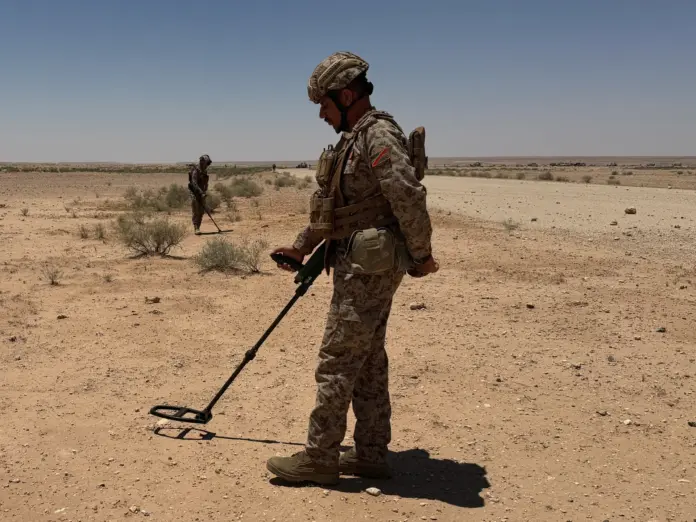
BAGHDAD — Israel constructed two clandestine military outposts in Iraq’s western desert, with one facility serving as a forward operating base for special forces and a logistical hub for air operations during the recent conflict with Iran, Iraqi officials and open-source analysts have confirmed.
Israel Military Bases Iraq — One of the installations was established shortly before hostilities with Iran began, while Israeli forces had been preparing the second site since late 2024. The bases were identified by Iraqi officials and at least one lawmaker, who described their existence publicly despite a senior Iraqi security official denying on Sunday that any such infrastructure existed.
The facility housed Israeli special forces and was equipped with search-and-rescue capabilities designed to recover downed pilots — an indication of its role supporting aerial operations in the region. Israeli forces launched attacks from the base against Iraqi units in early March, according to the accounts provided by Iraqi authorities.
Recommended Reading
One base operated with the knowledge of the United States, though American officials stated that Washington played no direct role in the operation. The disclosure has nonetheless deepened tensions between Baghdad and its international partners. Iraq privately lodged a formal protest with Washington in late March over the suspected covert military activity on its soil.
The commander of Iraq’s Karbala operations disclosed that an Israeli military group was detected in the Najaf desert in March, remaining in the area for fewer than 48 hours before withdrawing. The Najaf desert lies approximately 100 kilometres southwest of Baghdad, near the border with Saudi Arabia — a location corroborated by open-source analysts who used satellite imagery to pinpoint the suspected site.
Lieutenant-General Qais al-Muhammadawi, Iraq’s deputy commander of joint operations, confirmed that Iraqi authorities received reports of unidentified individuals and movement in the Najaf desert near Karbala on Thursday. Iraqi officials have publicly insisted they did not authorise any foreign military presence on their territory.
The revelations align with statements made in March by Major-General Tomer Bar, Israel’s former air force chief, who acknowledged that Israeli special forces conducted what he described as "extraordinary" operations during the conflict with Iran, without elaborating on their geographic scope.
The disclosures come amid broader regional turbulence. In March, US forces carried out strikes against the Popular Mobilisation Forces — the Iranian-aligned Iraqi paramilitary network — following attacks on an American diplomatic and logistics facility near Baghdad’s international airport. The strikes underscored the volatile security environment in which the Israeli bases were reportedly operating.
Israel Military Bases Iraq: Regional Implications
Iran moved swiftly to capitalise on the revelations. Esmaeil Baghaei, spokesperson for Iran’s Ministry of Foreign Affairs, said on Monday that Tehran would formally raise the issue with Iraqi authorities. Baghaei accused Israel of deliberately seeking to destabilise the region, framing the covert bases as evidence of a broader Israeli strategy to extend its military reach beyond its borders under the cover of the Iran conflict.
Baghdad’s response has been notably contradictory. While the commander of Karbala operations confirmed the detection of an Israeli military group to regional media, a senior Iraqi security official flatly denied the existence of any Israeli base on Sunday. The conflicting statements reflect the acute political sensitivity surrounding the issue for a government that must simultaneously manage its relationships with Washington, Tehran, and its own Iran-aligned political factions.
Iraq’s sovereignty has been a recurring flashpoint throughout years of competing foreign military activity on its territory. The country hosts both a residual US military presence and powerful Iranian-backed paramilitary forces, leaving Baghdad perpetually navigating between rival powers. The emergence of Israeli military activity — even temporarily — on Iraqi soil represents a significant escalation of that dynamic and is likely to intensify domestic pressure on the government to assert greater control over its borders and airspace.
Israel has not issued an official statement on the reported bases. The Israeli military rarely comments on special forces operations or intelligence activities abroad.