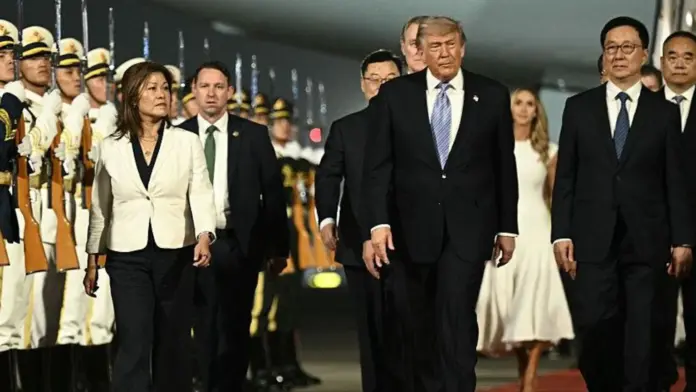
BEIJING — President Donald Trump touched down in the Chinese capital on Wednesday evening aboard Air Force One, launching a two-day summit with President Xi Jinping that carries enormous stakes for global trade, technology competition, and the widening conflict in Iran.
Trump Xi Summit — Chinese Vice-President Han Zheng received Trump on the red carpet upon arrival, a formal gesture signalling Beijing’s readiness to engage at the highest diplomatic level. Trump was accompanied by his son Eric Trump and an extraordinary roster of American corporate power, including Tesla and SpaceX chief executive Elon Musk, Nvidia founder Jensen Huang, Apple’s Tim Cook, BlackRock’s Larry Fink, and Boeing chief executive Kelly Ortberg.
The president wasted little time in framing his priorities. Before departing Washington, Trump told reporters that his ‘very first request’ to Xi would be to ‘open up’ China to American technology industry leaders — a signal that market access will sit at the centre of the economic agenda. He also confirmed the two leaders would have a ‘long talk’ about Iran, though he was characteristically blunt about Washington’s posture, insisting, ‘I don’t think we need any help’ in resolving the conflict.
Recommended Reading
Thursday’s schedule includes a formal welcome ceremony at the Great Hall of the People and a state banquet, with substantive working sessions — including tea and a working lunch between Trump and Xi — set for Friday before the American delegation departs.
The visit was originally planned for March but was postponed following the outbreak of the U.S.-Israeli military campaign against Iran, a conflict that has since reshaped geopolitical alignments across the Middle East and beyond. That war now looms over the Beijing summit in ways that extend well beyond the battlefield.
China’s oil lifeline severed
Beijing has a profound economic stake in the Iran conflict. China and Iran have maintained a strategic alliance spanning decades, with Beijing serving as Tehran’s largest oil customer and most important trading partner. The closure of the Strait of Hormuz to commercial shipping has severed that supply chain, cutting off a critical source of energy imports for the world’s second-largest economy. The disruption gives Washington both leverage and responsibility in any conversation about a path to de-escalation.
Trump’s insistence that the U.S. does not need Chinese assistance in resolving the Iran war may reflect domestic political positioning, but the economic reality is more complex. China’s energy vulnerability creates an unusual alignment of interests — Beijing wants the Strait reopened, and Washington controls the military tempo that could make that possible.
Trade and technology at the core
The economic dimensions of the summit are equally consequential. Bilateral trade between the two countries totalled $414.7 billion in the most recently recorded year, a sharp decline from $690.4 billion in 2022 — a contraction that reflects years of tariff escalation, supply chain restructuring, and strategic decoupling. The U.S. trade deficit with China exceeded $200 billion last year, a persistent imbalance that has fuelled political pressure in Washington to extract concessions.
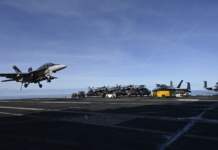
Trump Xi Summit: Indo-Pacific Security Context
Technology competition adds another layer of complexity. China is aggressively pursuing advances in artificial intelligence and has increased its demand for high-performance U.S.-made computing chips, even as Washington has moved to restrict their export. Beijing, for its part, holds a powerful counter-lever: its dominance over rare earth metals, the minerals essential to semiconductors, electric vehicles, and advanced defence systems. Any escalation in export controls could trigger retaliatory restrictions on those materials.
The presence of Musk, Huang, Cook, Fink, and Ortberg in the delegation underscores how directly American corporate interests are intertwined with the outcome of these talks. For companies like Apple, which manufactures the majority of its products in China, and Boeing, which counts Chinese airlines among its largest customers, the diplomatic temperature in Beijing has immediate bottom-line consequences.
Taiwan casts a long shadow
The question of Taiwan adds a further dimension of tension. A bipartisan group of U.S. senators sent a letter to Trump ahead of the visit urging him to reaffirm American support for the island. Congress approved a $14 billion arms sale to Taiwan last year, a move Beijing condemned as interference in its internal affairs. How explicitly Trump raises the Taiwan issue — or avoids it — will be closely watched by governments across the Indo-Pacific.
The summit represents the most significant direct engagement between the two powers in years, arriving at a moment when the architecture of the post-Cold War international order is under severe strain. With a war in Iran disrupting global energy markets, an AI arms race accelerating, and trade flows contracting, the conversations between Trump and Xi over the next two days carry consequences that will extend far beyond the walls of the Great Hall of the People.