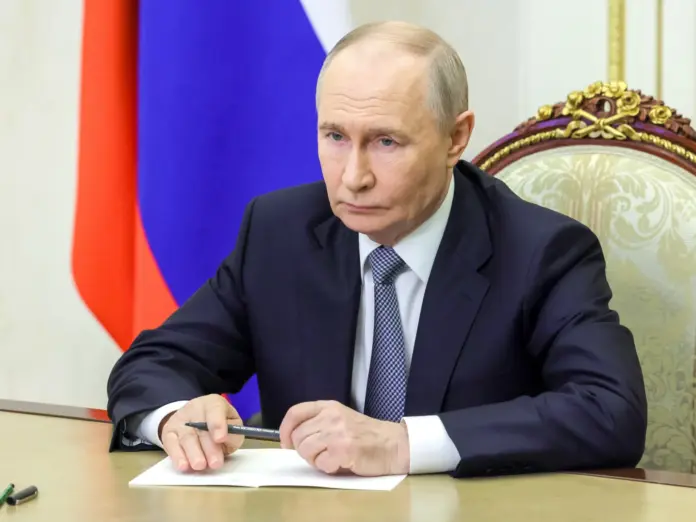
Moscow — Russia has test-fired its Sarmat intercontinental ballistic missile, with President Vladimir Putin declaring the nuclear-capable weapon the most powerful of its kind on earth and announcing it will enter combat service before the year’s end — a move that deepens global anxiety over a rapidly deteriorating arms control landscape.
Sarmat Missile Test — Putin described the Sarmat, designated ‘Satan II’ by Western military planners, as possessing a warhead yield more than four times greater than any comparable Western system. He claimed the missile is capable of suborbital flight with a range exceeding 35,000 kilometres — roughly 21,750 miles — and can penetrate all existing and future anti-missile defence systems. The weapon, he added, matches the destructive power of its Soviet-era predecessor, the Voyevoda, while delivering significantly higher precision.
The Sarmat is designed to replace approximately 40 Voyevoda missiles that have formed the backbone of Russia’s land-based strategic deterrent since the Cold War. Development of the new system began in 2011, and Putin first publicly unveiled it in 2018. Tuesday’s test, however, comes against a troubled development history: prior to this launch, only one successful test had been recorded, and the programme suffered a significant setback when the missile was destroyed in a massive explosion during an abortive test in 2024.
Recommended Reading
Sergei Karakayev, commander of Russia’s strategic missile forces, oversaw the latest launch. The test represents a critical milestone for a weapons programme that has faced repeated delays and technical failures.
The timing carries unmistakable geopolitical weight. New START, the last remaining nuclear arms reduction treaty between Russia and the United States, expired in February, leaving the world’s two largest nuclear arsenals unconstrained by any formal agreement for the first time in more than 50 years. The treaty had capped strategic warheads and delivery systems on both sides. Moscow and Washington have since agreed to resume high-level military dialogue, though no new framework has emerged.
US President Donald Trump has pushed for any successor agreement to include China, whose nuclear arsenal is expanding rapidly, though it remains considerably smaller than those of either Russia or the United States. Beijing has publicly rejected pressure to join such negotiations, complicating the path toward any new multilateral arms control regime. The US withdrawal from a Cold War-era pact limiting missile defences in 2001 further eroded the architecture of strategic stability that had governed superpower relations for decades.
The Sarmat test is only the most visible element of a sweeping Russian nuclear modernisation drive. The Avangard hypersonic glide vehicle, capable of flying at 27 times the speed of sound, has already entered service. Russia has also commissioned the Oreshnik, a nuclear-capable intermediate-range ballistic missile with a reach of up to 5,000 kilometres, and has used a conventionally armed variant of the weapon twice in strikes against Ukraine since Moscow launched its full-scale invasion in 2022. Two further systems — the nuclear-armed Poseidon underwater drone and the Burevestnik cruise missile, powered by miniature atomic reactors — are described as being in the final stages of development.
Sarmat Missile Test: The Nuclear Dimension
Together, the weapons represent the most ambitious overhaul of Russia’s nuclear forces since the Soviet era, and a direct challenge to Western deterrence doctrine. Putin, who came to power in 2000, has consistently framed the modernisation programme as a response to what he characterises as Western encroachment on Russian security interests — most notably the US withdrawal from the Anti-Ballistic Missile Treaty in 2001, which Moscow argued removed a foundational pillar of strategic stability.
The Sarmat’s entry into service, if confirmed on the timeline Putin outlined, would mark the culmination of more than a decade of development and signal Russia’s intent to maintain strategic parity with the West regardless of the diplomatic and economic pressures it faces over Ukraine. For arms control advocates, the combination of a new generation of Russian delivery systems, an expanding Chinese arsenal, and the absence of any binding treaty framework represents the most dangerous nuclear moment since the height of the Cold War.