Trump Ceasefire Collapse — A ceasefire announced by US President Donald Trump and declared effective from May 9 disintegrated within hours, as Russian strikes killed at least three civilians across Ukraine and both sides traded accusations of wholesale violations.
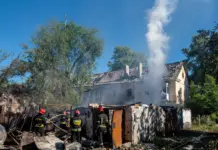
The dead included a 58-year-old woman in the village of Nezlamne in Kherson region, struck by a Russian drone while walking down the street on the very day the truce was supposed to begin. A 46-year-old woman was killed the previous day in the Mezhivska community near Synelnykove in Dnipropetrovsk region, where a second person was also injured. A third fatality was recorded in Zaporizhia region, where artillery and drone attacks wounded three additional people in the same 24-hour period.
The toll extended well beyond the dead. Seven people, among them a child, were injured across Kherson region in drone and artillery strikes since early Saturday. Eight more — including two children — were wounded in drone attacks on Kharkiv city and surrounding settlements. A child was separately injured in Dnipropetrovsk region on Sunday, compounding a picture of unrelenting violence despite the announced pause in hostilities.
Recommended Reading
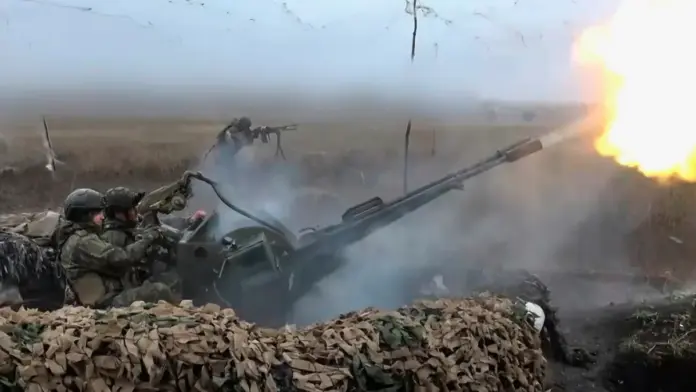
Overnight, Russia launched 27 long-range drones at Ukrainian territory. Kyiv’s air force reported that all 27 were intercepted by air defences — a rare complete success that nonetheless illustrated the continued tempo of Russian strikes. Ukraine’s General Staff recorded 147 battlefield clashes along the front line in the same 24-hour window, a figure that alone renders the notion of a functioning ceasefire difficult to sustain.
Russia’s Defence Ministry moved quickly to place blame on Kyiv, claiming Ukraine had committed more than 1,000 ceasefire violations involving drone and artillery attacks against both Russian troops and civilian targets. Moscow alleged the violations spanned a wide geographic arc, from occupied Crimea to the Russian regions of Belgorod, Kursk, Kaluga, Rostov, and Krasnodar. Russian forces said they shot down 57 Ukrainian drones during the period. Vladimir Saldo, the Russian-installed governor of occupied Kherson, reported two people injured by Ukrainian shelling in the Russian-controlled portion of the region.
The mutual recriminations follow a pattern that has defined previous attempts at pauses in the conflict. Each side frames the other as the aggressor, leaving independent verification of specific incidents difficult amid the fog of a sprawling front line stretching hundreds of kilometres.
Trump’s three-day ceasefire proposal had been presented as a potential stepping stone toward broader negotiations, but the immediate collapse of even a temporary halt to hostilities raises serious questions about the diplomatic leverage Washington can bring to bear. Neither Kyiv nor Moscow had publicly committed to the truce’s terms with the kind of verifiable guarantees that might have given it teeth.
Trump Ceasefire Collapse: The Wider European Impact
For the civilians caught in the crossfire, the distinction between a ceasefire and open conflict has become largely academic. The woman killed in Nezlamne was not near a military installation; she was on a village street. The children wounded in Kharkiv and Dnipropetrovsk were not combatants. Their injuries and deaths on a day nominally designated for peace encapsulate the human cost of a war now well into its fourth year.
The fighting has ground on across multiple axes, with the Zaporizhia, Kherson, Dnipropetrovsk, and Kharkiv regions bearing the brunt of daily strikes. Russian forces have maintained persistent drone and artillery pressure on civilian infrastructure and populated areas, while Ukrainian forces continue to contest front-line positions and conduct long-range strikes into Russian-held and Russian territory.
With 147 clashes recorded in a single day and casualty reports arriving from at least four separate regions, the ceasefire that Trump announced appears, for now, to exist in name only.