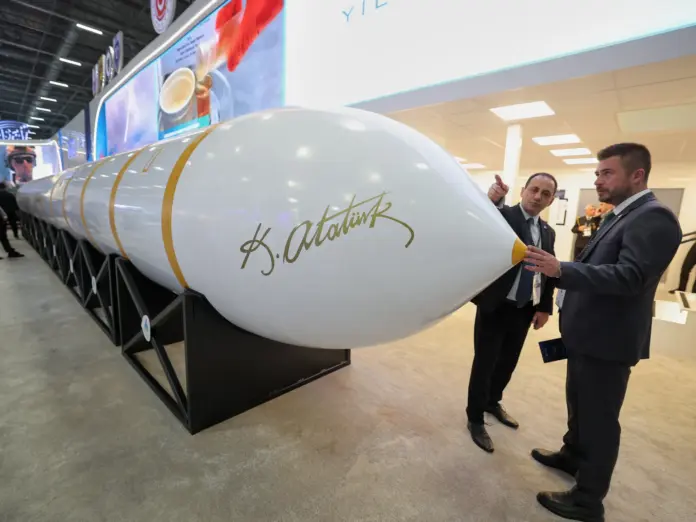
Turkey Intercontinental Ballistic Missile — Turkey pulled back the curtain on one of its most ambitious weapons programmes Tuesday, displaying a prototype intercontinental ballistic missile at the SAHA 2026 Defence and Aerospace Exhibition in Istanbul — a move that signals Ankara’s determination to join the world’s most exclusive club of long-range strike powers.
The missile, named the Yildirimhan, was developed by the Turkish Defence Ministry’s research and development centre and exhibited at the Istanbul Expo Centre before an audience of defence officials and industry representatives. Defence Minister Yasar Guler addressed the gathering, underscoring the government’s commitment to transforming Turkey into a self-reliant military power capable of projecting force far beyond its borders.
The Yildirimhan’s specifications are striking. The missile carries a payload capacity of 3,000 kilograms, reaches a maximum speed of Mach 25 — twenty-five times the speed of sound — and is powered by liquid nitrogen tetroxide across four rocket propulsion engines. Its stated range of 6,000 kilometres exceeds the 5,500-kilometre threshold the Federation of American Scientists uses to classify a weapon as an intercontinental ballistic missile. If fired from Turkish territory, the missile could theoretically reach targets across Europe, Africa, and large swathes of Asia.
Recommended Reading
Despite the dramatic unveiling, the Yildirimhan remains a prototype. Turkey has not commenced production, and analysts note that no confirmed flight tests have taken place. Critical subsystems have not been publicly detailed, and a planned test facility in Somalia has yet to be constructed. The gap between prototype display and operational deployment is considerable, and the timeline for the missile entering service remains unclear.
The exhibition nonetheless carries significant symbolic weight. Turkey’s defence ambitions have grown steadily since the establishment of the Defence Industry Development and Support Administration Office in 1985, accelerating sharply in the 2010s when Ankara pivoted toward domestic design rather than foreign procurement. The results have been commercially striking: Turkey’s defence and aerospace exports reached an all-time high of $10.05 billion in 2025, with the Bayraktar TB2 drone exported to at least 31 countries including Ukraine, Japan, Kenya, and Bangladesh. According to the Stockholm International Peace Research Institute, Turkey’s primary defence customers between 2021 and 2024 were the United Arab Emirates, Pakistan, and Qatar.
Turkey is also home to NATO’s second-largest standing army, a fact that lends the Yildirimhan’s debut an added layer of geopolitical complexity. NATO leaders pledged last June at a summit in The Hague to allocate up to five percent of their GDP to defence by 2035 — a commitment that reflects the alliance’s broader anxieties about strategic deterrence. Where a Turkish ICBM fits within that framework remains an open question.
The timing of the unveiling is charged. Regional tensions have spiked in recent months, with Turkey reporting in March that NATO air defences intercepted ballistic missiles fired toward Turkish territory on March 4 and March 9. Iran denied any involvement, suggesting Israel may have been responsible as acts of deliberate sabotage. The allegation has not been independently verified, but it reflects the deteriorating state of relations across the region.
Turkey Intercontinental Ballistic Missile: The Global Security Context
Turkish President Recep Tayyip Erdogan used an international conference in Istanbul in April to publicly criticise Israel’s conduct in Gaza, reinforcing Ankara’s increasingly adversarial posture toward Tel Aviv. Former Israeli Prime Minister Naftali Bennett had already declared Turkey a threat to Israel in February, a characterisation that would have been unthinkable a decade ago when the two countries maintained close military ties.
Against that backdrop, the Yildirimhan’s unveiling is as much a political statement as a technical one. Ankara is positioning itself as an indispensable defence actor in a Middle East reshaped by the US-Israel conflict with Iran, whose fragile ceasefire continues to hold following six weeks of strikes. President Erdogan has consistently framed Turkey’s defence build-up as a matter of sovereignty and strategic independence — a message the Yildirimhan delivers with unmistakable clarity, whatever the missile’s current operational limitations may be.
Whether the Yildirimhan transitions from exhibition centrepiece to deployed weapon will depend on engineering milestones, political calculations, and the broader trajectory of Turkey’s relationships with its NATO allies and its regional rivals. For now, its appearance on the floor of the Istanbul Expo Centre has served its purpose: announcing that Turkey intends to be taken seriously as a long-range strike power in an era of rapidly shifting global alignments.