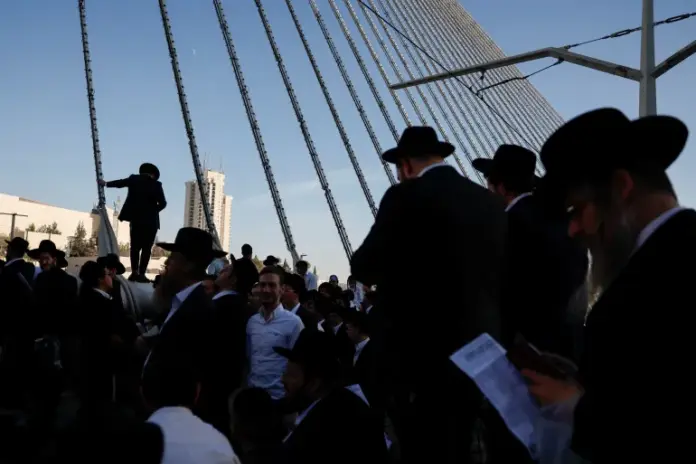
Ultra-Orthodox Draft Crisis — Thousands of ultra-Orthodox Jewish men flooded the streets of central Israel on Thursday night, rallying against the arrest of fellow community members who have refused military conscription — the latest eruption in a deepening crisis over who bears the burden of defending the country.
The protests are part of a broader wave of unrest that has left dozens of police officers and demonstrators injured and resulted in scores of arrests. Demonstrators have also targeted the homes of individual Supreme Court justices, a stark escalation reflecting the intensity of anger within ultra-Orthodox circles over the court’s intervention in the draft exemption debate.
At the heart of the dispute is a fundamental clash of values. Ultra-Orthodox men do not frame their refusal to serve as a moral objection to Israel’s wars. Rather, they argue that military service would dilute their faith and pull them away from Torah study — a religious obligation they regard as non-negotiable. The community, which constitutes roughly 12 percent of Israel’s Jewish population and typically raises families of eight to ten children, has long maintained a separate social compact with the state.
Recommended Reading
That compact is now under severe strain. In June 2024, the Supreme Court declared the existing draft exemption system unlawful and ordered the conscription of eligible ultra-Orthodox men — the latest in a series of rulings stretching back to the 2010s that have repeatedly struck down blanket exemptions. The numbers involved are staggering: where just 400 ultra-Orthodox students received exemptions in 1948, more than 54,000 are now eligible for recruitment.
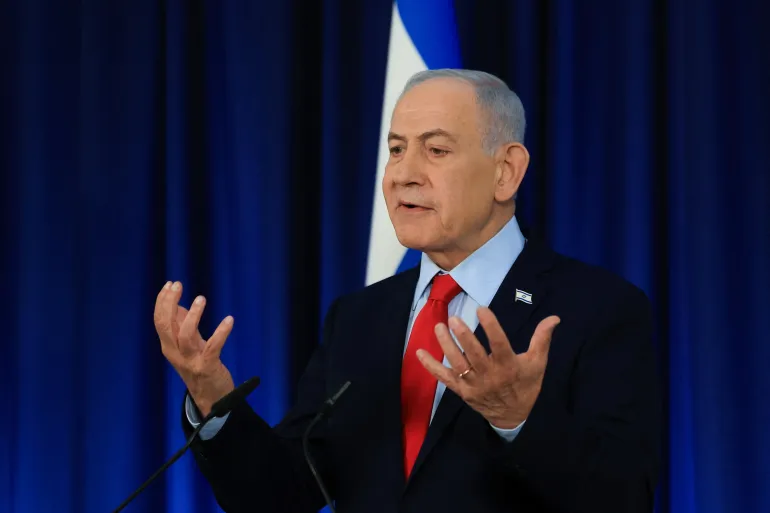
Rather than implementing the court’s directive, Prime Minister Benjamin Netanyahu’s coalition is moving in the opposite direction. A bill currently advancing through parliament would formally enshrine draft exemptions for ultra-Orthodox religious students into law, effectively nullifying the court’s ruling through legislation. The political calculus is transparent: Netanyahu’s right-wing Likud party depends on the support of the two main ultra-Orthodox parties, Shas and United Torah Judaism (UTJ), to maintain its parliamentary majority. When that support appeared threatened, the coalition went so far as to bring forward a bill to dissolve parliament entirely — a measure of how precarious the government’s position has become.
UTJ parliamentarians Yisrael Eichler and Meir Porush have been prominent voices defending the exemptions, framing the issue as one of religious freedom and communal survival. Their leverage over the coalition has given the ultra-Orthodox bloc outsized influence over a question that the broader Israeli public views very differently.
Public opinion on the matter is unambiguous. Polls show approximately four-fifths of Israelis support either conscripting ultra-Orthodox men or imposing sanctions on those who refuse to serve. A survey by the Israel Democracy Institute found that 85 percent of Israelis back penalties for draft refusal — a figure that underscores how isolated the ultra-Orthodox position is within the wider electorate.
Benjamin Brown, an authority on ultra-Orthodox Judaism at the Israel Democracy Institute, has noted the deep structural tensions the exemption system creates within Israeli society, particularly as the country continues to prosecute active military campaigns. The burden of service falls disproportionately on secular and modern Orthodox Israelis, fuelling resentment that has only intensified during prolonged conflict.
Ultra-Orthodox Draft Crisis: Regional Implications
Former Prime Minister Naftali Bennett has been among the most vocal critics of the status quo, warning that the failure to confront the exemption issue represents a "slow-motion path to suicide" for the country. Political analyst Nimrod Flaschenberg and commentator Ori Goldberg have both highlighted the issue as one of the most combustible fault lines in Israeli domestic politics, with social-political psychologist Daniel Bar-Tal of Tel Aviv University pointing to the deepening polarisation it generates between religious and secular communities.
The timing adds further urgency. An election is scheduled for later in the year, and the conscription question is expected to feature prominently in campaigning. Netanyahu faces the unenviable task of satisfying ultra-Orthodox coalition partners whose demands are increasingly at odds with the preferences of the broader electorate — and with the rulings of the country’s highest court.
What began as a legal and religious dispute has evolved into a constitutional confrontation, pitting the judiciary against the legislature, and a deeply divided public against a political class struggling to reconcile irreconcilable demands. With violence on the streets and legislation in parliament pulling in opposite directions, resolution appears distant.