Israel Lebanon Buffer Zone — Israel has unilaterally carved out a buffer zone stretching approximately 10 kilometres north of the Lebanese border, a move that threatens to unravel a hard-won maritime boundary agreement and deny Lebanon access to significant offshore energy reserves. Avichay Adraee, the Israeli military’s Arabic-language spokesperson, published a map demarcating the zone — defined by what Israel calls the ‘Yellow Line’ — on April 19, framing the occupation as a security necessity to guard against Hezbollah.
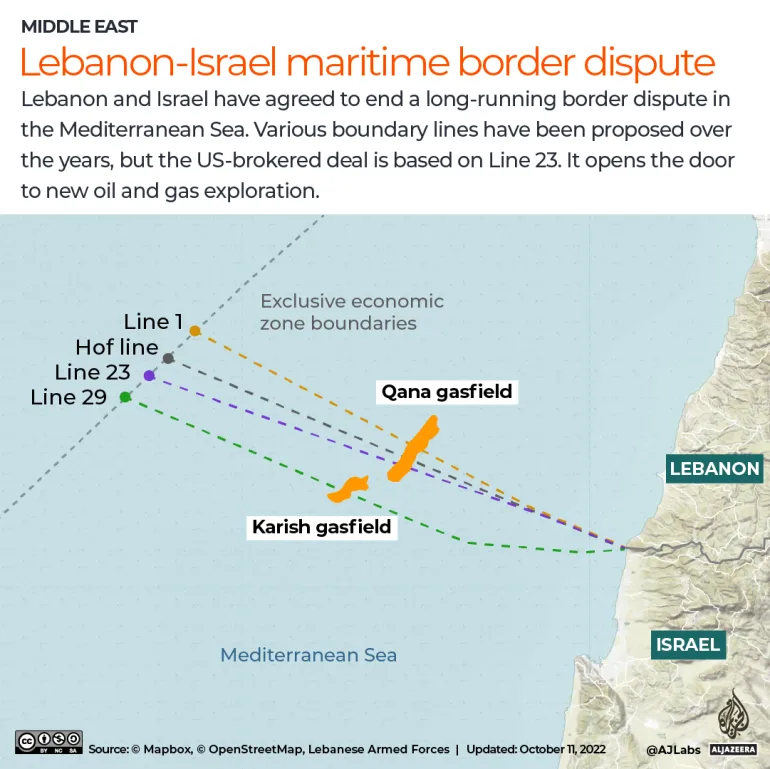
The territorial claim, however, extends well beyond land. The buffer zone absorbs Block 8 and Block 9 of Lebanon’s Qana gasfield, waters lying within 12 nautical miles of Lebanon’s coastline that were explicitly guaranteed to Beirut under a 2022 US-brokered maritime demarcation agreement. That accord, signed on October 27, 2022, resolved a long-standing dispute over 860 square kilometres of contested Mediterranean waters without the two countries ever entering direct negotiations — a diplomatic feat engineered by US envoy Amos Hochstein.
The timing is particularly damaging for Lebanon’s nascent energy sector. In January, France’s TotalEnergies, Italy’s Eni, and QatarEnergy signed an offshore exploration permit with the Lebanese government specifically for Block 8. Lebanon passed its foundational hydrocarbon law in 2010, dividing its offshore territory into 10 blocks. Exploration on Block 4 began in 2020 but was abandoned as commercially unviable, and Block 9 yielded no discoveries — making the Qana field among the most strategically important remaining prospects for a country in severe economic distress.
Recommended Reading
Lebanese Energy Minister Joe Saddi pushed back firmly, stating on April 19 that the buffer zone map doesn’t change anything about the fact that there is a maritime border agreement.
Yet the practical reality of Israeli military presence in those waters casts serious doubt on whether any exploration can proceed.
Within Israel, the buffer zone has exposed a sharp political fault line. Prime Minister Benjamin Netanyahu‘s far-right government had already signalled its hostility to the 2022 deal, with Energy Minister Eli Cohen branding it a surrender agreement that ceded to Lebanon all the disputed territories.
Opposition leader Yair Lapid, who championed the accord at the time — calling it something that bolsters Israeli security and the Israeli economy
— reversed course dramatically on April 28, posting on X that there’s no gas there, no security risk there, nothing there at all.
The statement drew immediate criticism as a politically convenient abandonment of an agreement his own camp once celebrated.
The broader military context is stark. Despite a US-brokered ceasefire reached in April, Israel has killed close to 3,700 people in Lebanon in what international observers describe as systematic violations of the truce. Hezbollah launched strikes against Israel on March 2, following the killing of Iranian Supreme Leader Ali Khamenei, further inflaming a conflict that has already devastated Lebanon’s south.
Israel Lebanon Buffer Zone: Regional Implications
The pattern mirrors developments in Gaza, where a ceasefire agreement has similarly failed to halt Israeli territorial consolidation. Under that arrangement, Israel now occupies more than 60 percent of Gaza’s territory. The enclave’s waters hold their own energy significance: British Gas discovered the Gaza Marine gasfield in 2000, a reserve the US Energy Information Administration estimates holds 45.3 billion cubic metres of recoverable natural gas — enough to generate an estimated $4 billion in revenue. Gaza’s fishing industry has been devastated in parallel, with the United Nations estimating that 72 percent of the territory’s fishing fleet has been damaged or destroyed since October 2023, compounding restrictions on fishing zones that predated the current conflict.
The dual buffer zones — one in Lebanon, one in Gaza — are increasingly being read by regional analysts as a coordinated strategy to reshape the eastern Mediterranean’s resource landscape under the cover of security imperatives. For Lebanon, a country whose economy has been in freefall for years, the loss of access to offshore energy revenues represents not merely a geopolitical setback but an existential blow to any prospect of fiscal recovery. Whether the 2022 maritime agreement survives as anything more than a document will depend heavily on whether Washington, which brokered the deal, is willing to press Israel to honour its terms.