Ukraine Drone Strikes — A sweeping wave of Ukrainian strikes has killed and wounded civilians across multiple Russian regions while claiming lives inside Ukraine itself, as Kyiv’s campaign to strangle Russian logistics deepens and the occupied Crimean Peninsula grapples with a worsening fuel crisis.
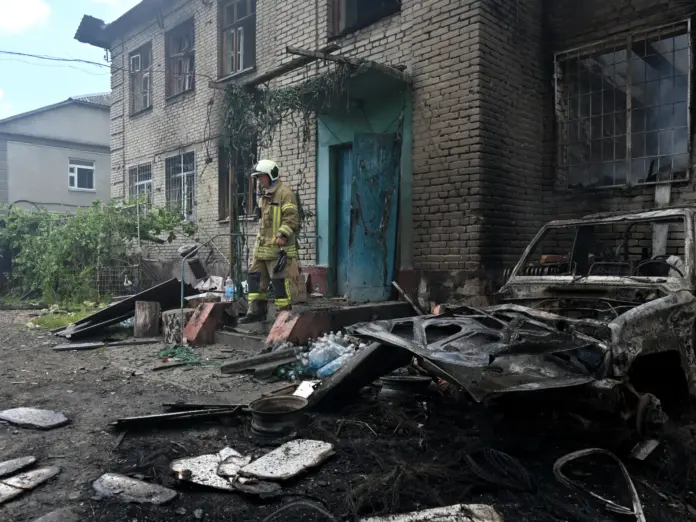
In Russia’s Bryansk region, bordering northeastern Ukraine, two civilians were killed and two others wounded after Ukrainian forces struck the settlement of Suzemka with artillery. Acting Governor Egor Kovalchuk confirmed the casualties on Friday via Telegram. The attack underscored the persistent danger facing communities along the front-line border, where exchanges of fire have become a near-daily reality.
Ukraine absorbed its own losses the same day. A 44-year-old rail station operator was killed in a Russian drone strike on the Sumy region, which also borders Russia. A second woman, a station attendant, was wounded in the same attack. Three further people sustained injuries in separate strikes on Ukraine’s southern Mykolaiv region.
Recommended Reading
Far from the front lines, Ukrainian drones reached deep into Russian territory overnight, striking the city of Togliatti — home to Russia’s largest carmaker, Avtovaz — situated on the Volga River approximately 800 kilometres southeast of Moscow. The industrial city’s targeting signals the expanding geographic ambition of Ukraine’s aerial campaign.
In the republic of Tatarstan, regional head Rustam Minnikhanov confirmed that drones struck industrial facilities, injuring three people when one hit an apartment building. Minnikhanov stated that production work at the affected facilities was not suspended. Tatarstan hosts critical oil processing and petrochemical infrastructure, making it a strategically significant target for Kyiv’s campaign to degrade Russian industrial capacity.
Ukraine has framed its mid-range strike operations — those conducted more than 30 kilometres from the front line — as a deliberate "logistics lockdown" strategy. The approach targets oil refineries, bridges, roads, and supply networks using long-range drones and heavy weaponry, with the explicit aim of severing Russian military supply chains. Attacks on routes feeding the Crimean Peninsula have intensified in recent weeks, and the consequences are now visible on the ground.
Fuel stations across Russian-held Crimea ran dry on Thursday. A witness in Sevastopol, the peninsula’s largest city, reported that most local petrol stations had no fuel available. In Yevpatoriya, a long queue formed outside the only station still operating. Local authorities have responded by imposing rationing regimes, and some foodstuffs are also reported to be running short across the peninsula. Moscow has denied any problems with fuel supplies, even as the shortages become difficult to conceal.
Ukraine Drone Strikes: The Wider European Impact
The fuel crisis in Crimea is a direct consequence of sustained Ukrainian pressure on the supply arteries connecting the peninsula to mainland Russia. Russia annexed Crimea in 2014, and the territory has since served as a major staging ground for Russian military operations in southern Ukraine. Disrupting its logistics has been a core Ukrainian objective throughout the conflict.
Beyond Crimea, only two regions in Siberia have officially acknowledged fuel shortages, highlighting how geographically concentrated the supply disruption remains — for now. Whether Ukraine’s intensifying drone campaign can extend that pressure further into Russian territory will be a key variable shaping the conflict’s trajectory in the months ahead.
The strikes on Tatarstan and Togliatti represent some of the deepest penetrations of Russian territory by Ukrainian drones recorded in recent months, demonstrating Kyiv’s growing capacity to project force well beyond the immediate theatre of ground combat. For Russian civilians living hundreds of kilometres from the front, the war is no longer a distant abstraction.