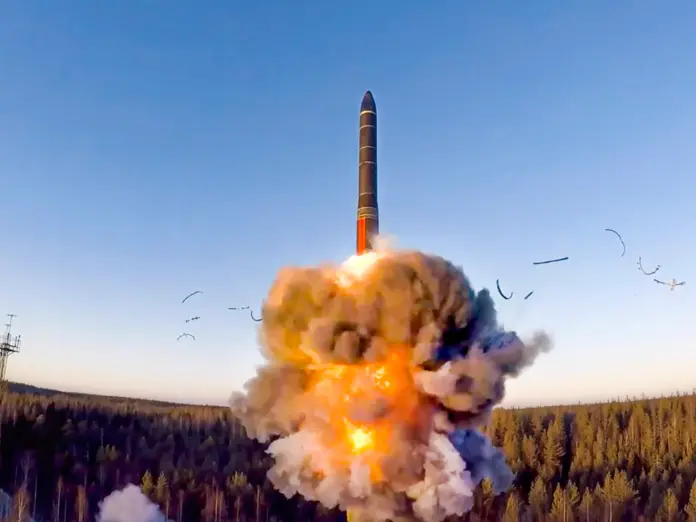
Global Nuclear Spending — The world’s nine nuclear-armed states collectively spent $119 billion on their nuclear arsenals in 2025, a record annual total that represents a $16.8 billion jump from the previous year, according to a new report from the International Campaign to Abolish Nuclear Weapons (ICAN) released Tuesday.
The figures underscore a dramatic and accelerating global arms race at a moment when the last binding treaty constraining the United States and Russian nuclear stockpiles has expired, leaving no formal framework to limit the world’s two largest arsenals.
The United States dominated spending, committing an estimated $69.2 billion to its nuclear programme — more than every other nuclear power combined. Washington’s outlay surged by $12.6 billion compared with 2024, accounting for the bulk of the worldwide increase and cementing its position as the single largest driver of global nuclear expenditure.
Recommended Reading
China ranked as the second-biggest spender at $13.5 billion, followed closely by the United Kingdom at $12.6 billion — a figure that reflects London’s ongoing programme to expand its Trident submarine fleet. Russia, despite holding the world’s largest nuclear warhead stockpile alongside the United States, spent $9.5 billion, while France allocated $7.7 billion to its independent deterrent force.
Among the remaining nuclear states, India spent an estimated $2.8 billion. Both Pakistan and Israel — the latter of which has never officially confirmed its nuclear status — each spent between $656 million and $2.8 billion. North Korea spent an estimated $656 million, the lowest confirmed figure among the nine states, though Pyongyang’s opaque finances make precise accounting difficult.
Taken together, the nine nuclear powers have now spent $471 billion on their arsenals over the past five years, a cumulative total that ICAN argues reflects a fundamental reorientation of global defence priorities toward nuclear capability at the expense of diplomatic disarmament efforts.
The spending surge arrives at a particularly fraught moment in arms control history. New START, the last remaining nuclear arms limitation treaty between the United States and Russia — the two countries that hold the vast majority of the world’s more than 12,000 warheads — expired in February, leaving no successor agreement in place. The US and Russia first began signing treaties to constrain their arsenals in the early 1990s following the Cold War, making the current absence of any binding bilateral framework the most significant arms control gap in decades.
The collapse of the treaty architecture has drawn renewed attention to the Treaty on the Prohibition of Nuclear Weapons, adopted by the United Nations in 2017 as the first legally binding international instrument to comprehensively ban nuclear weapons. To date, 99 countries have signed, ratified or acceded to the treaty. However, not a single nuclear-armed state has joined, rendering the agreement largely symbolic in practical terms.
Global Nuclear Spending: The Nuclear Dimension
ICAN, which won the Nobel Peace Prize in 2017 for its campaign to advance that treaty, has consistently argued that the resources directed toward nuclear weapons represent a profound misallocation of global capital — funds that could otherwise address climate change, poverty and public health crises. The organisation’s latest spending data is likely to intensify that argument as governments face mounting domestic fiscal pressures.
The United Kingdom’s $12.6 billion figure is particularly notable given London’s 2021 decision to raise the ceiling on its permitted warhead stockpile, reversing decades of gradual reduction. That policy shift, combined with NATO allies’ broader push to modernise ageing nuclear delivery systems, has contributed to the sharp upward trajectory in Western nuclear expenditure.
China’s continued investment reflects its ongoing effort to expand and diversify its arsenal, which analysts assess is growing faster than that of any other nuclear power. Beijing has historically maintained a relatively small stockpile compared with Washington and Moscow, but its modernisation programme — encompassing land-based missiles, submarine-launched weapons and air-delivered bombs — signals an ambition to close that gap over the coming decade.
With no multilateral disarmament negotiations currently active and bilateral US-Russia arms control in abeyance, the 2025 spending figures suggest the global nuclear order is entering a period of intensified competition rather than restraint — a trajectory that arms control advocates warn carries profound risks for international stability.