Settler Violence West Bank — The occupied West Bank is experiencing a systematic collapse of its agricultural economy, driven by intensifying settler violence that has displaced entire communities, stolen hundreds of thousands of livestock, and rendered vast swaths of farmland inaccessible to Palestinian farmers and shepherds.
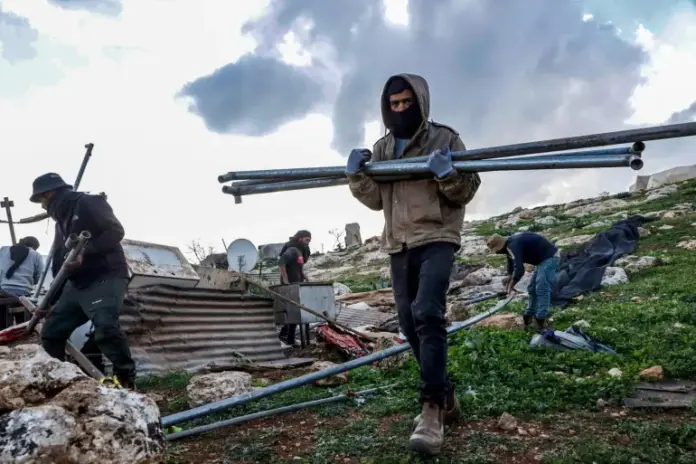
Mukhlis Masa’id no longer lives in Khirbet Yarza, the Jordan Valley community where his family once raised animals and tended crops. In March 2026, the last of the village’s fourteen families — roughly 100 Palestinians in total — abandoned their homes after years of relentless pressure. Settlers destroyed crops, attacked homes, assaulted shepherds and farmers, and stole hundreds of sheep and cattle. The attacks, which intensified sharply from October 2023 following the appointment of far-right ministers to the Israeli government, ultimately proved insurmountable.
The story of Khirbet Yarza is not isolated. In Jifna, north of Ramallah, Zuhair Abu Shaar watched on April 15 as settlers stormed his livestock pen, backed by 12 Israeli military vehicles. They left with 180 head of cattle. A neighbour was shot in the leg during the raid. Abu Shaar estimates his losses at no less than 450,000 shekels — approximately $150,000 — a figure that represents not just financial ruin but the destruction of a livelihood built over generations.
Recommended Reading
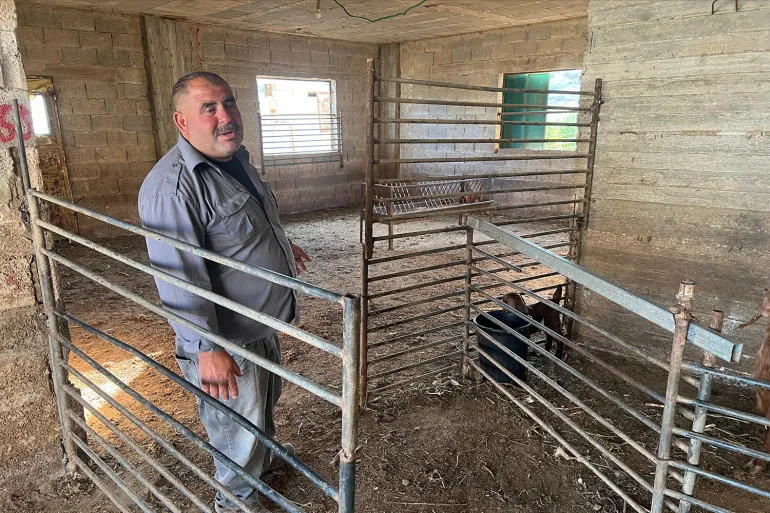
Further south, around Masafer Yatta near Hebron, Nidal Younis, head of the local village council, describes a landscape transformed by settler expansion. Twelve new outposts have been established around the area. Settlers have appropriated more than 90 percent of land cultivated with winter crops. On January 27, a raid on a nearby village resulted in the theft of 300 head of livestock. The cumulative toll is stark: livestock numbers in Masafer Yatta have fallen to less than 25 percent of what they were just a few years ago.
The scale of the crisis is documented in stark terms by international bodies. The United Nations Office for the Coordination of Humanitarian Affairs (OCHA) recorded a dramatic surge in settler incidents across the Jordan Valley — from an average of two per month in 2020 to 27 incidents per month in the first four months of 2026. A 2025 report by the Food and Agriculture Organization (FAO) found that nearly two-thirds of the 72,000 farming and herding families across the occupied West Bank required emergency assistance.
Abbas Melhem, head of the Union of Palestinian Agricultural Associations, frames the crisis in structural terms. Some 87 percent of the West Bank’s livestock sector is concentrated in a corridor stretching from Masafer Yatta to the Jordan Valley — yet more than 90 percent of that same corridor is off-limits to Palestinian farmers and shepherds. The result is a sector being strangled from multiple directions simultaneously.
The numbers tell the story with brutal clarity. Across the West Bank and Gaza, livestock numbers have collapsed from 1.75 million head four years ago to just 480,000 today — a decline of more than 70 percent. Communities that sustained themselves through herding for generations are being reduced to dependency on emergency food assistance.
Settler Violence West Bank: Regional Implications
The geographic and legal context amplifies the vulnerability of these communities. Area C, which comprises more than 60 percent of the West Bank and has been under full Israeli civil and military control since the Oslo Accords, encompasses most of the land where these attacks are occurring. The West Bank itself has been under Israeli military occupation since 1967, and Palestinian residents of Area C have extremely limited legal recourse against settler encroachment or military-backed raids.
What is unfolding across these communities represents more than individual acts of violence or theft. The systematic displacement of herding families, the seizure of livestock, the establishment of new outposts on agricultural land, and the effective closure of grazing areas together constitute a sustained assault on the economic and social fabric of rural Palestinian life. For families like those of Masa’id, Abu Shaar, and the communities around Masafer Yatta, the question is no longer simply one of security — it is one of survival.