Arctic Militarisation — Norwegian Defence Minister Tore Sandvik has issued an urgent warning that Russia must not be permitted to dominate the Bear Gap, a critical Arctic chokepoint that Western military planners regard as one of the most strategically sensitive waterways on earth. Speaking in an interview published Monday, Sandvik underscored the corridor’s outsized importance to NATO’s northern flank.
The Bear Gap stretches approximately 400 miles — roughly 650 kilometres — across the Arctic Ocean between the North Cape of mainland Norway and Bear Island, the southernmost point of Norway’s Svalbard archipelago. The passage separates the Barents Sea to the east from the Norwegian Sea to the west, making it a natural gateway through which Russian naval vessels must transit to reach the open Atlantic.
The strategic stakes are considerable. Directly east of the Bear Gap lies Russia’s Kola Peninsula, home to the headquarters of Moscow’s Northern Fleet and the bulk of Russia’s sea-based nuclear deterrent. Any adversary capable of controlling or monitoring the Bear Gap would effectively hold a chokehold over Russia’s primary submarine exit route — a fact that has shaped NATO planning for decades and has taken on renewed urgency as tensions between Moscow and the West have deepened.
Recommended Reading
Norway has already begun translating that concern into hardware. In December, Oslo announced the purchase of two German-built submarines, explicitly citing Russian military activity in the North Atlantic as the driving rationale. The acquisition signals a significant upgrade to Norway’s underwater warfare capability in waters it considers its own backyard.
Allied reinforcements are also arriving. Britain announced in February that it would double the number of troops stationed in Norway to 2,000 over the next three years, committing to what London described as a ‘vital’ role in a NATO Arctic operation. The pledge reflects a broader recognition among alliance members that the High North has re-emerged as a primary theatre of great-power competition.
Norway retains full sovereignty over Svalbard, though Russia maintains a legal presence on the islands under the terms of an international treaty signed in 1920. That arrangement has grown increasingly fraught as Moscow’s military posture in the region has expanded.
The militarisation of the Arctic is not confined to the European theatre. Canada released a 37-page security strategy in December 2024 outlining plans to strengthen its military footprint and diplomatic presence across the region. The document described Russian weapons tests and missile system deployments in the Arctic as ‘deeply troubling’ — language that reflects Ottawa’s alarm at Moscow’s accelerating modernisation programme.
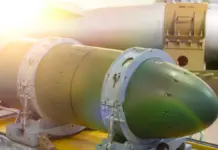
Central to that programme is the Oreshnik intercontinental ballistic missile, first publicly revealed by Russia in November 2024. Moscow claims the weapon is nuclear-capable and travels at hypersonic speeds, with a range of approximately 5,000 kilometres. US officials assess the Oreshnik as a derivative of the older RS-26 Rubezh missile system, suggesting it represents an evolution of existing technology rather than an entirely novel capability — though its operational deployment in Arctic conditions would pose serious challenges for NATO air defences.
Arctic Militarisation: The Arctic Strategic Context
Adding a further layer of complexity to Arctic geopolitics is the persistent ambition of US President Donald Trump to acquire Greenland. Trump has repeatedly described the island as vital to American national security and, in January, threatened additional trade tariffs against European nations that opposed his acquisition plans. Both Greenland and Denmark have firmly rejected any suggestion that the territory is for sale. Trump subsequently announced what he characterised as a ‘framework of a future deal’ on Greenland with NATO Secretary-General Mark Rutte, though the substance of that framework remains unclear. Greenland is also believed to hold vast, largely untapped reserves of rare-earth minerals, adding an economic dimension to the geopolitical contest.
China has further complicated the picture. Beijing is believed to have been routinely deploying vessels into northern Arctic waters equipped with dual-use technology capable of serving both military and civilian research purposes — a pattern that has drawn scrutiny from Arctic states.
Six nations border the Arctic: Russia, Canada, the United States, Denmark, Norway and Iceland. The Arctic Council, the primary intergovernmental forum for regional cooperation, was established in 1996. But the spirit of multilateral dialogue that underpinned its founding has been severely strained by Russia’s invasion of Ukraine, with Western member states suspending cooperation with Moscow and leaving the body effectively paralysed on security matters.
Sandvik’s warning reflects a consensus hardening across NATO capitals: the High North is no longer a peripheral concern but a frontline in the contest between Russia and the Western alliance — one where geography, nuclear deterrence and great-power rivalry converge with unusual intensity.