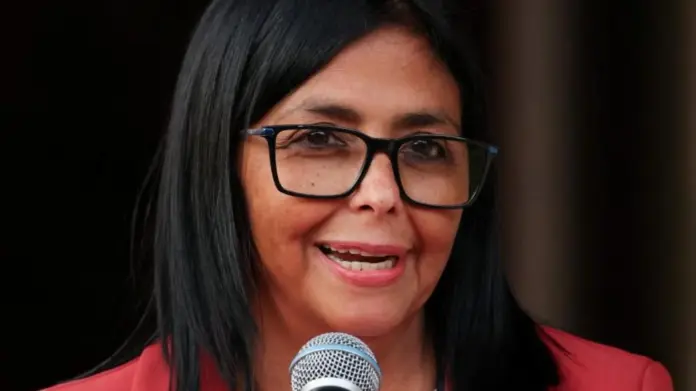
CARACAS — The United States lifted sanctions on Venezuelan interim President Delcy Rodríguez on Wednesday, removing her name from the Treasury Department’s Specially Designated Nationals list in a move that signals deepening engagement between Washington and Caracas following the dramatic military ouster of Nicolás Maduro.
The Office of Foreign Assets Control published the delisting on the Treasury Department’s website, formally ending restrictions that had blocked Rodríguez’s assets in the United States and barred American nationals from conducting any business with her. She had been placed on the SDN list in 2018, when Washington accused her of undermining democratic institutions during her tenure as Maduro’s vice-president.
Rodríguez assumed the presidency after Maduro and his wife, Cilia Flores, were seized from Caracas on January 3 in a US military raid. The operation, which Venezuelan authorities say killed approximately 100 people, resulted in both Maduro and Flores being transported to New York to face federal drug trafficking charges. Both deny the allegations. Venezuela’s National Assembly — dominated by Maduro loyalists — subsequently swore Rodríguez in as interim president.
![Venezuela's interim President Delcy Rodriguez holds a meeting with a Colombian government delegation at the Miraflores Presidential Palace in Caracas on March 13, 2026 [Juan Barreto/AFP]](https://world-tension.s3.us-east-2.amazonaws.com/articles/331/a7adc693ce894dffaae2ddaecf6d1608.webp)
Since taking power, Rodríguez has moved to align herself with the demands of the Trump administration, most notably by opening Venezuela’s energy sector to American companies. She also dismissed former Defence Minister Vladimir Padrino López in mid-March, a significant reshuffling of the security establishment inherited from Maduro. Former Interior Minister Diosdado Cabello, widely regarded as one of Rodríguez’s key political backers, remains in his post.
White House spokeswoman Anna Kelly commented on the sanctions relief, framing it within a broader strategic framework. Secretary of State Marco Rubio has outlined a three-pronged policy plan for Venezuela, and indicated this week that the country has now entered the second phase — described as recovery. Rubio has also demanded the release of all political prisoners as a condition of continued engagement.
Venezuela’s National Assembly passed an amnesty law, and hundreds of detainees have since been freed. However, prisoners’ rights organisation Foro Penal reports that close to 500 political prisoners remain incarcerated across Venezuelan jails, a figure that opposition activists in Caracas cited when criticising the decision to lift sanctions on Rodríguez.
The diplomatic thaw has been accompanied by concrete institutional steps. The US Embassy in Caracas resumed operations on Monday after remaining shuttered for seven years, while Venezuela dispatched a diplomatic team to Washington to reopen its own embassy there. Several high-level American delegations have visited Caracas since Maduro’s removal, underscoring the pace of the rapprochement.
Nobel Peace Prize laureate and opposition leader María Corina Machado, who collected the prize in December and has since been living in exile, met with Rubio on Tuesday. Her presence in those discussions reflects the complex political landscape Rodríguez must navigate — balancing the expectations of Washington against the demands of the Maduro-era loyalists who remain central to her political survival.
The sanctions relief represents a calculated bet by the Trump administration that engagement, rather than isolation, can accelerate Venezuela’s political and economic transformation. Whether Rodríguez can satisfy both her American interlocutors and her domestic power base — while nearly 500 political prisoners remain a persistent point of contention — will define the trajectory of this fragile new chapter in US-Venezuelan relations.