The United States and Israel launched a full-scale military campaign against Iran on February 28, 2025, striking the country’s three principal nuclear facilities in an operation designated ‘Midnight Hammer.’ The assault came just days after a round of negotiations in Geneva involving Omani mediators and Iranian officials — talks that Washington had itself initiated — marking one of the most dramatic collapses of diplomacy in recent memory.
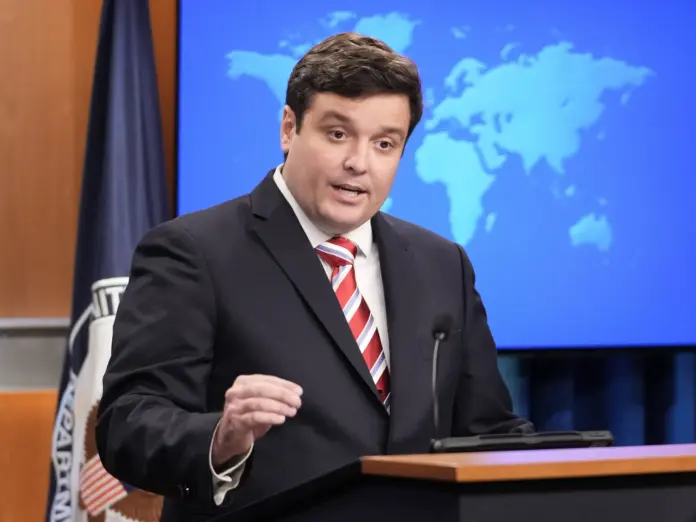
The war did not emerge without warning. Israel had already struck Iranian territory the previous year during ongoing nuclear negotiations between Washington and Tehran. That June 2025 attack, according to State Department spokesperson Tommy Pigott, paradoxically reopened the door to diplomacy — a door that ultimately failed to hold. Pigott, speaking in a television interview Thursday, insisted that President Donald Trump had genuinely pursued talks with Iran before hostilities began, framing the administration’s position as one of reluctant escalation.
Iran has consistently denied seeking a nuclear weapon, a position reinforced by Trump’s own intelligence chief. Tulsi Gabbard, the Director of National Intelligence, told lawmakers that Iran is not building a nuclear weapon and confirmed earlier this month that there have been no efforts by Tehran to rebuild its uranium enrichment capacity following the US strikes. Yet Iran has maintained its sovereign right to enrich uranium domestically and has categorically ruled out any negotiations over its ballistic missile programme or its support for non-state actors hostile to Israel — a position that has hardened the diplomatic impasse.
The contrast with Israel is not lost on analysts. Israel is widely believed to possess an undeclared nuclear arsenal, though it has never confirmed this publicly.
Iran’s military response has been swift and broad. Missile and drone attacks have struck US assets across the region, as well as energy infrastructure, hotels, and airports — civilian sites whose targeting legal experts say constitutes collective punishment, prohibited under international law. Tehran’s most consequential move has been the closure of the Strait of Hormuz, the narrow waterway through which a significant share of global oil passes. Energy prices have surged in response, sending economic shockwaves well beyond the immediate conflict zone.
Trump has responded with escalating rhetoric. In a Wednesday address, he threatened to destroy Iran’s power plants and warned that the US could obliterate the country’s water desalination stations — infrastructure upon which millions of civilians depend. The State Department, meanwhile, has accused Iran of attacking civilian sites, even as legal scholars note that threats against civilian infrastructure by either side raise serious questions under the laws of armed conflict.
On social media, Trump posted a stark ultimatum: ‘IT IS TIME FOR IRAN TO MAKE A DEAL BEFORE IT IS TOO LATE, AND THERE IS NOTHING LEFT OF WHAT STILL COULD BECOME A GREAT COUNTRY.’ He also shared footage of the destruction of an Iranian bridge. Iran has shown no indication it intends to capitulate.
At home, the war has ignited an anxious national conversation about military capacity and the spectre of conscription. Trump has ordered marines and army paratroopers to deploy to the Middle East in recent weeks. On March 8, White House press secretary Karoline Leavitt told Fox News that a military draft is ‘not part of the current plan right now,’ but added that the president ‘keeps his options on the table’ — a formulation that did little to quiet public concern.
The anxiety is not without context. Trump signed a National Defense Authorization Act in December that automates registration for the Selective Service. On March 20, the US Army revised its recruiting regulations, raising the maximum enlistment age from 35 to 42 and scrapping certain restrictions for individuals with prior marijuana possession convictions. Despite these changes, the Army met its 2025 recruiting goal of 61,000 new soldiers four months ahead of schedule.
The draft debate has spilled into popular culture. South Park writer Toby Morton launched the satirical website DraftBarronTrump.com following the initial strikes on Iran, and the hashtag #SendBarron was trending on X and TikTok by March 2. California Governor Gavin Newsom — who has never served in the military — suggested in a video interview published March 24 that Americans should have ‘a responsibility to serve for a year, six months minimum — year, 18 months.’ Actor Rob Schneider echoed the sentiment on X, calling for mandatory two-year military service at age 18. Trump himself rejected the idea of a draft during the 2024 campaign, writing on Truth Social in June of that year that he had ‘never even thought of that idea.’
Analysts caution that the scale of any ground campaign would be staggering. Iran has twice the population and three times the territory of Iraq — a country whose occupation consumed the United States for nearly two decades. Researchers at Clemson University in South Carolina have tracked Iranian-linked influence accounts amplifying anti-war commentary almost immediately after the first US strikes, suggesting Tehran is waging an information campaign alongside its military response.
With the Strait of Hormuz closed, energy markets in turmoil, and no credible diplomatic channel currently open, the conflict shows no signs of near-term resolution. The war that began on February 28 has already reshaped the geopolitical landscape of the Middle East — and its full consequences remain deeply uncertain.