Washington will host Lebanese and Israeli officials for a second round of direct negotiations on Thursday, as the State Department presses forward with diplomatic engagement even as Israeli forces continue to demolish civilian infrastructure along Lebanon’s southern border.
The talks represent the first formal follow-up since the two sides met last week — their first direct encounter in decades — shortly after a ceasefire between Hezbollah and Israel came into effect. A State Department spokesperson confirmed that Washington welcomes the productive engagement that began on April 14, framing the renewed diplomacy as a significant step toward stabilising the volatile frontier.
Lebanese President Joseph Aoun reaffirmed on Friday that Beirut intends to continue the negotiations, and his government has made clear it is pushing to separate Lebanon’s bilateral track from the broader web of US-Israel regional diplomacy. That position puts Beirut at odds with Iran, which has insisted Lebanon must be incorporated into any wider truce framework involving the region’s competing power blocs.
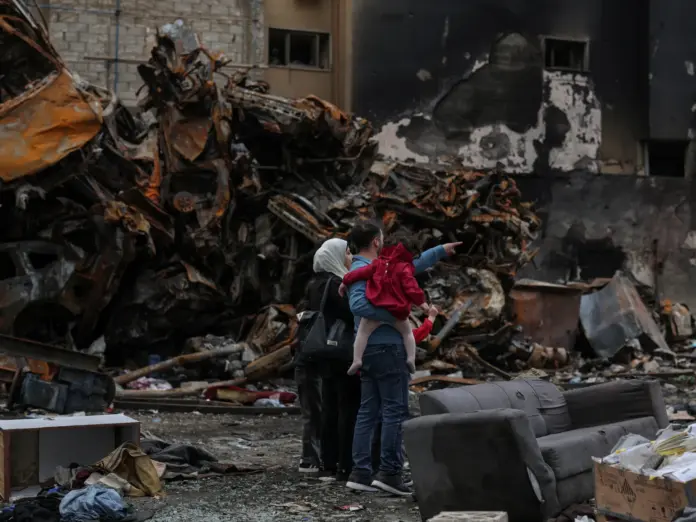
The diplomatic momentum, however, is shadowed by events on the ground. Despite the ceasefire, Israeli forces have continued to raze neighbourhoods in border villages across southern Lebanon. Israeli officials have stated openly that their objective is to replicate in southern Lebanon the scale of destruction visited upon towns in Gaza — a posture they describe as establishing a ‘forward defence’ line. On Monday, Israel said it killed militants it described as terrorists operating in the city of Bint Jbeil. Hezbollah, for its part, said it detonated an explosive device targeting an Israeli military convoy near the town of Deir Siriane in the eastern sector of the border.
The violence has continued even after President Donald Trump declared on Friday that he had ‘prohibited’ Israel from attacking Lebanon — a statement that appeared to have little immediate effect on Israeli operations in the south, where the destruction of civilian infrastructure has persisted.
President Aoun has vowed his government will work toward a full Israeli withdrawal from Lebanese territory, a demand that sits at the heart of Beirut’s negotiating position. Yet the path to that outcome is complicated by fierce domestic opposition. Hezbollah chief Naim Qassem rejected the negotiations outright last week, and the group has characterised the talks as a series of ‘losing concessions’ by the Lebanese government. Hezbollah further argued that no party holds the authority to steer Lebanon toward negotiations without achieving internal consensus across the country’s fractious political landscape.
The internal Lebanese divide reflects a broader tension: a government seeking to assert sovereignty and chart an independent diplomatic course, confronting both an armed domestic faction that refuses to recognise the process and an Israeli military that has shown little restraint despite the ceasefire’s existence.
For Washington, the stakes extend well beyond Lebanon’s borders. The State Department’s active facilitation of the talks signals a US interest in locking in a degree of stability on Israel’s northern front, even as the wider regional picture — encompassing Gaza, Iran’s influence, and the future of Hezbollah’s military posture — remains deeply unresolved. Iran’s insistence on linking Lebanon to broader negotiations adds another layer of complexity, potentially giving Tehran leverage to slow or derail a bilateral process that Beirut has worked to keep distinct.
Thursday’s session at the State Department will test whether the fragile diplomatic opening survives the weight of ongoing military activity, Hezbollah’s opposition, and competing regional agendas — or whether the gap between the negotiating table and the front lines proves too wide to bridge.