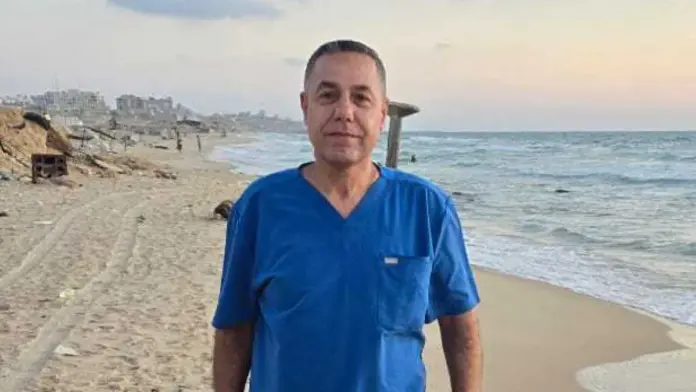
Two United Nations special rapporteurs have demanded Israel immediately release a Palestinian physician who has been held without charge since December 2024 and subjected to what UN experts describe as severe torture in Israeli detention.
Dr Hussam Abu Safia, the former director of Kamal Adwan Hospital in northern Gaza, was arrested by Israeli forces after he refused to evacuate the facility during Israeli military attacks. At the time of his detention, Kamal Adwan was the last functioning hospital in Gaza’s north — a distinction that made his decision to remain a matter of life and death for the patients under his care.
UN special rapporteurs Tlaleng Mofokeng and Ben Saul issued their call for his release on Tuesday, warning that Dr Abu Safia’s health condition remains dire. He has been systematically denied critical medical examination and treatment throughout his detention, the experts said, raising urgent concerns about his survival.
The two rapporteurs also urged the international community and nations with influence over Israel to take concrete action, calling on Israeli authorities to release all detained healthcare workers and guarantee them access to appropriate medical care.
Dr Abu Safia’s case has become a focal point in a broader reckoning over the destruction of Gaza’s medical infrastructure. Amnesty International characterised his arrest as emblematic of Israel’s systematic targeting of Palestinian health workers — a pattern, the organisation argues, that has deliberately dismantled the territory’s capacity to treat the wounded and sick.
The scale of that dismantlement is staggering. The World Health Organization has recorded more than 930 attacks on the healthcare sector in Gaza since October 2023. Every one of the territory’s 36 hospitals has sustained damage, and only half remain even partially functional. The healthcare system that once served more than two million people has been reduced to a shadow of itself.
The human toll on medical personnel has been equally devastating. Medical Aid for Palestinians documented the deaths of at least 1,722 medical workers between October 2023 and October 2025 — a rate exceeding two healthcare workers killed every single day over that two-year span. Physicians, nurses, paramedics, and support staff have died in strikes on hospitals, ambulances, and clinics.
The UN special rapporteurs did not mince words in characterising the broader context. They described Israel’s military operation in Gaza as a "genocidal war against Palestinians" — language that reflects the increasingly stark assessments emerging from UN human rights bodies as the conflict enters its third year.
Dr Abu Safia’s detention without charge or trial places Israel in direct violation of fundamental legal protections afforded to prisoners under international humanitarian law, which also grants special protections to medical personnel. His continued imprisonment, combined with the alleged denial of medical care, has drawn comparisons to the treatment of other Palestinian detainees whose cases have been documented by human rights monitors.
For Gaza’s battered population, the arrest of a physician who chose to stay at his post rather than abandon patients carries a particular weight. Kamal Adwan Hospital had become a symbol of medical resilience in the north — a place where staff continued operating under bombardment, with dwindling supplies and no safe evacuation routes for the critically ill.
The international response to the rapporteurs’ appeal remains to be seen. Previous UN calls regarding the treatment of Palestinian detainees and the protection of medical facilities have gone largely unheeded. Mofokeng and Saul, however, framed the release of Dr Abu Safia not merely as a humanitarian gesture but as a legal obligation — one that the international community bears collective responsibility for enforcing.
With Gaza’s healthcare system on the verge of total collapse and medical workers continuing to face lethal risk, the fate of one detained doctor has come to represent a much larger question: whether the protections that international law extends to medicine and those who practice it retain any meaning in the territory’s ongoing catastrophe.