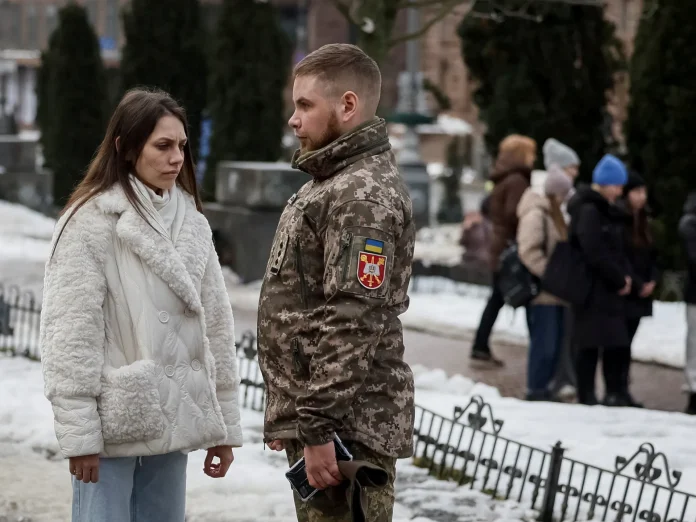
Three years after Russian forces crossed into Ukraine in what the Kremlin called a three-day operation, the war has entered its fifth year with no end in sight — and with Ukraine demonstrating a new capacity to strike at the industrial heart of Russia’s war machine.
On February 21, Ukrainian-made FP-5 ‘Flamingo’ missiles struck the Votkinsk missile factory in Russia’s Udmurtia republic, roughly 1,200 kilometres from the Ukrainian border. The facility manufactures several of Russia’s most advanced ballistic weapons, including the Oreshnik intermediate ballistic missile, which Moscow has deployed to Belarus. The Flamingo, which entered production in the second half of last year, carries a 1,150-kilogram warhead — the largest yet fielded by Ukraine. The strike represented a significant escalation in Kyiv’s campaign to degrade Russian military production at its source.
The same day, Ukrainian drones struck the Neftogorsk Gas Processing Plant in Samara. Days later, on Monday, Ukraine hit the Kaleykino Oil Pumping Station in Tatarstan, a key node in the Druzhba pipeline that supplies oil to Hungary and Slovakia. On Wednesday, a chemicals plant in Smolensk was also struck. The string of deep-penetration attacks underscored Ukraine’s expanding drone and missile arsenal — the country now produces more than three million first-person view drones annually and has destroyed 67,000 long-range Russian drones and 3,855 long-range missiles since the war began.
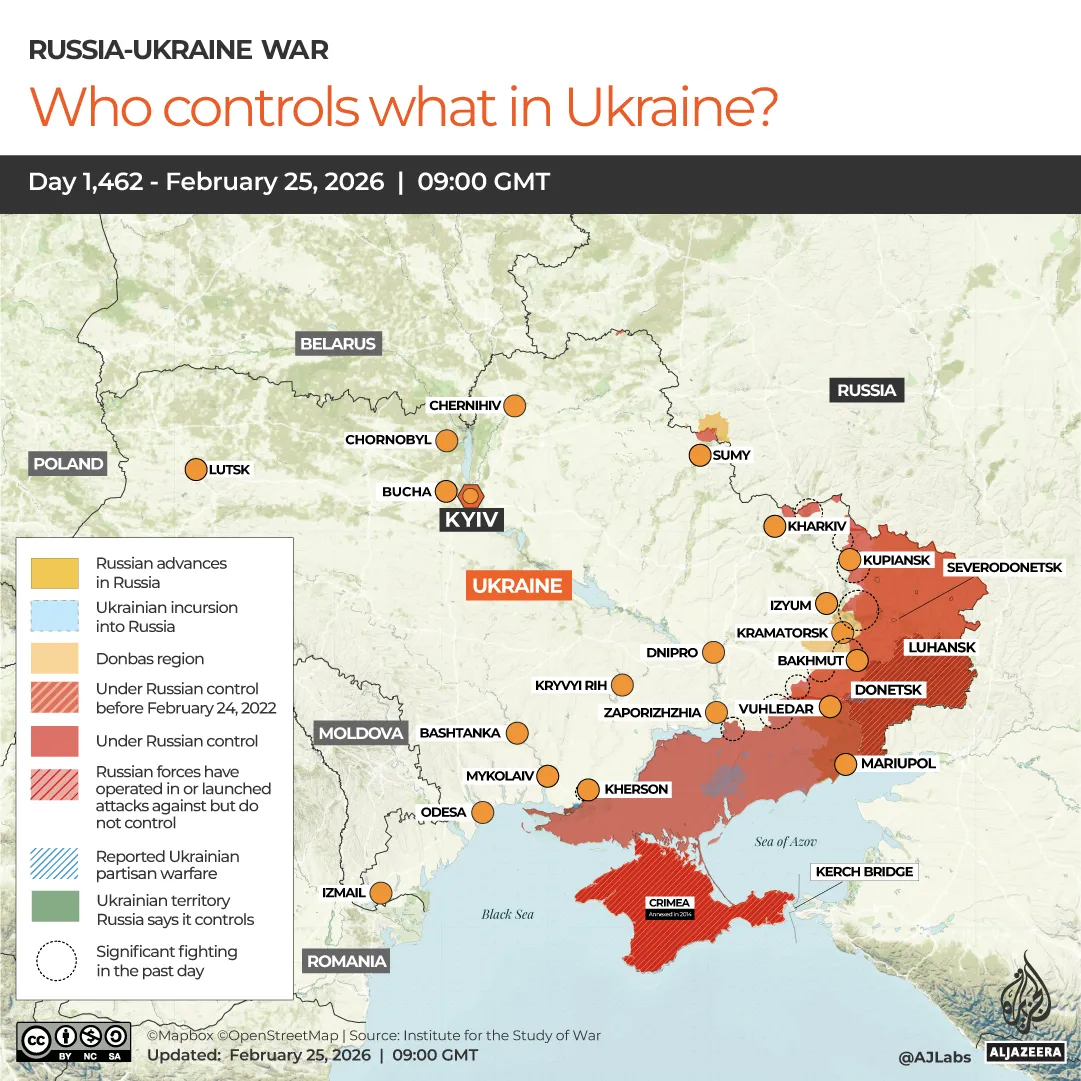
On the ground, Ukrainian commanders reported meaningful territorial recoveries in the south. President Volodymyr Zelenskyy said Ukrainian forces had reclaimed 300 square kilometres in southern Ukraine, while Commander in Chief Oleksandr Syrskii put the figure at 400 square kilometres, gains he said had accumulated since the end of January. Russian forces appear to have been forced to retreat in some areas east of Zaporizhzhia, a development analysts attribute in part to a significant shift in communications technology on the battlefield.
At the start of February, Elon Musk cut off Russian forces’ access to Starlink satellite internet — a decision made at Ukraine’s request after evidence emerged that Russian troops were using the service to mount increasingly accurate drone attacks. Ukraine subsequently persuaded Starlink to disconnect illegal Russian terminals operating in the theatre. Russia had also relied heavily on the Telegram messaging application for military coordination; the Kremlin’s partial disabling of the platform further disrupted frontline communications. The combined effect appears to have degraded Russian operational effectiveness in several sectors.
Russia’s overall battlefield record over three years remains deeply costly for Moscow. The Institute for the Study of War (ISW), a Washington-based think tank, calculates that Russia seized approximately 4,700 square kilometres of Ukrainian territory in 2025 alone — roughly twice the area of Moscow — though Russia claims the figure is closer to 6,000 square kilometres. Over the entire course of the war, Russia has captured no more than 1.5 percent of Ukraine at a cost the conflict’s casualty figures make staggering. Zelenskyy has acknowledged approximately 55,000 Ukrainian soldiers killed. On the Russian side, the BBC has confirmed the names of nearly 160,000 personnel killed fighting for Moscow.
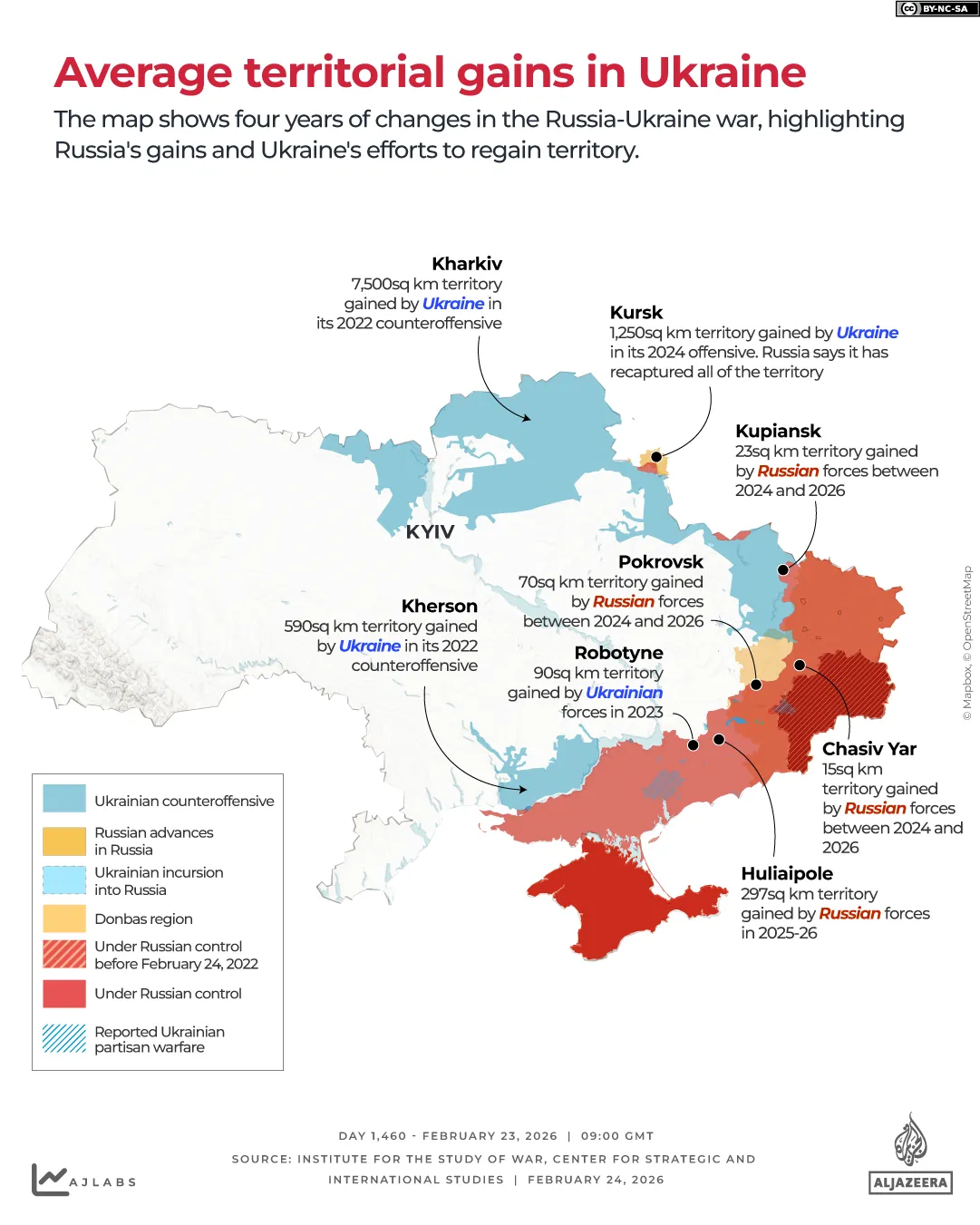
The grinding nature of the campaign is illustrated by the battle for Pokrovsk, a city of roughly 60,000 people in the eastern Donetsk region. Russian forces have spent nearly two years attempting to capture it. Russia did seize Avdiivka, located about 40 kilometres to the east, in early 2024, but the broader Donetsk campaign has stalled against what the ISW describes as a ‘fortress belt‘ — a 50-kilometre defensive arc through western Donetsk that Ukraine has been reinforcing for 11 years. The ISW estimates it would take Russian forces another two years to seize the remainder of the region.
Russia’s aerial campaign has continued at scale. During the past week alone, Russian forces launched more than 1,500 drones and at least 90 missiles at Ukrainian targets. On Sunday, a barrage of 197 drones and 50 missiles was partially intercepted — Ukraine downed all but 26 drones and 31 missiles. On Thursday, 420 drones and 39 missiles were launched; Ukrainian air defences neutralised 90 percent of the drones and 30 of the missiles.
Standing alongside Zelenskyy on the anniversary were European Commission President Ursula von der Leyen and European Council President António Costa, a visible demonstration of continued European solidarity. The European Union has transferred 195 billion euros to Ukraine since the invasion began and has voted to provide a further 90 billion euros over the next two years.
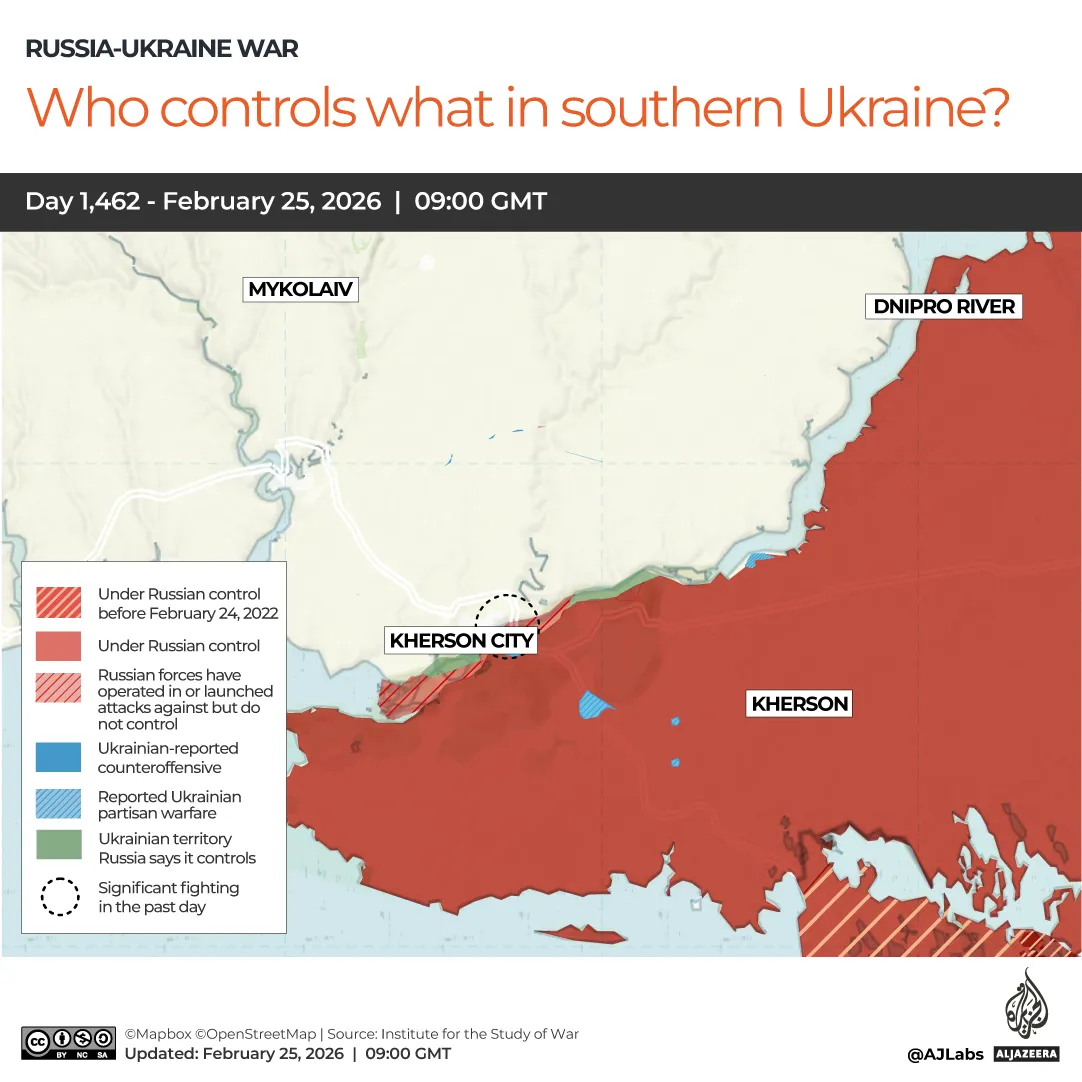
Zelenskyy marked the occasion by noting that four-fifths of Ukraine remains free — a framing that doubles as a rebuke of any settlement that would formalise Russian control over the territories it claims. A US-backed peace framework floated in November proposed that Ukraine cede control of Luhansk, Donetsk, Crimea, and parts of Zaporizhzhia and Kherson. Zelenskyy has consistently and categorically rejected any such arrangement. Russia annexed Crimea in 2014 and claims sovereignty over all four eastern and southern regions, though it does not fully control any of them.
As the war enters its fifth year, the front lines remain contested, the strikes are reaching deeper, and the political distance between a negotiated settlement and the positions of both sides shows little sign of narrowing.