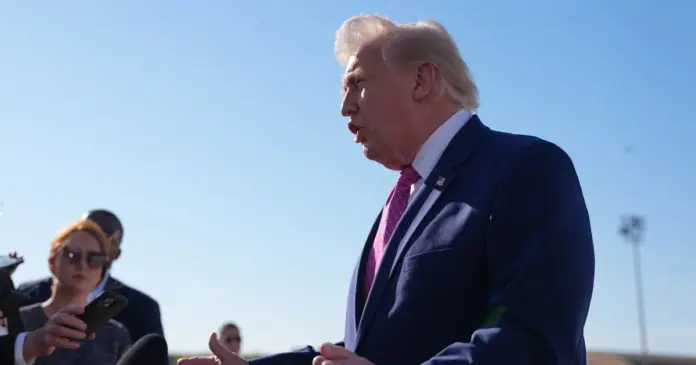
President Donald Trump declared Friday that the Strait of Hormuz would reopen "fairly soon," warning that the United States would act with or without Iranian cooperation to restore one of the world’s most critical maritime chokepoints. Speaking to reporters before boarding Air Force One at Joint Base Andrews in Camp Springs, Maryland, Trump drew a firm line against Tehran’s reported intention to impose transit fees on vessels passing through the strait — a system he characterised as an unacceptable de facto toll booth.
The remarks came hours before senior officials from both nations were due to sit down in Islamabad for negotiations aimed at securing a permanent end to the war. Vice President JD Vance will lead the American delegation, while Iran will be represented by parliamentary speaker Mohammad Bagher Ghalibaf. The talks follow a two-week ceasefire announced on Tuesday, though the two sides have already offered conflicting accounts of the agreed terms. Tehran has separately put forward a 10-point plan as the basis for discussions.
Trump also used the pre-departure remarks to restate Washington’s core demand: that any agreement must guarantee Iran does not acquire nuclear weapons. "That is the priority," he said, signalling that economic and maritime disputes, however urgent, remain secondary to the non-proliferation objective.
The humanitarian and economic toll of the blockade is mounting rapidly. Data from S&P Global Market Intelligence illustrates the near-total collapse of commercial traffic through the strait. Before the war, approximately 135 vessels transited the waterway each day. On Thursday, that figure had fallen to five. By Friday, only two ships passed through — a decline of more than 98 percent from pre-war norms.
Since the ceasefire took effect, just 22 ships with their automatic identification systems active have exited the strait. The backlog is severe: Lloyd’s List Intelligence reports that more than 600 vessels, including 325 tankers, remain stranded in the Gulf. The disruption is rippling far beyond the region, affecting roughly one-fifth of global oil and natural gas flows — a share large enough to rattle energy markets worldwide and contribute to the surge in US inflation recorded in March.
Iran’s signalled intention to charge vessels for safe passage — even in the event of a deal — represents a significant complication for negotiators. Trump’s explicit rejection of that framework on Friday suggests the issue could become a flashpoint in Islamabad, potentially undermining progress on the broader ceasefire architecture before talks have properly begun.
The Islamabad negotiations carry enormous weight. Both delegations arrive with domestic pressures and competing red lines, and the conflicting pre-talk statements from Washington and Tehran have already introduced uncertainty about whether a shared framework for discussion even exists. The 10-point Iranian plan has not been publicly detailed, and American officials have not confirmed whether it forms an agreed starting point or merely Tehran’s opening position.
Thailand’s multi-billion-dollar fishing industry is among the sectors feeling the indirect effects of the conflict, as disrupted shipping lanes and elevated fuel costs cascade through global supply chains. The economic consequences extend well beyond the Gulf, reinforcing the urgency felt by both sides — and by international observers — to translate the fragile ceasefire into something durable.
For now, the world’s attention turns to Pakistan, where Vance and Ghalibaf will attempt to bridge a gulf that is, at this moment, as much diplomatic as it is geographic. Whether the Strait of Hormuz reopens on terms acceptable to both Washington and Tehran — or whether Trump’s "with or without" warning signals a harder American posture to come — may depend on what happens in Islamabad on Saturday.