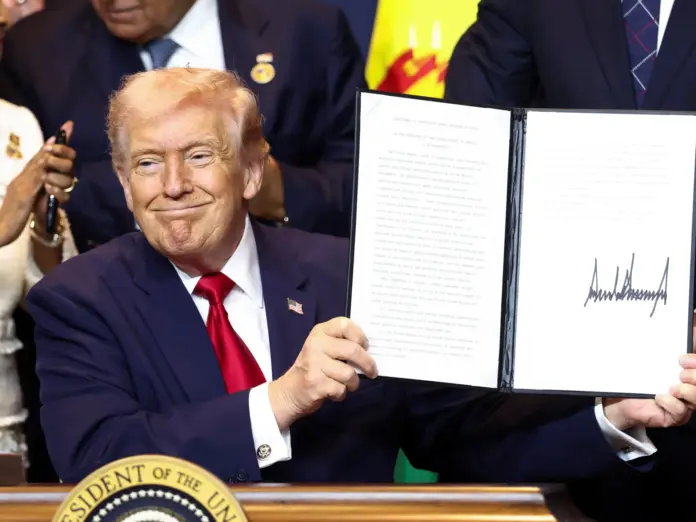
President Donald Trump formally launched the Americas Counter-Cartel Coalition at the inaugural Shield of the Americas summit, held at his Doral golf club near Miami, assembling a bloc of 17 politically aligned nations and declaring that drug trafficking organisations must be confronted with military power rather than conventional law enforcement alone.
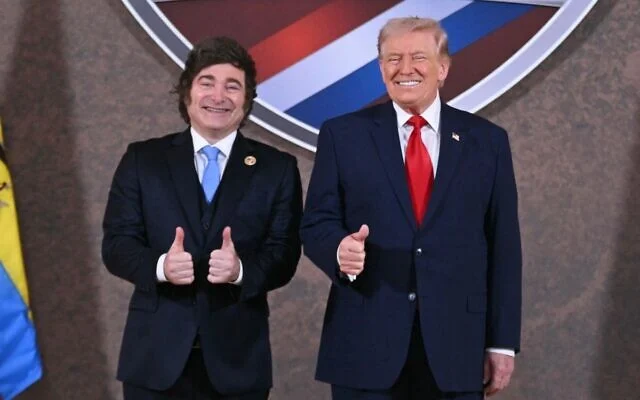
The summit brought together a roster of right-leaning heads of state, including Argentina’s Javier Milei, El Salvador’s Nayib Bukele, and Ecuador’s Daniel Noboa, alongside leaders from Bolivia, Costa Rica, the Dominican Republic, Guyana, Honduras, Panama, Paraguay, and Trinidad and Tobago. Jose Antonio Kast, Chile’s president-elect, also attended. Conspicuously absent from top-level representation were Mexico, Brazil, and Colombia — three nations whose left-wing governments have resisted alignment with Trump’s regional agenda.
Secretary of Defense Pete Hegseth set the tone early, describing criminal networks and cartels as posing an existential crisis for the entire Western Hemisphere. Secretary of State Marco Rubio praised the assembled leaders for their cooperation before hosting them for a working lunch after Trump departed for Delaware.
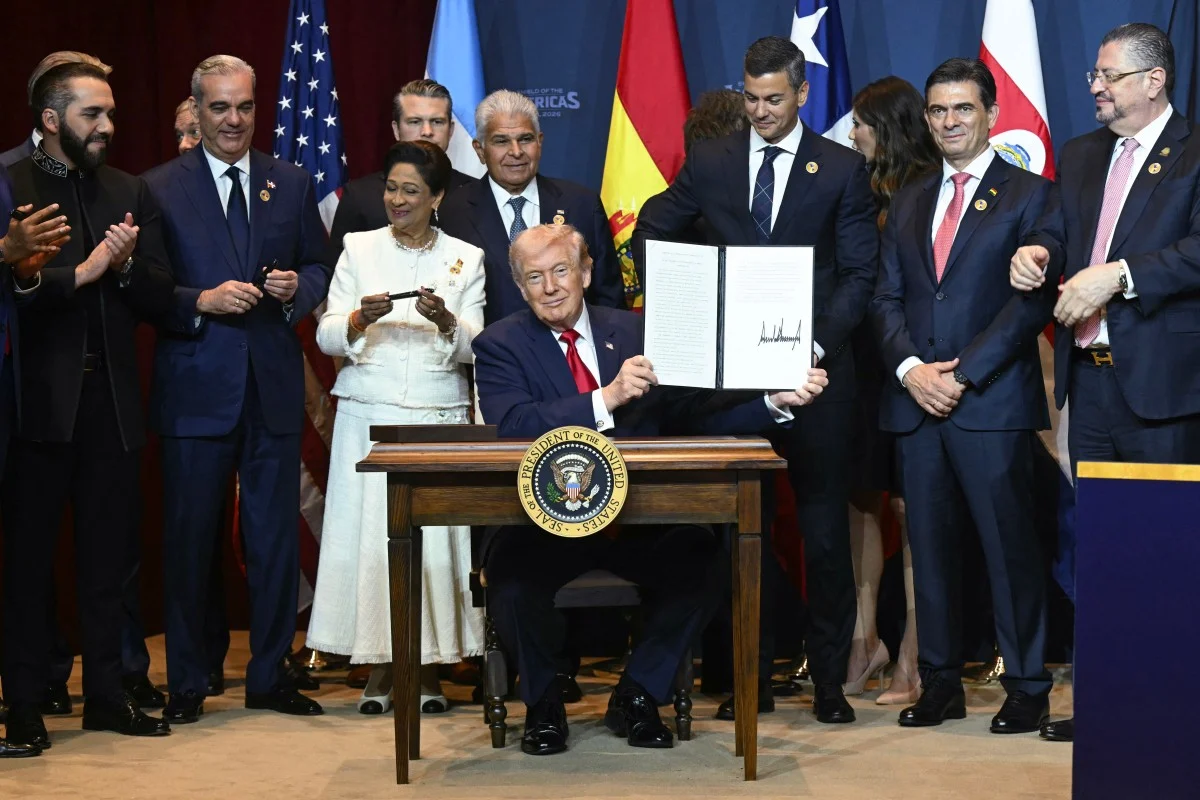
Trump offered attending nations direct US missile support to target cartel leadership, describing the weapons as ‘extremely accurate’ and capable of striking cartel figures inside their own homes. He identified Mexico as the epicentre of cartel violence in the hemisphere, even as Mexican President Claudia Sheinbaum announced in February that 10,000 soldiers would be deployed to the US-Mexico border. Mexico’s government has also launched a military operation in Jalisco targeting cartel leader Nemesio Oseguera Cervantes, known as ‘El Mencho.’
The summit’s rhetoric was matched by an already-escalating military posture. Since September, the Trump administration conducted at least 44 aerial strikes on maritime vessels in the Caribbean Sea and eastern Pacific Ocean, killing nearly 150 people whose identities were never publicly confirmed. Families in Colombia and Trinidad and Tobago have claimed some of the dead were relatives on fishing trips or travelling for informal work.
The most dramatic action disclosed at the summit involved Venezuela. In late December and early January, US forces struck a port linked to the gang Tren de Aragua. On January 3, Trump authorised a broader offensive — dubbed Operation Absolute Resolve — that resulted in the capture and imprisonment of President Nicolas Maduro. The operation killed at least 80 people, including 32 Cuban military officers. Trump described the mission as lasting approximately 18 minutes with no American lives lost. Maduro now awaits trial in New York on narcoterrorism and drug-trafficking charges.
Venezuela’s interim President Delcy Rodriguez has since complied with numerous US demands, including reforms to the country’s nationalised oil and mining sectors. Washington and Caracas re-established diplomatic relations for the first time since 2019, and Trump is working with Rodriguez on access to Venezuelan oil reserves.
The administration has simultaneously tightened its grip on Cuba. Trump severed the flow of oil and funds from Venezuela to Havana and, in late January, announced steep economic penalties on any country supplying Cuba with oil. The island has experienced widespread blackouts as a result, and the United Nations warned that Cuba is edging toward humanitarian collapse. Trump declared Cuba to be ‘in its last moments of life’ and ‘at the end of the line.’
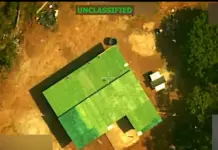
Joint operations with Ecuador were also announced at the summit. The US released footage of a structure exploding in a forested Ecuadorian area, characterising the strike as a blow against ‘narcoterrorists.’
Trump framed his broader Latin American strategy as the ‘Donroe Doctrine’ — a deliberate echo of the 19th-century Monroe Doctrine — while his national security apparatus has formalised a ‘Trump Corollary’ targeting Chinese infrastructure investment across the region. The administration successfully pressured Panama to withdraw from China’s Belt and Road Initiative, and Trump made pointed remarks to Panamanian President Jose Raul Mulino about foreign influence over the Panama Canal, stating bluntly: ‘we’re not going to allow it.’ Trump is scheduled to travel to Beijing later this month to meet with Chinese President Xi Jinping.
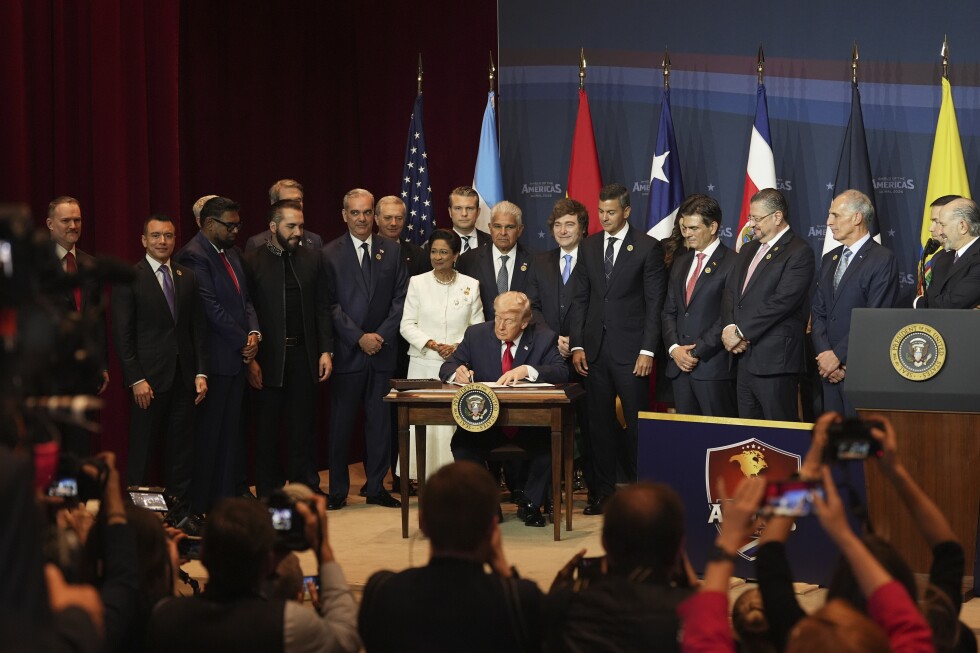
The summit also marked the debut of Kristi Noem in a new capacity. Fired as homeland security secretary earlier in the week, Noem appeared at Doral as special envoy for the Shield of the Americas initiative. The administration has simultaneously slashed foreign assistance across the region while channelling support toward governments that have backed Trump’s immigration enforcement agenda.
The coalition’s formation arrives against a backdrop of intensifying US-Israeli military coordination. A week before the summit, the United States and Israel launched a joint campaign of airstrikes against Iran, adding a further dimension to the administration’s simultaneous pressure campaigns across multiple theatres.