WASHINGTON — President Donald Trump on Friday floated the idea of a United States takeover of Cuba, describing the island nation as a “failed nation” in economic freefall and suggesting Washington could absorb it on “amicable terms” — the latest in a series of extraordinary territorial ambitions the administration has advanced since taking office in January.
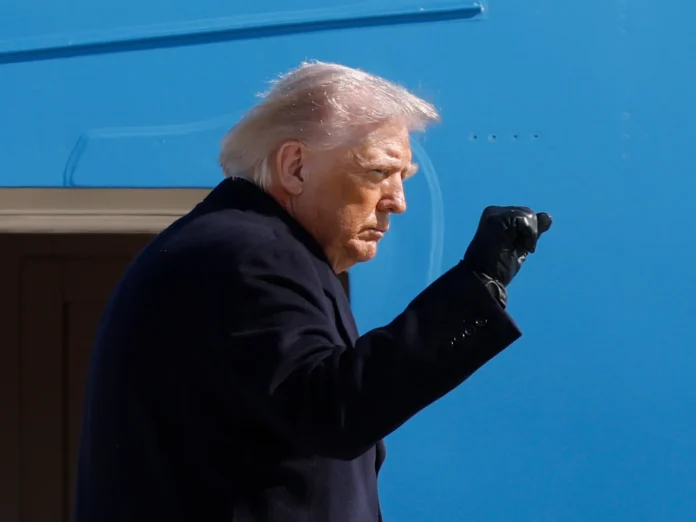
Speaking to reporters on the White House lawn as he prepared to board Marine One en route to Texas, Trump said the Cuban government was already in talks with the United States at a “very high level,” citing a lack of money, oil, and food as evidence that Havana had little leverage. “They have no money,” Trump said, framing the potential acquisition as a natural resolution to decades of mutual hostility.
Secretary of State Marco Rubio, a Cuban American whose family fled the island after Fidel Castro’s revolution, is leading the administration’s Cuba initiative. While Cuban officials have acknowledged dialogue with U.S. counterparts — including exchanges with the Coast Guard and the Department of Homeland Security — Havana has been emphatic that it is not engaged in any formal, high-level negotiations that would compromise its sovereignty.
Cuban President Miguel Diaz-Canel struck a defiant tone on Friday, stating that Cuba would defend itself “with determination” against any terrorist or mercenary aggression. Earlier in the week, on January 30, he had accused Trump of attempting to “strangle the Cuban economy” through a sweeping fuel blockade that has left the island critically short of energy supplies.
The economic pressure on Cuba has intensified dramatically in recent weeks. Following a U.S. military operation on January 3 that resulted in the capture of Venezuelan President Nicolás Maduro — and the deaths of an estimated 32 Cuban soldiers — shipments of Venezuelan oil to Cuba were severely disrupted. On January 11, Trump announced that no Venezuelan oil or money would flow to Cuba. Then, on January 29, he signed an executive order threatening tariffs against any country supplying oil to the island, directly or indirectly.
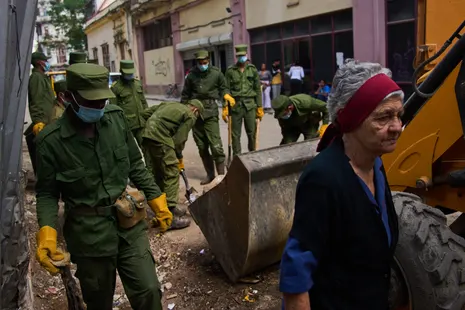
The United Nations has warned that Cuba faces an imminent humanitarian collapse if fuel supplies are not restored, and a UN panel of human rights experts has declared the fuel blockade a violation of international law. More than 40 U.S. civil society organisations have urged Congress to push back against the administration’s approach, warning that policies designed to cripple the Cuban economy risk triggering a mass humanitarian crisis on an island already reeling from years of instability. Nearly 2 million Cubans fled the country during the COVID-19 pandemic alone.
In a move that appeared to soften the administration’s posture — at least marginally — the U.S. Department of the Treasury on Wednesday announced it would implement a “favorable licensing policy” for the resale of Venezuelan oil to Cuba. The Trump administration also announced $6 million in humanitarian aid for Cuba in early February, to be distributed through intermediaries including the Catholic Church.
Tensions were further inflamed by a violent incident off Cuba’s northern coast, in which Cuban forces intercepted a Florida-registered speedboat carrying armed individuals. The confrontation resulted in at least four deaths and several injuries. Cuba described the vessel as part of an “infiltration for terrorist purposes”; the U.S. government denied any involvement. The episode nonetheless prompted a new round of communications between Havana and Washington.
Trump’s Cuba remarks fit a broader pattern of expansionist rhetoric that has defined his second term. In his January inaugural address, he pledged that the United States would “once again consider itself a growing nation,” and has since proposed to “own” Gaza, “run” Venezuela, and pressured Greenland, Canada, and Panama to cede sovereignty over their territories. He has invoked 19th-century doctrines of American expansionism — including manifest destiny and the Monroe Doctrine — and branded his hemispheric vision the “Donroe Doctrine.” During his State of the Union address, Trump announced that more than 80 million barrels of Venezuelan oil had been transferred into U.S. government possession.
Cuba, located just 145 kilometres from the Florida coast, has been subject to a comprehensive U.S. trade embargo since 1962. The Helms-Burton Act of 1996 further codified and intensified those restrictions following the collapse of the Soviet Union, which had been Havana’s principal economic patron. The island has never fully recovered from that loss of support — a vulnerability the Trump administration now appears determined to exploit.
Whether Trump’s “friendly takeover” language represents a concrete policy objective or political theatre remains unclear. What is certain is that the combination of military pressure, economic strangulation, and diplomatic overture has placed Cuba at the centre of one of the most aggressive U.S. foreign policy campaigns in the Western Hemisphere in decades.