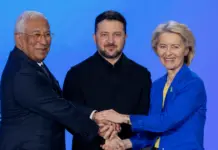
Washington / Beirut — Donald Trump announced Wednesday that the leaders of Israel and Lebanon would speak by telephone for the first time in 34 years, a diplomatic overture that arrived as Israeli forces simultaneously expanded their ground offensive in southern Lebanon and launched strikes that killed four paramedics in a single village.
The announcement, posted on Truth Social, offered few specifics — Trump did not name the leaders involved, and neither Israel nor Lebanon issued any official confirmation. Lebanese officials went further, stating they had no information about any upcoming contact with Israeli leadership. The ambiguity underscored the fragile and contradictory nature of diplomatic efforts running parallel to an intensifying military campaign.
Gila Gamliel, a member of Israel’s security cabinet, told Israel’s Army Radio that Prime Minister Benjamin Netanyahu would speak with Lebanese President Joseph Aoun. The call, if it proceeds, would represent an extraordinary moment: Israeli and Lebanese ambassadors have already held their first direct diplomatic talks in more than three decades in Washington, a quiet but significant shift in a relationship defined for generations by hostility and proxy conflict.
Netanyahu has framed the dual-track approach as deliberate strategy, saying Israel is pursuing negotiations with the Lebanese government while simultaneously conducting military operations against Hezbollah. The Lebanese government, for its part, has called for a ceasefire and the withdrawal of Israeli troops from southern Lebanon — demands that remain unmet as Israeli forces push deeper into the country.
On Wednesday, Netanyahu ordered the military to expand its invasion eastward in southern Lebanon, broadening an offensive that has already killed more than 2,000 people and displaced approximately 1.2 million since fighting resumed on March 2. That resumption followed Hezbollah’s decision to fire rockets at Israel after Lebanon was drawn into the wider US-Israel war on Iran — a conflict ignited after Israel killed Iranian Supreme Leader Ayatollah Ali Khamenei on February 28.
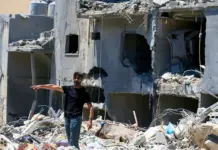
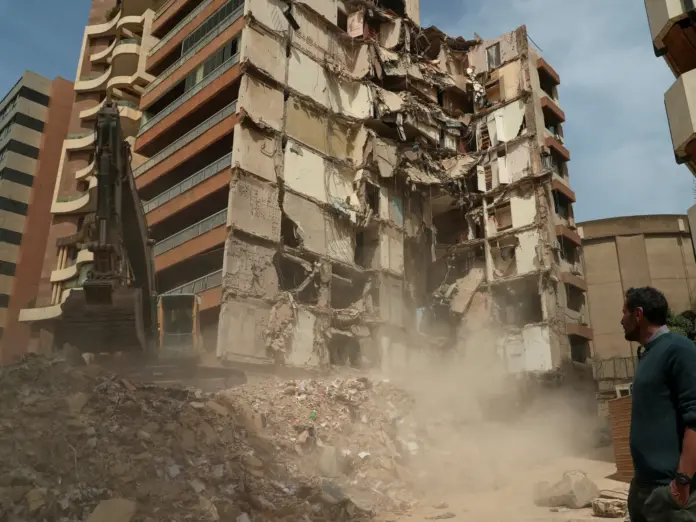
The human cost of the campaign is mounting rapidly. Israeli forces have killed at least 91 Lebanese medical workers since March 2, a toll that rose Wednesday when three consecutive strikes hit the village of Mayfadoun, killing four paramedics and wounding six others. Israeli forces have also struck multiple medical facilities and launched attacks near a hospital in the southern town of Tebnine. Civilian infrastructure across Lebanon — bridges, homes, entire neighbourhoods — has been systematically destroyed.
The battle for Bint Jbeil has emerged as a focal point of the ground campaign. Israel’s military stated its troops have encircled the southern town, a symbolic and strategic objective. Hezbollah said its fighters inside Bint Jbeil were continuing to resist. The town carries particular resonance: Israeli forces failed to take control of it during the 2006 war, and its fate in the current conflict is being watched closely as a measure of both military capability and Hezbollah’s remaining strength.
The ceasefire Israel agreed to with Lebanon in November 2024 has effectively collapsed, replaced by one of the most destructive military campaigns the country has seen in decades. The Lebanese government, caught between an emboldened Israeli military and a weakened but still-fighting Hezbollah, is navigating an extraordinarily difficult position — seeking diplomatic engagement while its territory is being reshaped by force.
Trump’s announcement, whatever its ultimate outcome, signals that Washington views some form of political resolution as necessary alongside the military campaign. Whether a phone call between Netanyahu and Aoun can translate into meaningful progress — given the scale of destruction, the displacement of more than a million Lebanese civilians, and Hezbollah’s continued armed resistance — remains deeply uncertain. For now, diplomacy and bombardment are advancing together, with no clear indication of which will define the outcome.