Sudan Gezira Scheme — Sudan’s civil war has transformed one of Africa’s most productive agricultural landscapes into a wasteland of broken canals, looted warehouses, and abandoned fields — a catastrophe that has pushed 25.6 million people, roughly half the country’s population, into acute food insecurity.
The conflict erupted on April 15, 2023, when a long-simmering power struggle between the Rapid Support Forces (RSF) and the Sudanese Armed Forces (SAF) exploded into open warfare in the capital, Khartoum, before spreading rapidly across the country. The RSF moved with particular speed through Sudan’s agricultural heartland, sweeping across the states of Gezira, Sennar, and Khartoum in the closing months of 2023.
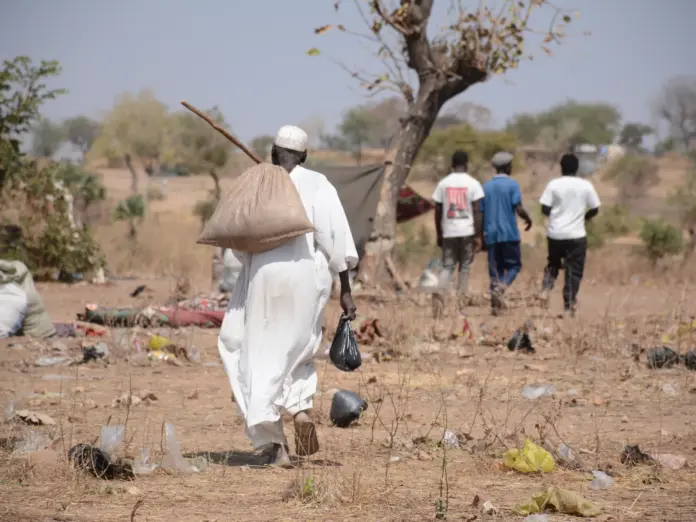
At the centre of the destruction lies the Gezira Scheme, one of the world’s largest irrigation projects. Spanning 924,000 hectares — roughly 2.28 million acres — between the Blue and White Nile Rivers and threaded by more than 8,000 kilometres of canals, the scheme historically supplied half of Sudan’s wheat. Today, it stands as a symbol of the war’s devastating reach into civilian life.
Recommended Reading
When RSF fighters captured Wad Madani, the capital of Gezira state, in December 2023, the consequences were immediate and severe. In the town of Abu Quta in northern Gezira, fighters looted markets, the local police station, and the agricultural bank. The national seed bank was ransacked by armed groups. The al-Haiwawa canal, which served 2,360 farmers across 48 villages, was severely damaged, severing the agricultural lifeline for entire communities.
The economic shock to farming has been staggering. Wheat production in Gezira collapsed by 58 percent during the 2023-2024 growing season. The cost of a 50-kilogram bag of fertiliser surged from 20,000 Sudanese pounds — approximately $33 — to 120,000 pounds, or roughly $200. Tractor rental prices tripled. For smallholder farmers already operating on thin margins, the arithmetic of survival became impossible.
World Food Programme warehouses in Wad Madani, which had held enough food to sustain 1.5 million people for a month, were systematically drained. An RSF-imposed telecommunications blackout in early 2024 paralysed financial transfers across the region, forcing 200 of 300 local soup kitchens to shut down — eliminating a critical safety net for the most vulnerable residents at the worst possible moment.
Satellite imagery analysis using the Normalised Difference Vegetation Index (NDVI), drawn from Sentinel-2 and Planet Labs high-resolution imagery, has documented the scale of agricultural abandonment across the affected states. The data paints a picture of fields left unplanted across vast stretches of what was once Sudan’s most fertile terrain.
The destruction extends beyond agriculture. Sudan’s Minister of Industry Mahasin Ali Yagoub confirmed that 126 large industrial facilities and 3,131 small factories in Gezira state alone were severely damaged during the fighting. In Khartoum’s industrial zones, located approximately 150 kilometres north of Gezira, nearly 3,200 facilities were destroyed.
Sudan Gezira Scheme: The Broader African Context
The broader schemes of Rahad, covering 126,000 hectares across Sennar and Gedaref states, and Suki, spanning 37,800 hectares, have also been caught in the conflict’s destructive sweep.
The military tide has since shifted. The SAF recaptured Singa in Sennar state in November 2024, retook Wad Madani in January 2025, and by March 2025 controlled most of both Sennar and Gezira states. In May 2025, the SAF declared full control of Khartoum. Yet military victory has not translated swiftly into food security. An Integrated Food Security Phase Classification (IPC) report found that 755,000 people remained in catastrophic famine conditions even as the front lines shifted.
There are tentative signs of partial recovery. By late 2025, an estimated 3.4 million people had moved out of crisis-level food insecurity — a meaningful improvement, though one that underscores how far conditions had deteriorated from any pre-war baseline.
The road back for Sudan’s agricultural sector will be long. Canals require reconstruction. Seeds must be sourced and distributed. Farmers who fled their land must be persuaded to return. The infrastructure of an entire food system — built over decades — has been dismantled in two years of war, and rebuilding it will demand sustained investment and security that remains elusive across much of the country.