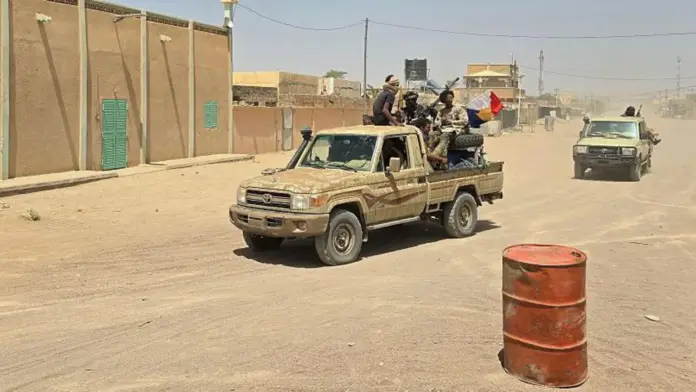
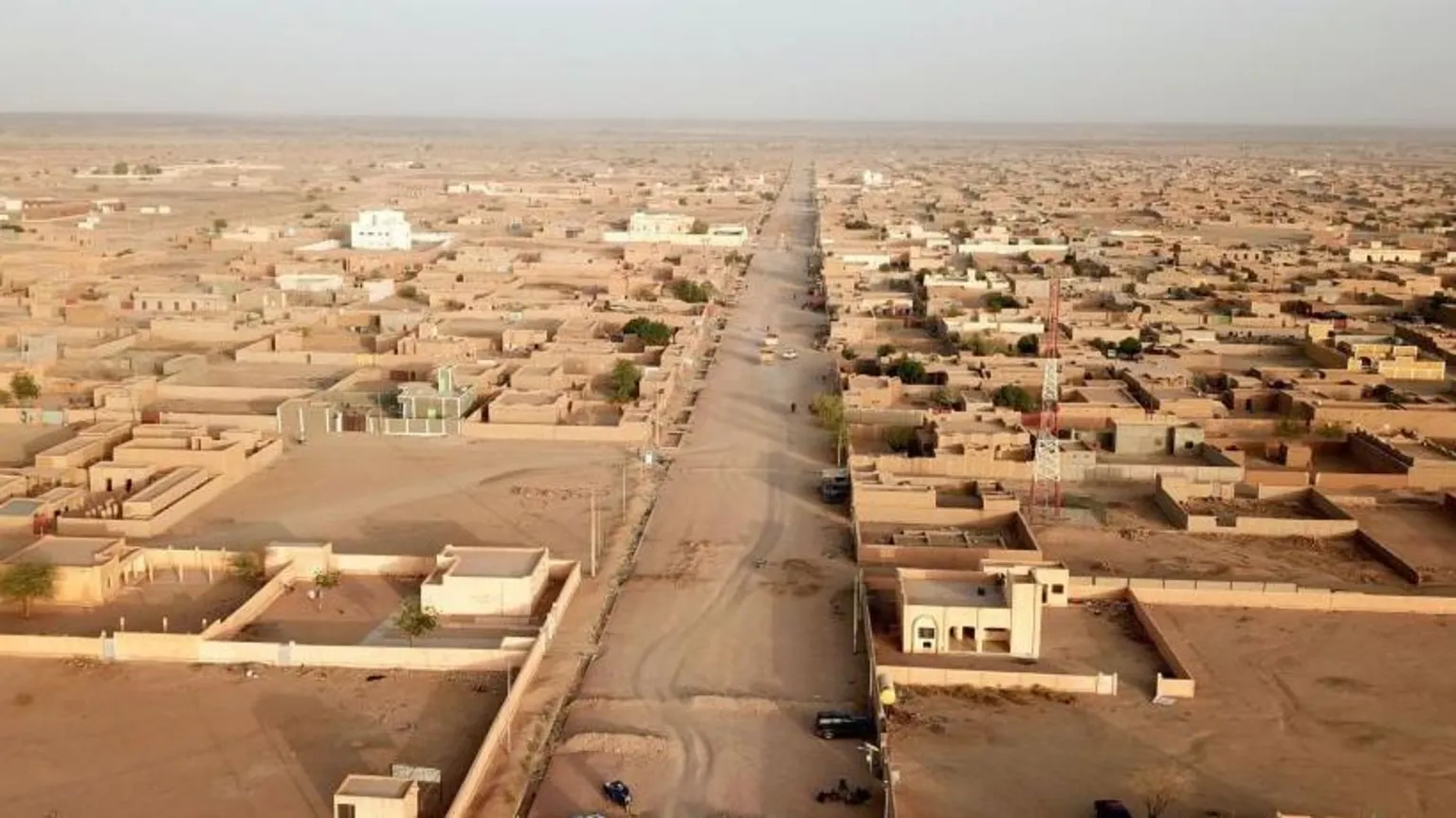
BAMAKO — Russian Africa Corps forces and Malian troops have pulled out of the northern city of Kidal following a devastating weekend of coordinated attacks that killed the country’s defence minister, shook the capital, and handed separatist fighters a symbolic victory in Mali’s long-running conflict.
The Azawad Liberation Front (FLA) claimed control of Kidal on Sunday after sustained fighting forced a Russian and Malian military withdrawal. The Africa Corps confirmed the retreat via social media, stating that wounded personnel and heavy equipment had been evacuated and that operations would continue elsewhere in Mali. FLA spokesman Mohamed Elmaouloud Ramadane said a negotiated agreement had been reached with the Africa Corps to allow their safe passage out of the city.
The violence began on Saturday with near-simultaneous strikes across the country. Explosions and sustained gunfire erupted in the capital Bamako, the central cities of Sevare and Mopti, and the northern hubs of Gao and Kidal. The jihadist alliance Jama’at Nusrat al-Islam wal-Muslimin (JNIM) claimed responsibility for multiple simultaneous attacks, while FLA separatist fighters pressed their assault on Kidal. A number of civilians wounded in the fighting were taken to Russian medical units for treatment.
The most shocking blow came in Kati, a garrison town near Bamako that houses one of Mali’s most important military bases. A suicide truck bombing targeted the residence of Defence Minister Sadio Camara, killing him in an attack that struck at the heart of the country’s military establishment. The loss of the defence minister in a single strike underscored the scale and ambition of the coordinated offensive.
Kidal carries enormous symbolic weight. For more than a decade, the city served as the unofficial headquarters of the Tuareg-led separatist movement before Malian forces, backed by Russian mercenaries, recaptured it in late 2023. The FLA, which seeks an independent state for the predominantly Tuareg ethnic communities of northern Mali, had vowed to retake it. Sunday’s events suggest that ambition has now been realised, at least temporarily.
The Africa Corps — the successor organisation to the notorious Wagner Group — has been central to Mali’s counterinsurgency strategy since the country’s military junta expelled French forces and pivoted toward Moscow. Most Africa Corps fighters are veterans of Wagner’s African operations. Following the death of Wagner founder Yevgeni Prigozhin in 2023, the Russian defence ministry absorbed the group’s operations, creating the Africa Corps under the oversight of Deputy Defence Minister Yunus-Bek Yevkurov. Day-to-day operations are run by Maj-Gen Andrey Averyanov, a figure from Russia’s GRU military intelligence directorate.

Russia’s engagement in Mali, as elsewhere across Africa, has been structured around a transactional model: security assistance in exchange for access to natural resources, including gold, diamonds and uranium. Africa Corps fighters deployed in Mali are reportedly paid a minimum of $3,000 per month. The arrangement has drawn sharp international criticism, with the corps accused of committing widespread atrocities against civilian populations.
Despite the Kidal withdrawal, the Africa Corps signalled it has no intention of abandoning its broader Mali mission. The statement announcing the retreat was explicit that forces would redeploy and continue operations in other parts of the country — a message aimed as much at the Malian junta as at the separatist and jihadist forces now emboldened by the weekend’s events.
The coordinated nature of Saturday’s attacks — spanning hundreds of kilometres from the capital to the far north, and involving both the FLA and JNIM — points to a level of operational sophistication and, potentially, tactical coordination between two groups that have not always shared objectives. Analysts have long warned that the junta’s reliance on Russian firepower, while effective in conventional engagements, has done little to address the underlying political grievances driving the insurgency.
Mali has been governed by a military junta since a 2021 coup. The country remains one of the world’s most volatile conflict zones, with overlapping insurgencies, ethnic tensions and a humanitarian crisis affecting millions of people across the Sahel region.