An internal US Department of Defense email has laid bare the depth of Washington’s frustration with key NATO allies, outlining potential punitive measures against Spain and the United Kingdom that range from suspension from the alliance to a dramatic reversal of longstanding American policy on the Falkland Islands.
The document, which characterised European attitudes as reflecting ‘a sense of entitlement,’ considered suspending Spain from NATO — a move the email itself acknowledged would carry symbolic weight but little operational consequence for the US military. For the UK, the proposed lever was more historically charged: a re-evaluation of Washington’s position on the Falkland Islands, the South Atlantic archipelago over which Britain and Argentina fought a brief but bloody war in 1982, a conflict that claimed approximately 255 British and 650 Argentine lives.
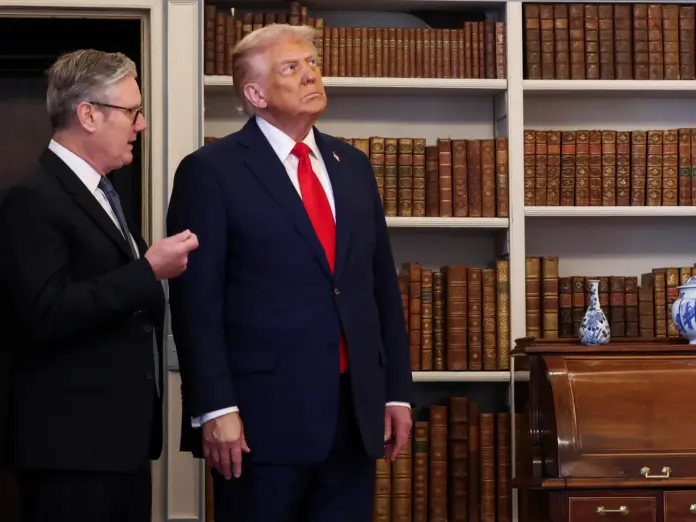
A spokesperson for British Prime Minister Keir Starmer moved swiftly to dismiss any ambiguity, stating that the UK’s position on the islands is ‘unchanged’ and that sovereignty remains firmly with Britain. Starmer himself has already faced pointed criticism from President Donald Trump, who called him ‘no Winston Churchill’ and dismissed the Royal Navy’s aircraft carriers as ‘toys.’
The tensions are rooted in the ongoing US military campaign against Iran and the broader crisis gripping the Strait of Hormuz, which has been largely closed to global shipping for two months. Trump has urged NATO members to deploy their navies to help force the waterway open, calling alliance members ‘cowards’ for failing to act and describing NATO itself as ‘a paper tiger’ without American leadership.
Spain has refused to permit the United States to conduct strikes on Iran from Spanish airspace or military bases, a decision that drew a sharp personal rebuke from Trump, who called the country ‘terrible’ and threatened to terminate all trade with Madrid. The UK’s position was more nuanced: Starmer initially withheld authorisation for US aircraft to launch attacks on Iran from two British bases before later permitting their use for what he described as ‘defensive purposes.’
Speaking at a news conference on Friday, Defence Secretary Pete Hegseth delivered an unambiguous message to European capitals. ‘The time for free-riding is over,’ he said, adding that being an ally is ‘a two-way street.’ Hegseth also argued that Europe has far greater economic exposure to the Strait of Hormuz than the United States does, framing European reluctance as both strategically incoherent and politically untenable.
European leaders pushed back with varying degrees of firmness. Spanish Prime Minister Pedro Sanchez insisted that Madrid is a ‘reliable member’ of NATO that meets all its obligations. Italian Prime Minister Giorgia Meloni, whose government has generally maintained warmer ties with the Trump administration than most European counterparts, nonetheless stated that NATO ‘must remain united.’ A German government spokesperson was direct: Spain’s membership in the alliance was not in question.
One US official sought to limit the diplomatic fallout by clarifying that the Pentagon email does not present a full US withdrawal from NATO as an option under consideration — a distinction that may offer limited reassurance to allies already rattled by the document’s tone and content.
The episode underscores a fundamental tension that has defined transatlantic relations since Trump’s return to power: an American administration that views collective defence obligations as transactional, and European governments that continue to insist on the primacy of institutional solidarity even as they struggle to meet Washington’s escalating demands. With the Strait of Hormuz crisis showing no sign of resolution and US military operations against Iran ongoing, the pressure on alliance cohesion is unlikely to ease in the near term.
The Falklands dimension carries particular resonance. Any shift in the longstanding US position of neutrality — or tacit support for British sovereignty — would represent a seismic departure from decades of policy and would almost certainly embolden Argentina, which has never relinquished its territorial claim to the islands it calls the Malvinas. That such a reversal is even being discussed internally at the Pentagon signals how far the Trump administration is willing to push its leverage over a country it considers insufficiently cooperative.