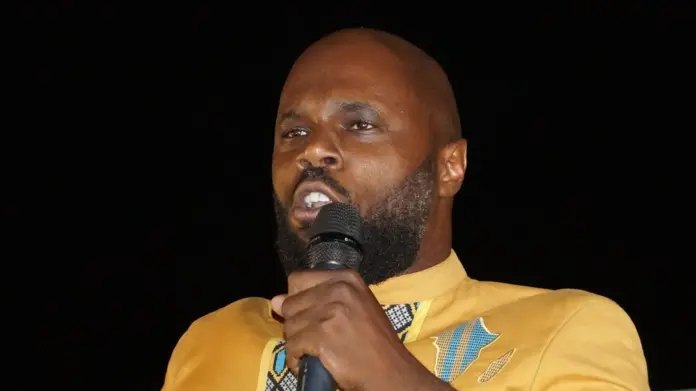
PRETORIA — Kemi Seba, the French-born Pan-Africanist activist whose firebrand politics have made him one of the most polarising figures in the Francophone world, was arrested Monday at a shopping centre in Pretoria alongside his 18-year-old son, as South African authorities moved to detain him on the strength of international warrants issued by both France and Benin.
Seba, whose legal name is Stellio Gilles Robert Capo Chichi, is 45 years old and commands an online following of 1.5 million people. He heads the NGO Pan-Africanist Emergency, an organisation that advocates African sovereignty and continental solidarity, and has long positioned himself as a leading voice against what he describes as continued French dominance over its former African colonies.
A third individual — described as a facilitator — was detained at the same time. That person had allegedly been paid approximately 250,000 South African rand, equivalent to roughly $15,000 or £11,000, to smuggle Seba and his son across the Limpopo River into Zimbabwe, allowing them to evade the international warrants hanging over them.

Seba and his son appeared before a South African court on Wednesday and were remanded in police custody. The case has been adjourned to 20 April, with extradition proceedings now formally underway.
The charges against Seba centre on his vocal support for a failed coup attempt in Benin. On 7 December, mutinying soldiers declared they had overthrown the Beninese president, a claim that proved short-lived — the attempt was suppressed within hours, with military assistance from Nigeria and France. Seba posted a video in the immediate aftermath of the announcement, declaring it "the day of liberation" for his country. Beninese authorities subsequently issued an international arrest warrant charging him with inciting rebellion.
Benin, a former French colony on West Africa’s Atlantic coast, is among the states where Seba’s rhetoric has found a receptive audience, even as its government has remained more closely aligned with Paris than its neighbours. The failed putsch and Seba’s enthusiastic endorsement of it placed him squarely in the crosshairs of Cotonou’s justice system.
France, meanwhile, has its own longstanding grievances with Seba. He has been convicted multiple times in French courts for inciting racial hatred. In 2024, French authorities stripped him of his citizenship — a move Seba met with a characteristically theatrical response, burning his French passport in a public ceremony. Shortly afterward, he was granted a diplomatic passport by Niger‘s military government, which designated him a special adviser to junta leader Abdourahamane Tchiani.
That appointment reflects a broader geopolitical shift reshaping West Africa. The military governments of Niger, Mali, and Burkina Faso have each severed or severely curtailed military cooperation with France in recent years, pivoting instead toward Russia for security partnerships. Seba has been an ideological champion of this realignment, framing it as a long-overdue assertion of African self-determination against neo-colonial interference.
His arrest in South Africa — a country that has itself navigated a careful path between Western alliances and partnerships with Russia and China — adds a new dimension to an already complex diplomatic picture. Extradition proceedings will require South African courts to weigh the validity of the warrants and the legal frameworks governing Seba’s transfer to either Benin or France, a process that legal observers expect to be contested vigorously.
For Seba’s supporters, the arrest is likely to be cast as political persecution by the very French-aligned establishment he has spent his career opposing. For Beninese and French authorities, it represents the culmination of an international manhunt for a man they accuse of actively working to destabilise a sovereign government.
The next court date on 20 April will determine the immediate trajectory of the case, though a final resolution — given the competing jurisdictional claims and the political sensitivities involved — may take considerably longer to reach.