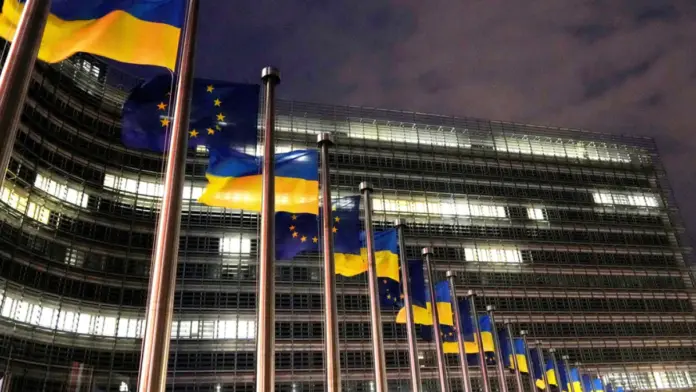
The political landscape in Europe shifted dramatically as Viktor Orban was voted out of office as Hungarian Prime Minister, removing the bloc’s most persistent internal obstacle to a sweeping package of measures that include a 90-billion-euro loan to Ukraine, equivalent to approximately $106 billion, and long-delayed sanctions against Israeli settlers in the occupied West Bank.
Orban’s government had spent months wielding Hungary’s veto power to block EU initiatives on both fronts. His departure clears the way for Brussels to act on commitments that senior officials say have been held hostage to Budapest’s political feuds. EU Commissioner for Enlargement Marta Kos said plainly that the EU would deliver the Ukraine loan following the Hungarian election result.
Peter Magyar, Hungary’s incoming leader, wasted little time in signalling a break from his predecessor’s confrontational posture. Magyar declared he is ready to work constructively with the European Union — a stark contrast to Orban’s years of brinkmanship with Brussels. On Monday, Magyar also called for the reopening of the Druzhba pipeline, which had become a central flashpoint in the standoff between Budapest and Kyiv.
Orban had used the 90-billion-euro loan as leverage in a feud with Ukraine over the suspension of Russian oil supplies through the Druzhba pipeline. Ukraine maintained the pipeline was shut as a direct result of a Russian attack. Ukrainian President Volodymyr Zelenskyy said the pipeline would be restored to operation by the end of April, a timeline that, if met, would remove one of the last pretexts for delay on the loan.
EU foreign policy chief Kaja Kallas said it was "high time" to unblock the loan and simultaneously advance a new sanctions package against Russia. Cyprus, which holds the EU’s rotating presidency, confirmed that an EU meeting scheduled for Wednesday would take up the Ukraine loan as a priority agenda item. A separate gathering of EU diplomats on the same day was set to seek consensus on a necessary amendment to the bloc’s budget.
The Israeli dimension of Orban’s obstruction is equally significant. For months, Budapest had vetoed EU sanctions targeting hardline settlers in the West Bank. Kallas confirmed on Monday that a single member state had blocked those measures — a reference widely understood to mean Hungary. With Orban gone, the path toward those sanctions has opened considerably.
Broader EU policy toward Israel is also under active review. Spain’s Prime Minister Pedro Sanchez has pushed for a full suspension of the EU’s cooperation agreement with Israel, though such a move requires unanimity among all 27 member states. A less sweeping option — dropping an isolated portion of the deal that facilitates closer trade ties — would require only a weighted majority of EU countries, making it a more viable near-term step. A meeting of EU foreign ministers was scheduled for Tuesday in Luxembourg to address these questions.
Italy has already moved in a tougher direction, suspending a bilateral defence agreement with Israel — a signal that momentum within the bloc is shifting. The combination of Orban’s exit and Italy’s unilateral action may accelerate consensus around at least partial measures against Israel.
The week’s diplomatic calendar is dense. With the Ukraine loan, Russian sanctions, and Israel policy all simultaneously in motion, EU officials are framing the moment as an opportunity to break a prolonged institutional gridlock. The bloc has long struggled to project unified foreign policy, and Orban’s repeated vetoes had become a symbol of that fragmentation.
Magyar’s early statements suggest Hungary under new leadership may not simply fall into line on every EU position, but his willingness to engage constructively represents a fundamental change in tone. Whether that translates into concrete votes at the Council level will determine how quickly Brussels can move on the accumulated backlog of blocked decisions.
For Ukraine, the stakes are immediate. A 90-billion-euro injection would provide critical financial support as the war with Russia continues. Zelenskyy’s government has been pressing for the funds for months, and the combination of Orban’s defeat and Magyar’s conciliatory signals offers the clearest opening yet for the loan to proceed.