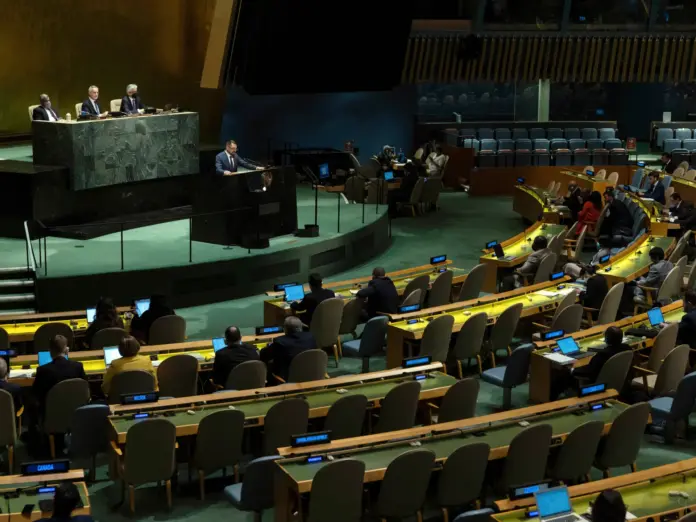
The Treaty on the Non-Proliferation of Nuclear Weapons (NPT) review conference has convened in New York at one of the most volatile moments in the treaty’s 55-year history, with the global non-proliferation framework facing simultaneous crises that threaten to render its foundational bargain obsolete.
The timing could scarcely be more dramatic. On February 27, Omani Foreign Minister Badr Albusaidi announced that Iran had agreed to conditions described as ‘zero accumulation’, ‘zero stockpiling’ and full verification of its existing nuclear stockpile by the International Atomic Energy Agency (IAEA). Within hours of that announcement, US and Israeli military strikes against Iran commenced, shattering what had appeared to be a diplomatic breakthrough and plunging the conference into an atmosphere of deep uncertainty.
The NPT, which was opened for signature in 1968 with Ireland as its first signatory and entered into force in 1970, now counts 191 member states. Its central bargain has always been straightforward in principle: states without nuclear weapons pledge not to acquire them, while the five formally recognised nuclear-weapon states — the United States, Russia, China, the United Kingdom and France, all permanent members of the UN Security Council — commit to eventual disarmament. The IAEA serves as the treaty’s verification backbone. In practice, that bargain has grown increasingly strained.
Iran’s nuclear trajectory illustrates the challenge acutely. Tehran joined the NPT in 1974, but in 2002 a dissident group exposed undeclared uranium-enrichment facilities at the Natanz Nuclear Facility and a heavy-water reactor in Arak, triggering years of international confrontation. The 2015 Joint Comprehensive Plan of Action (JCPOA), negotiated between Iran and the five permanent Security Council members plus Germany, appeared to offer a durable solution. Under its terms, Iran slashed its enriched uranium stockpile by 98 percent to 300 kilograms, capped enrichment at 3.67 percent purity and reduced its centrifuge capacity by two-thirds.
That architecture collapsed in May 2018, when President Donald Trump withdrew the United States from the agreement, calling it ‘defective at its core’. The consequences have been severe. By early 2025, Iran was enriching uranium to 60 percent purity — far beyond the JCPOA ceiling and approaching the roughly 90 percent threshold considered weapons-grade. The Omani-brokered announcement on February 27 had raised hopes of a return to restraint; the strikes that followed hours later have made the path forward deeply unclear.
Beyond Iran, the conference must grapple with a broader landscape of proliferation pressure. North Korea joined the NPT in 1985, was found non-compliant with its safeguards obligations, and formally withdrew in 2003, subsequently developing and testing nuclear weapons. Four UN member states — India, Pakistan, Israel and South Sudan — have never signed the treaty at all. India and Pakistan both conducted nuclear weapons tests in 1998. Israel, which has never officially acknowledged possessing nuclear weapons, is widely believed to hold at least 90 warheads, a posture that sits in uncomfortable tension with its active role in strikes against a country whose nuclear programme is the subject of the very conference now underway.
The review conference’s prospects for consensus are historically poor. The last three occasions on which member states reached substantive agreement were in 1995, 2000 and 2010. The 2000 conference represented the final significant moment of unity before the 2003 Iraq War fractured relations among major powers. Subsequent review cycles in 2005 and 2015 ended without agreed final documents, and the 2022 conference — delayed by the COVID-19 pandemic — similarly failed to produce consensus, largely over language related to Russia’s war in Ukraine and nuclear facilities on Ukrainian territory.
A parallel challenge comes from the Treaty on the Prohibition of Nuclear Weapons, adopted in 2017, which goes further than the NPT by calling for the complete elimination of nuclear arsenals. None of the five recognised nuclear-weapon states has signed it, and they have actively discouraged allies from doing so, arguing it undermines the NPT framework. Critics counter that the nuclear-weapon states’ failure to make meaningful progress on disarmament — the third pillar of the NPT alongside non-proliferation and peaceful use of nuclear energy — has itself eroded the treaty’s legitimacy.
As delegates gather in New York, the conference faces a fundamental question: whether a treaty designed in the Cold War era, premised on a stable hierarchy of nuclear haves and have-nots, retains the credibility and enforcement mechanisms to manage a world in which that hierarchy is being challenged from multiple directions simultaneously. The events of February 27 have ensured that question will be answered against a backdrop of active conflict rather than cautious diplomacy.