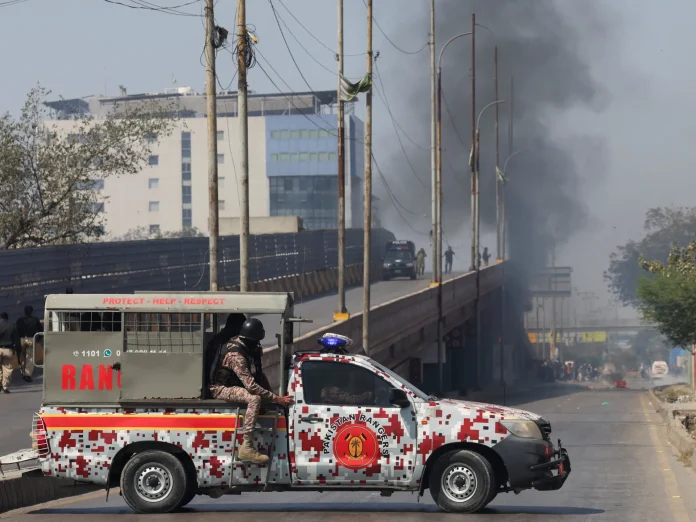
KARACHI, Pakistan — At least nine people were killed and twenty others wounded Sunday when security forces opened fire on hundreds of pro-Iranian demonstrators who stormed the United States consulate in Karachi, triggering a wave of violent protests across Pakistan and beyond in the wake of the assassination of Iranian Supreme Leader Ayatollah Ali Khamenei.
The deaths, confirmed by police surgeon Dr Summaiya Syed, came after protesters breached the perimeter of the consulate on Mai Kolachi Road in the early hours of Sunday morning. Demonstrators scaled the main gate, flooded into the driveway of the consular building, smashed windows, and attempted to set the compound ablaze. The American flag continued to fly over the barbed-wire-topped perimeter as security forces deployed tear gas before ultimately opening fire to repel the crowd.
Muhammad Amin, spokesman for the Edhi Foundation rescue service, confirmed that the majority of casualties sustained bullet wounds. Eight bodies were transported to Karachi’s civil hospitals, with a ninth death subsequently confirmed. Twenty people were treated for injuries sustained during the confrontation.
The violence was ignited by the killing of Khamenei, which Pakistani protesters and governments across the Muslim world attributed to a joint strike carried out by the United States and Israel. The assassination sent shockwaves through Shia communities in particular, fuelling fury directed at American diplomatic installations across the region.
In Lahore, thousands flooded the streets in a demonstration that dwarfed the Karachi consulate protest in size, though not in bloodshed. Hundreds gathered directly outside the US consulate there, with witness Aqeel Raza describing how some in the crowd attempted to damage a security gate located hundreds of yards from the consulate building itself. Police managed to contain the situation without resorting to force. Further demonstrations were anticipated Sunday afternoon near the diplomatic enclave in Islamabad that houses the US embassy.
In Skardu, a city in the Shia-majority Gilgit Baltistan region of northern Pakistan, thousands also took to the streets. Protesters there set fire to a United Nations office building. Local government spokesperson Shabbir Mir confirmed the arson but reported no casualties from the incident.
The unrest was not confined to Pakistan. In Baghdad, hundreds of pro-Iranian demonstrators converged on the fortified Green Zone, where the US embassy is located, attempting to breach its perimeter. Iraq officially declared three days of national mourning for Khamenei — a reflection of the deep political and financial influence Iran-backed armed groups have accumulated within the country. Protests also erupted in Morocco and in Indian-administered Kashmir.
The scale and coordination of the demonstrations underscored the profound regional influence Khamenei wielded during his decades as Iran’s supreme leader, and the degree to which his death has destabilised an already volatile geopolitical landscape. Iran’s network of allied movements and political factions — stretching from Baghdad to Beirut and beyond — has long served as a force multiplier for Tehran’s regional ambitions, and the anger now coursing through those networks is manifesting in street-level fury directed squarely at Washington and its allies.
The Karachi consulate attack represents one of the most serious breaches of a US diplomatic facility in recent memory. Images circulating widely on social media showed young men smashing the consulate’s windows while others surged through the compound’s entrance. The consulate’s barbed-wire perimeter and security infrastructure proved insufficient against the scale of the assault before live fire was used to disperse the crowd.
Pakistani authorities have not yet issued a formal statement detailing the security response or announcing any arrests. The full diplomatic fallout between Islamabad and Washington over the deaths of Pakistani nationals outside a US government facility remains to be seen, as governments across the region brace for further unrest in the coming days.