Nigeria has filed treason charges against six individuals accused of conspiring to overthrow President Bola Tinubu, with the case landing before the Federal High Court in Abuja in what prosecutors describe as a coordinated plot to destabilise the state and overawe the country’s elected leadership.
The charges — encompassing treason, terrorism, and money laundering — were filed by the Attorney General and brought before Justice Joyce Abdulmalik, before whom the defendants were scheduled to appear on Wednesday. A seventh suspect named in the charge sheet, Timipre Sylva — a former state governor and one-time federal oil minister — had not yet been apprehended, according to court documents.
The six defendants represent a striking cross-section of Nigerian society. Mohammed Ibrahim Gana, a retired major general, and Erasmus Ochegobia Victor, a retired navy captain, anchor the military dimension of the alleged conspiracy. They are joined by Ahmed Ibrahim, a serving police inspector; Zekeri Umoru, an electrician employed at the Presidential Villa; Bukar Kashim Goni, identified as a civilian; and Abdulkadir Sani, an Islamic cleric.
Prosecutors allege that the defendants conspired to levy war against the Nigerian state with the explicit aim of removing the president from power. Central to the case is Col Mohammed Alhassan Ma’aji, identified as the ringleader of the plot, who was arrested along with a number of accomplices. The charge sheet contends that all six defendants possessed prior knowledge of Col Ma’aji’s treasonable activities yet deliberately withheld that intelligence from the authorities — an act prosecutors characterise as suppression of intelligence and evidence of intent to destabilise the state.
The money-laundering allegations add a significant financial dimension to the case. Prosecutors assert that funds changed hands in connection with the financing of terrorism, suggesting the plot was not merely opportunistic but systematically resourced. Under Nigerian law, a conviction for treason carries severe penalties, up to and including life imprisonment.
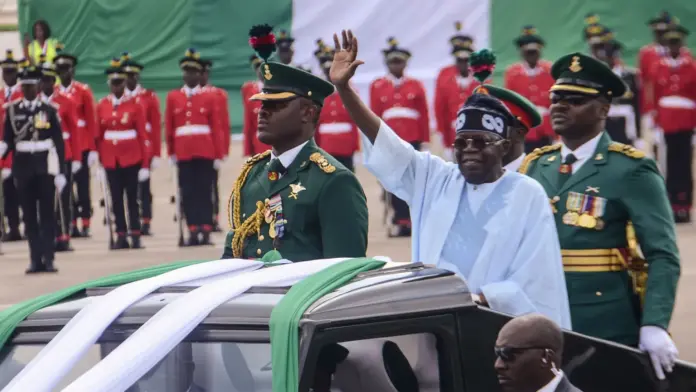
The first public indication that something was seriously amiss emerged in October 2025, when the government abruptly cancelled a planned military parade marking Nigeria’s 65th Independence Anniversary. Officials cited unspecified security threats as the justification, a decision that immediately fuelled speculation about the stability of the administration. The cancellation of such a high-profile national event was widely interpreted as an extraordinary precautionary measure.
The civilian court proceedings follow a parallel military justice process. In January, the armed forces announced that 16 officers would face trial before a military tribunal on charges related to the same alleged attempt to unseat the president. The dual-track legal approach — military courts handling serving personnel while the Federal High Court addresses civilians and retired officers — underscores the breadth of the alleged conspiracy and the government’s determination to prosecute it comprehensively.
Nigeria’s military has issued public statements reaffirming its loyalty to civilian authority throughout the affair, a posture consistent with the institution’s conduct since the country transitioned to unbroken civilian rule in 1999. That democratic continuity, now stretching more than a quarter of a century, represents a hard-won achievement for Africa’s most populous nation, which endured a succession of military coups and counter-coups in the decades following independence.
The presence of an electrician from the Presidential Villa among the accused raises pointed questions about internal security protocols at the heart of government. His alleged involvement suggests that those seeking to exploit vulnerabilities within the administration may have cultivated access at multiple levels, from senior retired officers to support staff with physical proximity to the presidency.
The case is expected to draw sustained attention both domestically and internationally, given Nigeria’s strategic weight in West Africa and its role as a benchmark for democratic governance on the continent. A successful prosecution could reinforce institutional confidence in civilian oversight of the military; a protracted or inconclusive process risks the opposite. The continued absence of Timipre Sylva — a figure with deep connections across Nigeria’s political and energy sectors — will remain a conspicuous gap in the proceedings until he is brought before the court.