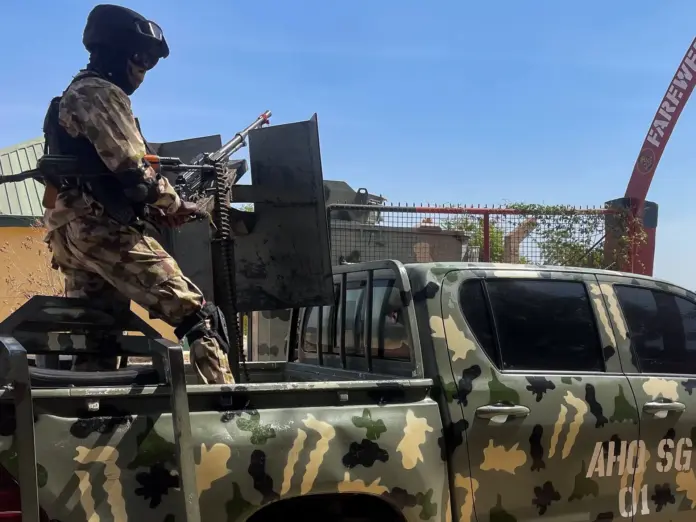
METELE, NIGERIA — A joint Nigerian-American military operation has eliminated Abu-Bilal al-Minuki, the second-in-command of the Islamic State (ISIL), in a pre-dawn strike on his compound in Metele, a town in Borno state in northeast Nigeria. The operation, which unfolded between midnight and 4am local time (23:00 to 03:00 GMT), also killed several of al-Minuki’s senior lieutenants.
Iswap Second-In-Command Killed — Nigerian President Bola Tinubu confirmed the militant’s death on Saturday, a day after Donald Trump announced the killing via social media. The Nigerian army characterised the mission as a "meticulously planned and highly complex precision air-land operation," underscoring the level of coordination involved between the two countries’ forces.
Al-Minuki, also known as Abu-Mainok, had been under US sanctions since 2023 and was regarded as one of the most dangerous figures in the global jihadist network. Beyond his leadership role within ISIL, he oversaw the organisation’s operations across the Sahel and West Africa, providing strategic guidance to affiliated entities on media operations, economic warfare, and weapons manufacturing.
Recommended Reading
His trajectory through the region’s militant landscape spanned more than a decade. Originally a prominent figure within Boko Haram, al-Minuki pledged allegiance to ISIL in 2015, helping to establish what became known as the Islamic State West Africa Province (ISWAP). He rose further through the ranks following the disappearance of veteran commander Mamman Nur in 2018 — the same year al-Minuki was linked to the kidnapping of more than 100 schoolgirls in Dapchi, Yobe state, an abduction that drew international condemnation.
His death comes despite a previous declaration by Nigerian authorities that he had been killed during a military operation in Kaduna state in 2024 — a claim that proved premature. This time, both governments have confirmed the strike’s outcome with apparent confidence.
The operation reflects deepening military cooperation between Washington and Abuja. Dozens of US troops have been deployed to Nigeria in recent months, providing intelligence sharing and technical support as Nigerian forces battle a persistent insurgency. That partnership has not been without diplomatic friction: Trump has publicly accused Nigeria of failing to adequately protect Christians in the country’s north from attacks by armed groups. The Nigerian government firmly rejected that characterisation, noting that Muslims are equally targeted by the violence.
Borno state has long been the epicentre of the insurgency that has destabilised northeast Nigeria and spilled across borders into Cameroon, Niger, and Chad. ISWAP has recently intensified attacks along the Nigeria-Cameroon border, striking military outposts and humanitarian convoys with increasing frequency. The broader security environment remains dire: a ransom economy in Nigeria generated an estimated $1.66 million between July 2024 and June 2025, according to intelligence firm SBM Intelligence, reflecting the scale of kidnapping operations that armed groups continue to exploit.
Iswap Second-In-Command Killed: What This Means for the Sahel
The Lake Chad Basin — where al-Minuki’s compound was located — has served for years as a strategic sanctuary for ISWAP fighters, offering porous borders and difficult terrain that complicate counterterrorism efforts. The group’s ability to sustain cross-border operations and maintain ideological links to ISIL’s global network made al-Minuki a high-priority target for both Nigerian and American intelligence services.
Whether his elimination will meaningfully degrade ISWAP’s operational capacity remains to be seen. The group has demonstrated resilience in the past, absorbing the loss of senior commanders and reconstituting its leadership. Nevertheless, the removal of a figure who provided centralised guidance on financing, propaganda, and weapons production represents a significant disruption to the network’s strategic functions across the region.