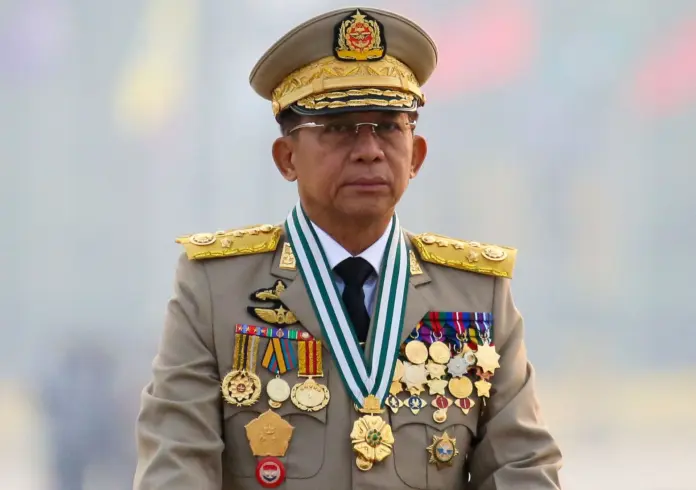
NAYPYIDAW — Senior General Min Aung Hlaing, the 69-year-old military commander who seized power in a 2021 coup, was formally elected president of Myanmar on Friday after winning 429 of 584 votes cast across the combined upper and lower houses of parliament in Naypyidaw. Parliament speaker Aung Lin Dwe announced the result, completing a political transition that critics say entrenches military dominance behind a civilian facade.
The vote was a three-person contest, and the two runners-up were appointed vice presidents. Min Aung Hlaing had been nominated as a presidential candidate earlier in the week, setting in motion a swift consolidation of authority that has unfolded over just days.
To assume the presidency, Min Aung Hlaing relinquished the post of commander-in-chief, a step required under Myanmar’s constitution, which bars the president from simultaneously holding the top military position. His successor at the helm of the armed forces is Ye Win Oo, a former intelligence chief described as fiercely loyal to the outgoing general. The handover, which took effect on Monday, was accompanied by a broader reshuffle of military leadership.
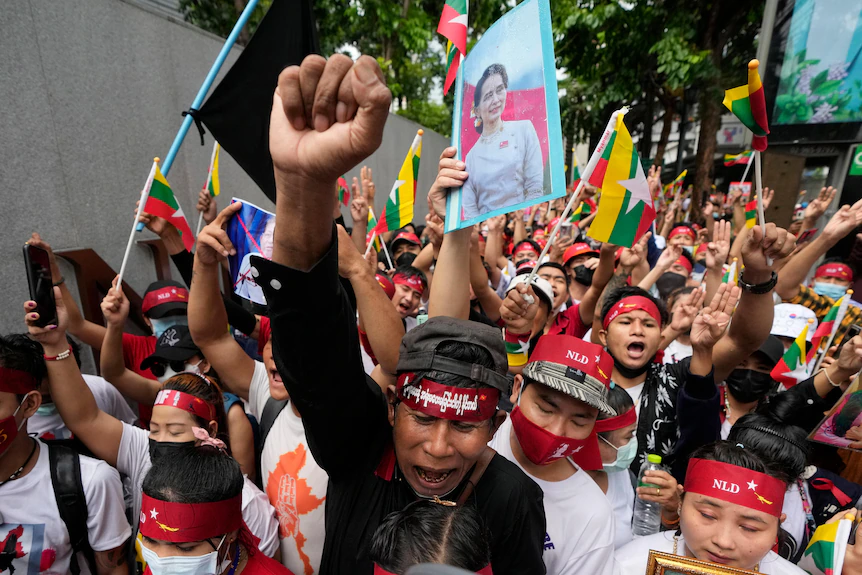
Min Aung Hlaing has led Myanmar’s armed forces since 2011. In February 2021, he orchestrated the overthrow of the elected government led by Nobel Peace Prize laureate Aung San Suu Kyi, placing her under arrest and later dissolving her party. That coup ignited mass protests across the country, which over the following years evolved into a full-scale armed resistance movement. A civil war has ravaged Myanmar for much of the past five years, with no resolution in sight.
The parliamentary vote that elevated Min Aung Hlaing to the presidency was the product of elections held in December and January, in which the pro-military Union Solidarity and Development Party captured more than 80 percent of contested parliamentary seats in a landslide. The military’s structural advantage was further reinforced by a constitutional provision reserving a quarter of all parliamentary seats for unelected serving members of the armed forces — a guarantee that ensures the junta retains a decisive legislative bloc regardless of electoral outcomes.
Western governments condemned the entire electoral process as a sham engineered to perpetuate military rule under a veneer of democratic legitimacy. The criticism reflects a broader international isolation that has shadowed the junta since the 2021 coup.
Against this backdrop, opposition forces moved this week to sharpen their own organisational structure. Anti-junta groups — including remnants of Aung San Suu Kyi’s disbanded party and a coalition of ethnic minority armies — announced the formation of a new combined front. The Steering Council for the Emergence of a Federal Democratic Union declared on Monday its intention to dismantle all forms of dictatorship in Myanmar, signalling an attempt to unify the fragmented resistance under a common political framework.
The timing of the council’s formation, coinciding with Min Aung Hlaing’s formal ascent to the presidency, underscores the deepening polarisation gripping the country. Analysts warn, however, that resistance groups may face intensified military pressure in the months ahead, as well as increased scrutiny from neighbouring countries wary of instability along their borders. Economic hardship, including fuel shortages and broader financial crises, could also strain the opposition’s organisational capacity.
Myanmar’s history offers little comfort to those hoping for a swift democratic restoration. The military has governed the country directly for five of the past six decades, and Friday’s parliamentary vote suggests the institution has no intention of loosening its hold. For Min Aung Hlaing, the presidency represents the culmination of a decades-long career in uniform — and, for millions of Myanmar’s citizens, a further entrenchment of the authoritarian order they have been fighting to dismantle.