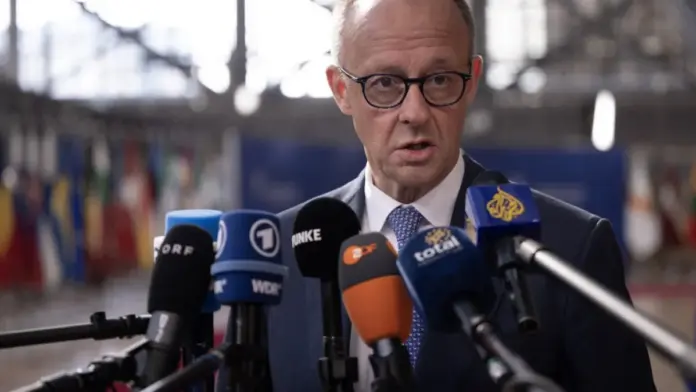
MARSBERG, Germany — German Chancellor Friedrich Merz delivered a blunt and unusually candid assessment of the United States-Iran conflict on Monday, warning that Washington is being humiliated on the world stage and has no clear strategy for ending the war.
Speaking directly to students in the western German town of Marsberg, Merz said that "an entire nation is being humiliated by the Iranian leadership," pointing specifically to the role of the Islamic Revolutionary Guard Corps. He described Iranian officials as "obviously negotiating very skilfully" and appearing "clearly stronger than one thought."
The German leader drew sharp historical parallels, invoking the United States’ 20-year military engagement in Afghanistan and its prolonged intervention in Iraq as cautionary precedents. In his view, the current conflict risks following a similarly unresolved trajectory — a costly entanglement with no defined exit.
Merz’s remarks carry particular weight given Germany’s position as one of Washington’s closest European allies. His willingness to characterise American conduct in such stark terms reflects growing unease across the continent about the direction and duration of the conflict.
Beyond the geopolitical dimensions, Merz was direct about the economic consequences for Germany itself. The war, he warned, is already having a measurable impact on German economic output — a concern that resonates deeply in a country whose export-driven industrial base is acutely sensitive to global energy prices and supply chain disruptions.
Central to those concerns is the Strait of Hormuz, the narrow waterway through which a substantial share of the world’s petroleum supplies flows. Merz confirmed that Germany remains prepared to deploy minesweepers to help secure shipping routes through the strait, though he stressed that any such deployment is conditional on a cessation of hostilities. The offer underscores Berlin’s recognition that the conflict’s economic ripple effects extend far beyond the Middle East.
Germany’s engagement with the crisis extends to the diplomatic and nuclear dimensions as well. Foreign Minister Johann Wadephul issued a separate warning that nuclear threats continue to define the broader security environment, speaking ahead of meetings at the United Nations focused on the Treaty on the Non-Proliferation of Nuclear Weapons. Wadephul stated that Germany will require a credible deterrent for as long as nuclear threats against the country and its partners persist — a position that signals a significant evolution in German strategic thinking.
Berlin simultaneously reaffirmed its commitment to nonproliferation, a stance that reflects the tension at the heart of European security policy: the need to deter nuclear-armed adversaries while upholding the international frameworks designed to prevent further proliferation. France and Germany have recently moved to deepen cooperation on nuclear deterrence, a development that would have been politically unthinkable just a few years ago.
European anxiety over the Iran conflict has been mounting on multiple fronts. Energy disruptions and economic instability are increasingly cited by policymakers across the continent as direct consequences of the fighting, with the Strait of Hormuz functioning as a chokepoint whose vulnerability affects everything from fuel prices to manufacturing costs.
Merz’s comments in Marsberg represent one of the most forthright public critiques of American strategy in the conflict to emerge from a major allied government. By invoking Afghanistan — a campaign that consumed two decades, vast resources, and ultimately ended in a chaotic withdrawal — he appeared to be signalling that Germany views the current trajectory with deep scepticism and is unwilling to simply defer to Washington’s lead.
The remarks also arrive at a moment when European capitals are recalibrating their own defence postures with greater urgency than at any point since the Cold War. The combination of the Iran conflict, ongoing instability elsewhere, and shifting perceptions of American reliability has accelerated debates about European strategic autonomy that were once largely theoretical.
Whether Merz’s public candour will prompt a response from Washington or deepen transatlantic friction remains to be seen. What is clear is that Berlin is no longer content to observe the conflict from a distance — and is prepared to say so plainly.