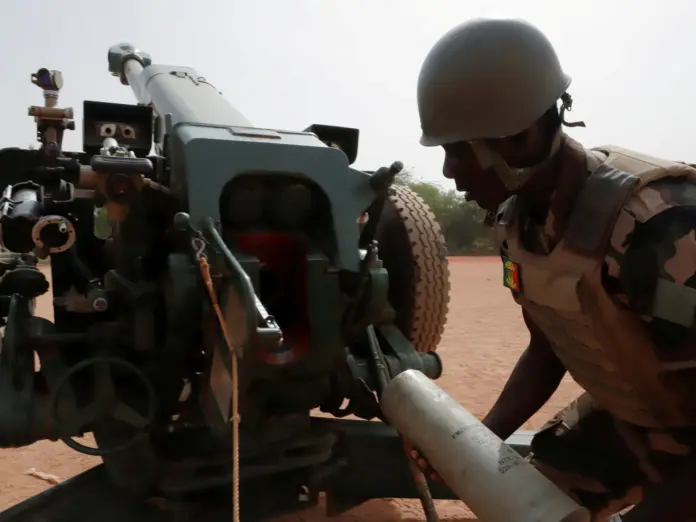
BAMAKO — Mali’s Defence Minister General Sadio Camara was killed Sunday following coordinated attacks on military installations across the country, a devastating blow to the ruling junta that has staked its legitimacy on restoring security to one of West Africa’s most volatile nations.
The assault began in the pre-dawn hours of Saturday, April 25, when two loud explosions and sustained gunfire erupted shortly before 6am GMT near Kati, a garrison town approximately 15 kilometres northwest of the capital, Bamako and home to Mali’s main military base. Camara’s residence in Kati was struck by a suicide car bomb, and his death was announced the following day. Simultaneously, gunfire rang out near a military camp close to Bamako’s international airport, where Russian mercenary forces maintain a presence.
The violence was not confined to the capital’s outskirts. Near-simultaneous unrest erupted in the central town of Sevare, and in the northern cities of Kidal and Gao — a multi-front offensive that underscored the operational reach of the groups behind it.
![Colonel Sadio Camara, Minister of Defence and Veterans of Mali, was a central figure in Mali's military government [File: Fanny Noaro-Kabr/AFP]](https://world-tension.s3.us-east-2.amazonaws.com/articles/610/a345ed8f741e47068cb87be75e53f5ae.webp)
Jama’at Nusrat al-Islam wal-Muslimin (JNIM), the Sahel’s most active armed group and al-Qaeda’s regional affiliate, claimed responsibility for attacks in Kati, at the Bamako airport, and in Mopti, Sevare, and Gao. The Azawad Liberation Front (FLA), a Tuareg separatist organisation, claimed it had seized multiple positions in Kidal and Gao in a coordinated operation with JNIM. A spokesperson for the FLA, Mohamed Elmaouloud Ramadane, said fighters had taken control of several sites in both cities, while JNIM declared Kidal ‘captured.’ Videos verified independently showed armed men entering the National Youth Camp in Kidal on Saturday.
Mali’s military said it killed ‘several hundred’ assailants and repelled the assault — a claim that could not be independently verified. International condemnation followed swiftly, with the African Union, the secretary-general of the Organisation of Islamic Cooperation, and the United States Bureau of African Affairs all denouncing the attacks.
The scale and coordination of the offensive represent a profound challenge to Assimi Goita, who seized power in a second coup in May 2021 after first taking control in August 2020. Goita came to power promising to crush the insurgencies that had humiliated previous governments. Instead, the country’s security situation has continued to deteriorate.
JNIM has been steadily tightening its grip on Mali’s economic lifelines. Since September 2025, the group’s fighters have targeted fuel tankers supplying the country. By October 2025, a JNIM-imposed blockade of major highways from Senegal and Ivory Coast brought Bamako to a standstill. As recently as March 2026, the capital faced acute diesel shortages, with remaining supplies prioritised for the energy sector.
Goita’s government expelled French forces and in December 2021 invited Russian mercenaries — then operating under the Wagner Group banner — to fill the security vacuum. Wagner formally announced its withdrawal from Mali in June 2025 after more than three and a half years of operations. However, Russian forces have remained in the country under the banner of Africa Corps, a Kremlin-backed paramilitary organisation established following the failed mutiny by Wagner chief Yevgeny Prigozhin in June 2023. Africa Corps is also active in Equatorial Guinea and the Central African Republic.
The roots of Mali’s crisis stretch back more than a decade. In 2012, ethnic Tuareg separatists allied with al-Qaeda-linked fighters launched a rebellion that swept through the country’s vast north — Mali covers twice the area of France. The chaos prompted soldiers to depose democratically elected President Amadou Toumani Toure in May 2012. Islamist fighters from Ansar Dine subsequently pushed out the Tuareg rebels and seized key northern cities, triggering a French military intervention in early 2013. Ansar Dine and allied factions later merged to form JNIM.
A fragile peace deal signed in 2015 with Tuareg groups eventually collapsed when Mali’s military government unilaterally terminated the agreement in January 2024, accusing the rebels of non-compliance. That decision appears to have accelerated the reconstitution of the Tuareg-jihadist alliance now striking at the heart of the state.
Mali’s isolation has deepened in parallel with its insecurity. The country, along with Niger and Burkina Faso, formally withdrew from the Economic Community of West African States (ECOWAS) to form the Alliance of Sahel States (AES). Mali’s Foreign Minister Abdoulaye Diop, speaking at a security forum in Senegal earlier this week, described the departure from ECOWAS as ‘final.’
The killing of the defence minister — the most senior military official in a government defined by its military character — signals that no institution within Mali’s junta is beyond the reach of its enemies. With Russian partners unable to prevent Saturday’s carnage, and diplomatic bridges to regional bodies burned, Goita’s administration faces its gravest test since taking power.