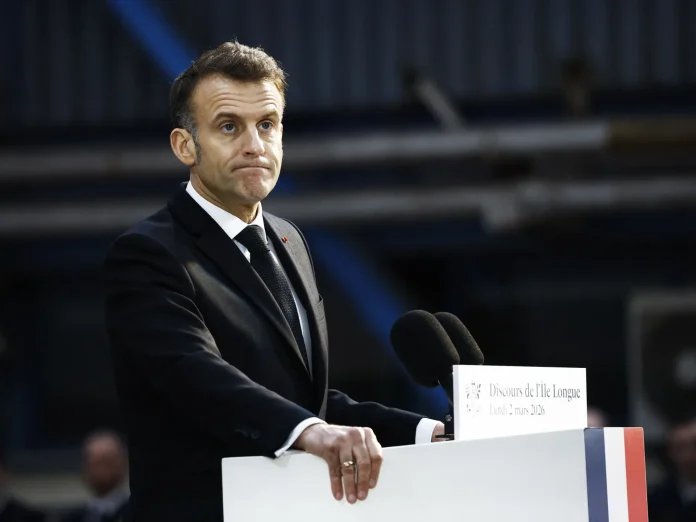
ILE LONGUE, France — French President Emmanuel Macron unveiled a sweeping transformation of France’s nuclear strategy on Monday, announcing the country will expand its warhead stockpile for the first time in more than three decades and extend its nuclear umbrella to eight European allies — a move that reshapes the continent’s security architecture at a moment of profound geopolitical uncertainty.
Speaking at the Ile Longue ballistic missile submarine base on France’s Atlantic coast, Macron confirmed that French nuclear-armed aircraft will be permitted to deploy temporarily to Germany, Britain, Poland, the Netherlands, Belgium, Greece, Sweden, and Denmark under a new framework he described as ‘forward deterrence’ — a concept deliberately positioned as distinct from existing NATO arrangements.
The announcement marks the first increase to France’s nuclear arsenal since at least 1992. The country currently holds an estimated 290 warheads, placing it fourth globally behind the United States and Russia — each of which maintains thousands — and China. Macron declined to specify the scale of the planned increase, and in a significant reversal of past transparency practices, stated that France will no longer publicly disclose figures for its nuclear stockpile.
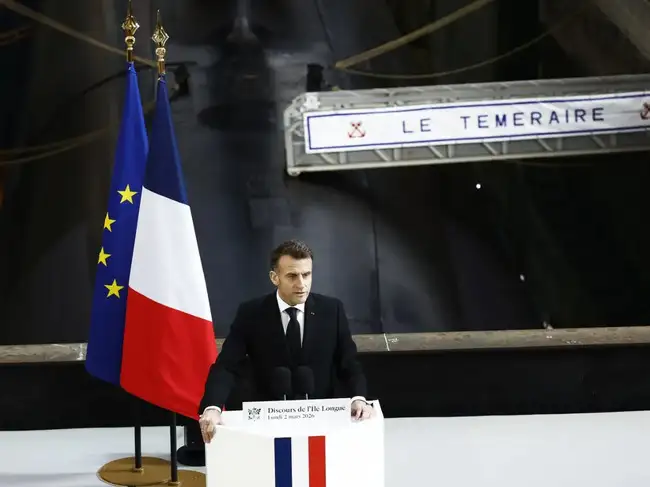
The speech arrives at a moment of acute anxiety across European capitals. Recurring tensions with U.S. President Donald Trump have eroded confidence in Washington’s commitment to defend Europe under the NATO nuclear umbrella, while Russia‘s ongoing war in Ukraine — which Macron characterised as a ‘slow and cruel’ campaign — has forced governments to reconsider long-held assumptions about continental security. Macron also pointed to a broader global arms dynamic, noting that China has embarked on a rapid military build-up and ‘manufactures more weapons than any other country,’ while India, Pakistan, and North Korea are rapidly expanding their own strategic forces.
Macron warned additionally that the widening conflict involving the United States, Israel, and Iran risks spilling over to Europe’s borders — a threat he said compounds the urgency of the new deterrence posture.
France is the sole nuclear power within the European Union, a status it has held exclusively since Britain’s departure from the bloc in 2020. Britain remains the only other European nation with an independent nuclear deterrent, and in July the two countries adopted a joint declaration allowing their nuclear forces to be coordinated while each retaining full independence. Britain is among the eight nations now invited into the forward deterrence framework.
The deepest bilateral engagement appears to be with Germany. Chancellor Friedrich Merz held initial talks with Macron on the nuclear issue earlier this month and publicly raised the possibility of German Air Force aircraft carrying French nuclear bombs — a statement that would have been unthinkable in previous decades. A joint France-Germany statement confirmed the two countries will deepen deterrence integration beginning this year, including German conventional participation in French nuclear exercises and joint visits to strategic sites.
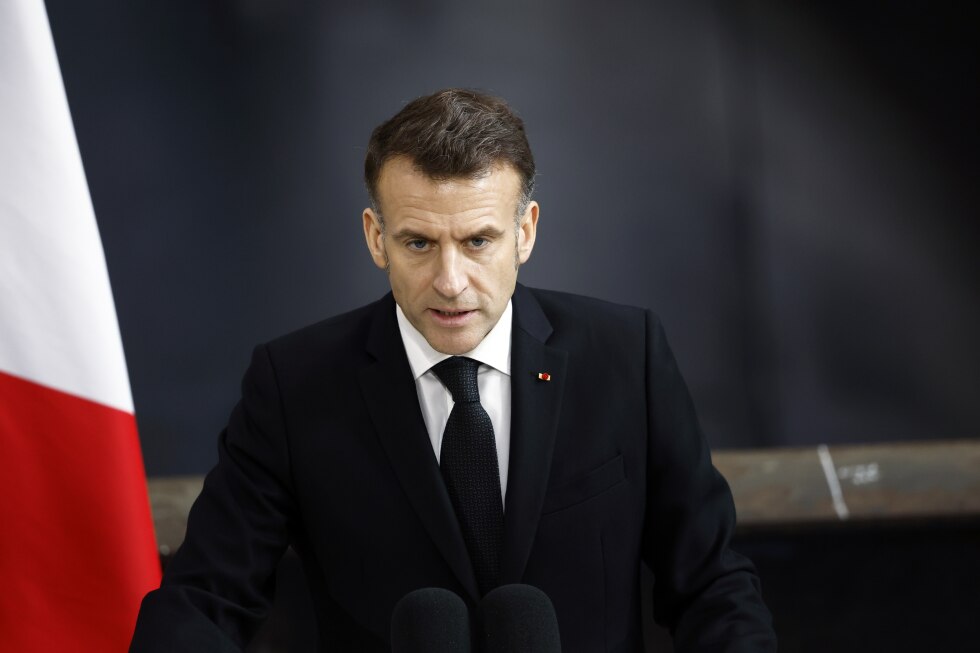
The Netherlands is also in active strategic talks with Paris. Dutch Defence Minister Dilan Yesilgöz-Zegerius and Foreign Minister Tom Berendsen confirmed their country’s engagement with the framework. Polish Prime Minister Donald Tusk signalled Warsaw’s enthusiasm, writing publicly about the need to arm up together with allies.
Under the new arrangement, partner nations will be permitted to participate in French deterrence exercises, and their non-nuclear forces will be integrated into French nuclear activities. Macron was unambiguous, however, that the architecture stops well short of shared decision-making. Any decision to deploy France’s nuclear weapons will remain solely in the hands of the French president — a red line he has consistently maintained and reiterated Monday.
The announcement had been scheduled before the latest escalation in the Middle East, underscoring that its primary drivers are the European security environment and the continent’s fraught relationship with Washington. European leaders have grown increasingly vocal about doubts over U.S. reliability, and Macron’s offer last year to open discussions on French nuclear deterrence with European partners laid the groundwork for Monday’s formal declaration.
Domestic politics add another layer of urgency. Allies and European partners have expressed concern that a potential victory by the far-right National Rally party — led by Marine Le Pen — in next year’s French presidential election could unravel the cooperative frameworks Macron is now constructing. Monday’s announcement can also be read as an attempt to embed France’s European nuclear role so firmly that any successor would find it difficult to reverse.
The initiative represents the most significant shift in European nuclear posture since the end of the Cold War, driven by a convergence of threats that European governments no longer believe they can outsource to Washington alone.