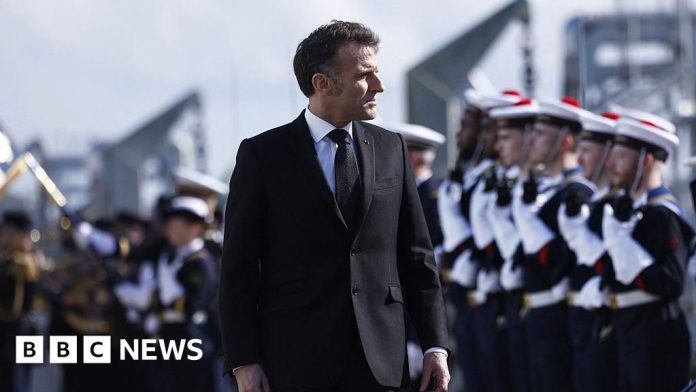
French President Emmanuel Macron announced Monday that France will expand its nuclear arsenal for the first time since at least 1992 and extend its deterrent to cover eight European allies, marking the most consequential transformation of French strategic doctrine in more than six decades.
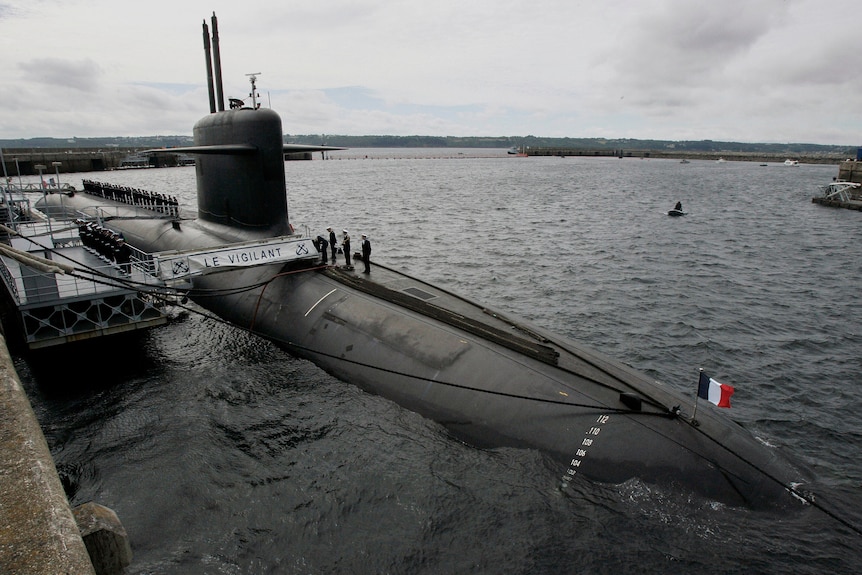
Standing before a nuclear-armed submarine at the Ile Longue base near the port of Brest in Brittany, Macron declared that the next 50 years would constitute an era of nuclear weapons and outlined a sweeping advanced deterrence strategy that fundamentally redefines France’s role as the European Union’s sole nuclear power since Britain’s departure from the bloc in 2020.
France currently holds approximately 300 nuclear warheads. Macron confirmed that number will rise, though he declined to specify a target figure. He also announced that France will cease publicly disclosing the size of its nuclear stockpile going forward — a deliberate shift toward strategic ambiguity.
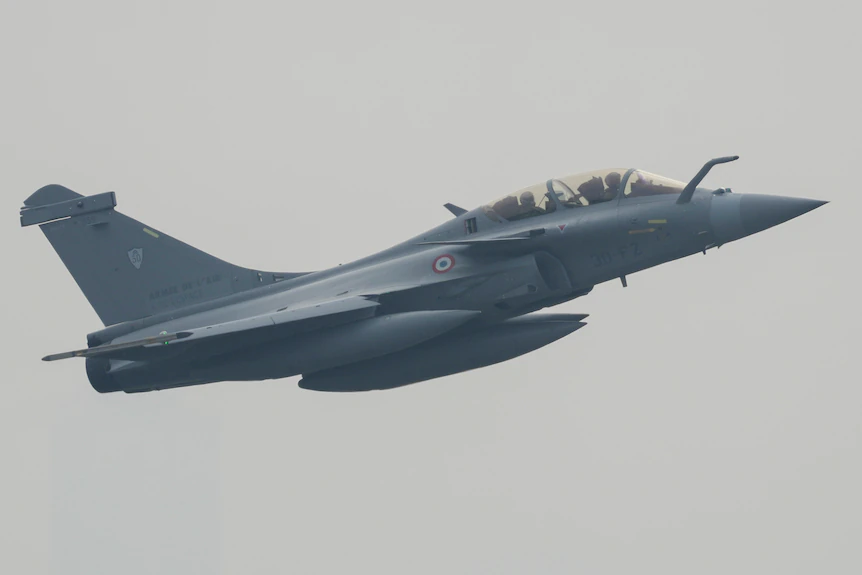
The centrepiece of the new strategy is a framework inviting Germany, Poland, the United Kingdom, the Netherlands, Belgium, Greece, Sweden, and Denmark to participate in exercises involving France’s air-launched nuclear capacity, known as the force de frappe. Allied nations may also host French nuclear-armed aircraft at their air bases for deterrence missions — a deployment posture with no precedent in French nuclear history.
Partners will additionally share in the development of auxiliary capabilities, including space-based early warning systems, advanced air defence networks, and long-range missile technology. Despite the depth of this integration, Macron was unequivocal on one point: the decision to fire a nuclear weapon remains exclusively in the hands of the French president, with no sharing of that authority under any circumstances.
The announcement formalises and accelerates cooperation that has been building quietly in recent months. UK officials participated for the first time in exercises conducted by France’s Strategic Air Forces, and a joint Franco-British declaration signed last July established a framework for coordinating — while keeping independent — the two countries’ nuclear forces. France and Britain have maintained a bilateral nuclear cooperation agreement for years.
The most symbolically charged new partnership is with Germany. President Macron and German Chancellor Friedrich Merz jointly announced plans to deepen deterrence integration beginning this year, encompassing German conventional participation in French nuclear exercises and joint visits to strategic sites. The two governments were careful to frame the arrangement as complementing, rather than replacing, NATO‘s existing nuclear deterrent architecture.
German participation represents a significant political milestone. Berlin has long been constrained by its post-war constitutional and political culture from engaging directly with nuclear strategy, making its willingness to enter French deterrence exercises a marker of how dramatically Europe’s security calculus has shifted.
Polish Prime Minister Donald Tusk acknowledged the development on X, writing about the imperative of arming up together with friends. The Netherlands confirmed it is engaged in strategic talks with France on nuclear deterrence as a supplement to NATO’s collective defence posture.
Macron cited several converging pressures driving the expansion: the emergence of new regional nuclear powers, the risk of adversarial coordination among hostile states, and the dangers posed by nuclear proliferation. He also pointed directly to recent changes in US defence strategy, stating that shifts in American posture had encouraged Europe to assume greater direct responsibility for its own security — a pointed reference to growing European doubts about Washington’s reliability as a guarantor of the continent’s defence.
The concept of France’s vital interests — the threshold whose violation would trigger a nuclear response — has been given sharper definition under the new strategy, though officials have not elaborated publicly on precisely how that threshold has evolved.
Looking further ahead, Macron announced the planned launch in 2036 of a new nuclear-armed submarine to be named The Invincible, reinforcing France’s sea-based second-strike capability as the cornerstone of its long-term deterrence posture.
French officials described the overall package as the most significant change in the country’s strategic thinking since France first developed its independent nuclear deterrent in 1960. For a continent recalibrating its security architecture in real time, Monday’s announcement from a windswept submarine base in Brittany may prove to be one of the defining moments of the post-Cold War era’s unravelling.