Tehran/Washington — Ayatollah Ali Khamenei, the 86-year-old cleric who ruled Iran with absolute authority for 35 years, has been killed in coordinated US-Israeli strikes, setting off a cascade of grief, celebration, and threats of catastrophic retaliation that reverberated from Tehran to the Gulf and beyond.
Iranian state television confirmed Khamenei’s death early Sunday, announcing a 40-day mourning period and seven public holidays. The strikes that killed him had been launched the previous day, with US President Donald Trump breaking the news on his Truth Social network late Saturday, describing Khamenei as ‘one of the most evil people in history’ and calling his killing ‘the single greatest chance for the Iranian people to take back their country.’
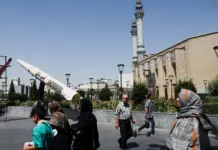
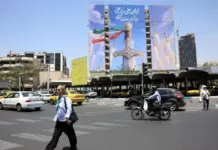
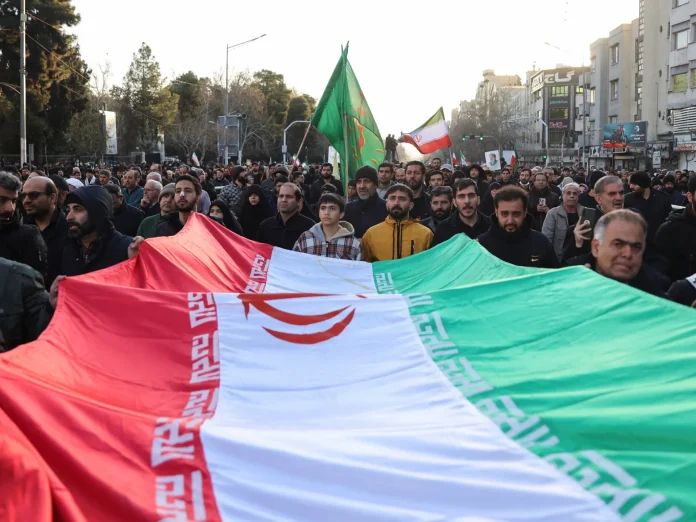
The reaction inside Iran was immediate and sharply divided. Thousands of mourners dressed in black flooded Enghelab Square — Revolution Square — in central Tehran, waving Iranian flags and holding photographs of the slain leader while chanting ‘death to America’ and ‘death to Israel.’ Yet even before state television had formally confirmed his death, a separate crowd gathered elsewhere in the capital to celebrate. Loud whistles, cheers, and fireworks lit the Tehran skyline shortly after 11 pm local time (1930 GMT), with verified footage capturing scenes of jubilation that stood in stark contrast to the official mourning declared by the state.
Iranian-Americans joined the celebrations thousands of miles away. In Los Angeles and Boston, crowds took to the streets, with marchers in Los Angeles carrying flags bearing the insignia of shah-era Iran alongside posters of Trump — a pointed symbol of the political rupture that Khamenei’s death has exposed within the Iranian diaspora.
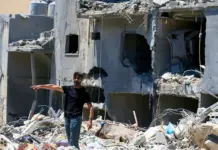
The Islamic Revolutionary Guard Corps wasted no time in issuing a response. In a statement, the IRGC pledged ‘severe, decisive’ punishment for Khamenei’s ‘murderers’ and vowed to launch what it described as the ‘most ferocious’ operation in its history against Israel and US military bases in Gulf countries. That threat carried immediate weight: explosions were heard in Doha, Dubai, and Manama on Sunday, as Gulf states — already reeling from what officials described as unprecedented deadly Iranian strikes — braced for further escalation. Warning sirens simultaneously sounded across central Israel, with the Israeli military confirming it was responding to incoming Iranian missile fire.
Trump responded to the IRGC’s threats with characteristic bluntness, warning that any Iranian retaliation would bring a response of a magnitude ‘never been seen before.’ The exchange underscored how rapidly the conflict, now entering its second day of US-Israeli strikes, risks expanding into a broader regional conflagration.
Iran’s President Masoud Pezeshkian branded the killing a ‘declaration of war against Muslims,’ stating that Iran considers it a ‘legitimate duty and right to avenge the perpetrators and masterminds.’ Israeli Prime Minister Benjamin Netanyahu, by contrast, called on Iranians to ‘overthrow the regime,’ echoing Trump’s framing of the moment as a political opportunity rather than a provocation.
International reactions reflected deep geopolitical fault lines. Reza Pahlavi, son of the shah deposed in the 1979 revolution that brought Khamenei’s predecessor to power, declared that the Islamic Republic ‘will soon be consigned to the dustbin of history.’ Iraqi cleric Moqtada al-Sadr declared a three-day mourning period, while hundreds of Iraqis attempted to storm Baghdad’s Green Zone in protest. Hamas mourned Khamenei as a steadfast patron who ‘provided all forms of political, diplomatic and military support,’ blaming Washington and Tel Aviv for ‘this blatant aggression and heinous crime.’
Western governments were notably cooler in their assessments. UK Defence Secretary John Healey said ‘few people will mourn’ Khamenei, while Australian Prime Minister Anthony Albanese stated the leader’s passing ‘will not be mourned’ — language that stopped short of endorsing the strikes but signalled little appetite for sympathy.
Khamenei had served as Supreme Leader since 1989, making him one of the longest-serving heads of state in the world and the dominant architect of Iran’s foreign policy, nuclear programme, and support for regional proxy forces. His death leaves Iran without a designated successor and its political establishment facing its most acute crisis since the revolution itself — a vacuum that both his enemies and his mourners understand could reshape the Middle East for a generation.
The US-Israeli strikes continue, and the full scope of their targets has not yet been disclosed. With Gulf capitals under fire, Israeli cities on alert, and Iran’s military vowing its most aggressive response in history, the region stands at the edge of a conflict with no clear boundaries and no obvious off-ramp.