BEIRUT — Ayatollah Ali Khamenei, Iran’s Supreme Leader and one of the most consequential figures in Middle Eastern geopolitics for more than three decades, was killed in a joint US-Israeli military strike early Saturday, along with several other senior Iranian leaders. The operation, confirmed by US Central Command, also claimed the lives of at least three American service members.
The killing of Khamenei — the architect of Iran’s regional influence and the patron of armed groups stretching from Lebanon to Yemen — sent immediate tremors through the political and military landscape of the Middle East. Iran’s foreign minister indicated a successor could be named within days, signalling that Tehran intends to project continuity even as it absorbs an unprecedented blow to its leadership structure.
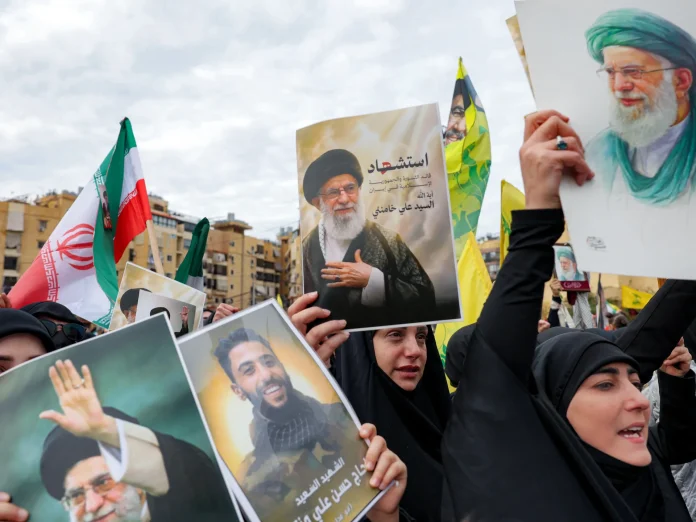
In Lebanon, the reverberations were immediate and visceral. Hezbollah, the Iran-aligned armed movement that has long served as Tehran’s most powerful regional proxy, organised a mass mourning gathering in Beirut on Sunday, drawing thousands of supporters into the streets. Crowds chanted ‘Death to America, death to Israel’ as the movement called on mosques across the country to recite the Quran and hold ceremonies honouring Khamenei.
Zainab al-Moussawi, a 23-year-old teacher who attended the Beirut gathering, drew a direct parallel to the killing of former Hezbollah leader Hassan Nasrallah in 2024. ‘Every time they take one of our leaders, they think we will collapse,’ she said. ‘We do not collapse.’
Despite the charged rhetoric, Hezbollah had not launched any military action against Israeli or American targets as of Sunday. The group issued a statement pledging to confront what it described as US and Israeli aggression, but stopped short of announcing any specific military response — a posture that reflects both the scale of the blow and the precarious position Lebanon now occupies.
The Lebanese government moved with unusual speed to assert its authority. President Joseph Aoun convened an emergency session of the country’s Higher Defence Council on Sunday, emerging to declare that decisions on war and peace rest exclusively with the Lebanese state. Prime Minister Nawaf Salam was equally direct, stating he would not permit any party to drag Lebanon into ‘adventures’ that threaten the country’s security and national unity.
The statements carry particular weight given Lebanon’s recent history. A yearlong war between Hezbollah and Israel concluded with a ceasefire in November 2024, but the fragile calm has since been repeatedly tested. Israel has continued to conduct strikes inside Lebanese territory in violation of that agreement and has maintained several military outposts on Lebanese soil — a source of deep resentment that complicates Beirut’s efforts to keep the country out of a broader regional conflagration.
The killing of Khamenei represents a dramatic escalation in the conflict between the United States, Israel, and Iran’s so-called ‘axis of resistance.’ Khamenei had led the Islamic Republic since 1989, overseeing the construction of a network of allied militias and political movements across the region that successive US and Israeli administrations sought to contain or dismantle. His death, alongside other senior Iranian officials, removes the central node of that network at a moment of already intense regional tension.
CENTCOM’s acknowledgment that three US service members died during the operation underscores the kinetic nature of the strike and the risks Washington accepted in authorising it. The confirmation also makes explicit what had previously been a pattern of plausible deniability — direct American military participation in an operation targeting the head of a sovereign state.
Iran’s foreign minister’s suggestion that a new supreme leader could be selected within days points to a succession process that, under the Iranian constitution, falls to the Assembly of Experts. The speed with which Tehran is signalling that transition reflects an effort to prevent a power vacuum from emboldening adversaries or destabilising the country’s internal order.
For Hezbollah, the death of Khamenei is not merely the loss of a spiritual figurehead — it is the severing of a relationship that has defined the group’s identity, funding, and strategic direction for decades. How the movement recalibrates, and whether it ultimately chooses confrontation or restraint, will shape the trajectory of the broader conflict in the weeks ahead. Lebanon, still scarred from its last war, is watching that calculation with dread.