Tehran — Israel and the United States launched a devastating joint bombing campaign against Iran beginning Saturday morning, killing Supreme Leader Ayatollah Ali Khamenei and striking military and strategic installations in relentless day-and-night raids that have sent shockwaves through the country and across the region.
The death of Khamenei, the Islamic Republic’s paramount leader, marks one of the most consequential moments in the Middle East in decades. The strikes represent a dramatic escalation following a 12-day war between Iran and Israel in June, a conflict that had already reshaped the region’s security calculus.
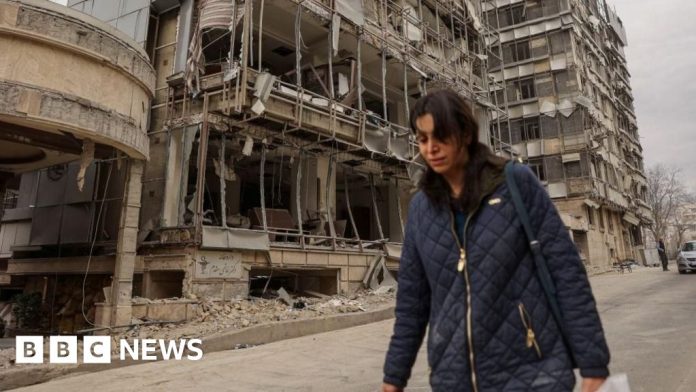
Since the initial strikes on Saturday, attacks on military and strategic sites have continued around the clock. In Karaj, a city west of Tehran, a resident identified as Hossein described the terrifying scale of the bombardment firsthand. During one night alone, he counted 17 consecutive explosions near his home. ‘It was one after another,’ he said, describing the blasts as enormous.
In Tehran, a resident named Amir reported that people rushed to stock up on groceries and essential supplies as uncertainty gripped the capital. Bakeries and petrol stations saw surging activity as residents braced for a prolonged crisis. Street life otherwise contracted sharply, with most people choosing to remain indoors. Security forces patrolled Iranian cities through the night, and multiple checkpoints were established around Tehran to intercept suspicious individuals.
Iranian authorities moved swiftly to control information, cutting off internet access in the immediate aftermath of the strikes — the third such blackout imposed by the regime this year alone. The move mirrored tactics used during previous periods of civil unrest, when the government severed digital communications to suppress the spread of information and limit the coordination of dissent.
On the streets, the political atmosphere was volatile. Government supporters were visible in some areas but appeared visibly angry and agitated rather than celebratory. Hossein observed that Khamenei’s death had sharpened the divide between pro- and anti-government Iranians. The Supreme Leader had presided over a brutal crackdown on protesters in recent years, during which many demonstrators were killed. His death, Hossein suggested, has now become a flashpoint that forces Iranians to choose sides more starkly than ever before.
Despite the chaos, the Islamic Revolution Guard Corps (IRGC) retained a firm presence on the ground, according to Hossein. The elite military force, which serves as the ideological backbone of the Islamic Republic and answers directly to the Supreme Leader, has long been the regime’s primary instrument of internal control. Its continued operational posture signals that the state’s security apparatus remains intact even as its political leadership has been decapitated.
The killing of Khamenei raises urgent and unanswered questions about the future of the Iranian state. The Supreme Leader held near-absolute authority over the country’s military, judiciary, and foreign policy. No formal succession mechanism has been publicly activated, leaving a dangerous power vacuum at the apex of the Islamic Republic at precisely the moment it faces its gravest external military threat.
The joint Israeli-American campaign represents a fundamental shift in how both countries have chosen to confront Iran’s nuclear ambitions and regional influence. For years, both governments pursued a combination of sanctions, covert operations, and diplomatic pressure. The open, sustained military assault now underway signals that those approaches have been abandoned in favour of direct confrontation.
The broader regional and global implications are still unfolding. The IRGC’s continued control on the ground means Iran retains significant capacity to retaliate through proxy forces across the Middle East, including in Lebanon, Iraq, Syria, and Yemen. Whether Tehran’s remaining leadership chooses escalation or seeks some form of de-escalation remains the defining question of the coming days.
For ordinary Iranians, the immediate reality is one of fear, uncertainty, and isolation — cut off from the internet, surrounded by security forces, and caught between a government fighting for survival and foreign militaries reshaping their country from the air.