Israel Standoff Strikes — Two precision strikes carried out by Israel in early 2025 have laid bare a fundamental vulnerability in the world’s most advanced air defence architectures, demonstrating that a small family of air-launched ballistic missiles can defeat systems costing billions of dollars — not through stealth or electronic warfare, but through the unforgiving physics of hypersonic re-entry.
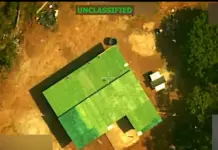
On February 28, Israeli aircraft struck the compound of Supreme Leader Ayatollah Ali Khamenei in Tehran. Months later, on September 9, a second strike hit the Qatari capital of Doha, targeting a gathering of Hamas leadership convened to review a ceasefire proposal from the Trump administration. Israel subsequently apologised for the Doha strike. Both operations share a defining characteristic: in neither case did Israeli aircraft enter the airspace of the targeted state.
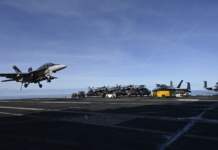
The operational architecture behind both strikes centres on the F-15I, Israel’s heavily modified variant of the American fighter jet, and missiles drawn from the Sparrow family — a lineage originally developed as ballistic target missiles for missile defence testing. For the Doha strike, an F-15I flew over international waters in the Red Sea, positioning itself roughly at the latitude of the Saudi port of Yanbu, before releasing what is assessed to be a Silver Sparrow air-launched ballistic missile. For the Tehran strike, the aircraft is believed to have operated over eastern Syrian or western Iraqi airspace, creating a northern vector into Iran and likely employing the Blue Sparrow variant.
Recommended Reading
The missile’s flight profile is what makes interception so difficult. After release, it follows a ballistic arc that carries it entirely outside the conventional air defence engagement envelope during its midcourse phase — operating beyond traditional atmospheric zones before re-entering the atmosphere at hypersonic speed in a near-vertical descent. The interval between a reliable radar track forming and the moment of impact is measured in seconds. That window is simply too narrow for existing systems to exploit.
THAAD and Patriot, the most capable terminal-phase interceptors currently deployed, cannot overcome the constraint imposed by the missile’s velocity and trajectory geometry. No defence system can exempt itself from those physics. The same principles apply regardless of who is operating the interceptor or how sophisticated its software.
The integration required to field this capability is considerable. The Sparrow system has been incorporated into the F-15I through deep structural and software modification, representing a level of sovereign integration that Israel’s partners do not share. Saudi Arabia, the world’s largest purchaser of American weapons and operator of the largest F-15 fleet outside the United States, flies the F-15SA variant — but without the same degree of independent weapons integration. Qatar‘s F-15QA is similarly constrained. The capability, for now, remains uniquely Israeli.
That exclusivity may not last. The industrial base required to develop comparable architectures exists in a small number of states: the United States, Russia, China, France, Pakistan, and a handful of others possess the technical foundation to pursue similar systems. As the concept is validated in combat and its effectiveness demonstrated, the incentive for proliferation grows sharply.
Israel Standoff Strikes: The Global Security Context
The strategic implications extend well beyond the specific conflicts in which these weapons have been used. Once this capability becomes normalised, the boundary between atmospheric and suborbital military operations will begin to erode. Warfare will grow more unpredictable. Decision-making timelines will compress dramatically, forcing political and military leaders to make consequential choices — choices that could escalate or de-escalate regional conflicts — in minutes rather than days. The margin for miscalculation narrows accordingly.
The strikes also carry a pointed diplomatic message. Israel demonstrated that it can reach the most heavily defended locations in both Iran and a Gulf state hosting major American military infrastructure, without exposing its aircraft to local air defences. The apology issued after the Doha strike acknowledged the political sensitivity of striking a close American partner, but the technical message was unmistakable: geography and air defence coverage no longer guarantee sanctuary.
For defence planners across the region and beyond, the challenge is acute. Investments in layered air defence — already measured in the hundreds of billions of dollars globally — must now contend with a class of threat for which no reliable intercept solution currently exists at scale. The physics that make the Silver and Blue Sparrow variants so effective are not proprietary to Israel. They are available to any state with the engineering capacity to exploit them.