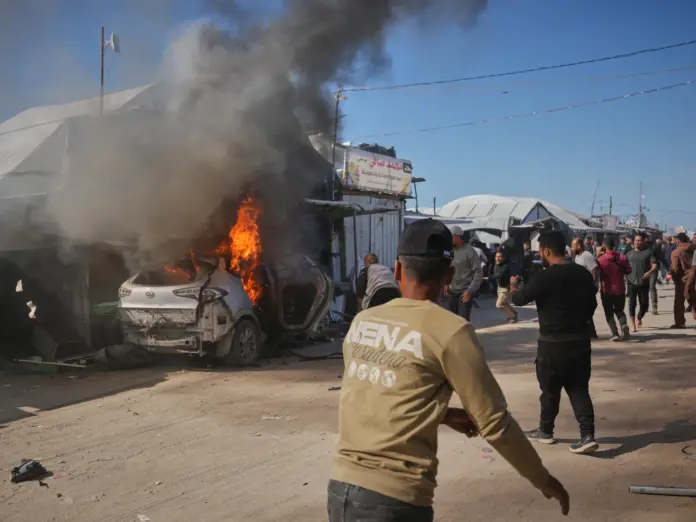
KHAN YOUNIS, Gaza Strip — An Israeli air strike killed a senior Gaza police commander and wounded at least 17 others in the southern city of Khan Younis on Wednesday, underscoring the fragility of a US-brokered ceasefire that has failed to halt near-daily Israeli military operations across the territory.
Naseem al-Kalazani, a colonel who led the anti-narcotics force in Khan Younis, was struck in a targeted attack on his vehicle near the al-Mawasi area in the city’s western reaches. Hamas sources confirmed his identity and rank within Gaza’s police structure. The strike wounded at least 17 bystanders in the immediate vicinity.
Gaza Ceasefire Collapse — Separately, at least three Palestinians were killed near the Zeitoun neighbourhood of Gaza City, according to health officials at al-Ahli Arab Hospital, bringing the day’s confirmed death toll to a minimum of four.
Recommended Reading
Israel maintains that its strikes are aimed at disrupting attempts by Hamas and other Palestinian armed groups to plan and execute attacks against Israeli forces. The military has conducted operations at a near-daily pace since the ceasefire came into effect.
The scale of violence since the truce began is stark. More than 830 Palestinians have been killed during the ceasefire period, according to local medics — a figure that has drawn international concern and deepened questions about the agreement’s viability. Israel, for its part, says Hamas has killed four Israeli soldiers during the same period.
The ceasefire, brokered by the United States and which came into effect in October, was intended to pause the fighting and create space for negotiations over a longer-term arrangement. Those talks have stalled badly. Israel’s security cabinet convened earlier this week to deliberate on renewing full-scale military operations, reflecting growing frustration within the Israeli government over Hamas’s negotiating posture.
At the centre of the impasse is the question of disarmament. Israel has demanded that Hamas commit to full disarmament as a condition for any durable agreement. Hamas has flatly refused, instead submitting a counteroffer that insists weapons be addressed within a broader political framework — one that culminates in the establishment of a Palestinian state. The group has also demanded that Israel halt its expanding territorial control within Gaza and significantly increase the flow of humanitarian aid into the territory.
On the aid front, the reopening of the Zikim crossing has produced a modest increase in supplies entering Gaza. However, the United Nations Office for the Coordination of Humanitarian Affairs (OCHA) reports that overall humanitarian conditions in the territory continue to worsen, with the incremental aid flow falling far short of what is needed to address the crisis.
Gaza Ceasefire Collapse: Regional Implications
The broader human cost of the conflict since it erupted in October 2023 is staggering. More than 72,500 Palestinians have been killed, according to Palestinian health authorities, in a war that has reduced large swaths of Gaza’s urban landscape to rubble and displaced the vast majority of the territory’s population multiple times over.
The killing of al-Kalazani is the latest in a series of targeted strikes against Hamas-affiliated officials and security personnel. Such strikes have continued throughout the ceasefire period, with Israel arguing they fall within its right to act against imminent threats. Critics, including several international bodies, contend the operations undermine any prospect of a negotiated resolution and perpetuate civilian suffering.
With diplomatic efforts stalled, the security cabinet’s deliberations over a renewed military offensive loom large. Any such escalation would likely further entrench the humanitarian catastrophe that OCHA and other agencies have repeatedly warned is reaching a breaking point. For the residents of Khan Younis and Gaza City, the distinction between war and ceasefire has, in practice, become increasingly difficult to discern.