Israeli authorities have forcibly displaced at least 11 Palestinian families from the Batn al-Hawa neighbourhood in Silwan, occupied East Jerusalem, in a move rights organisations describe as part of a widening campaign to transfer Palestinian-held properties to Israeli settler groups.
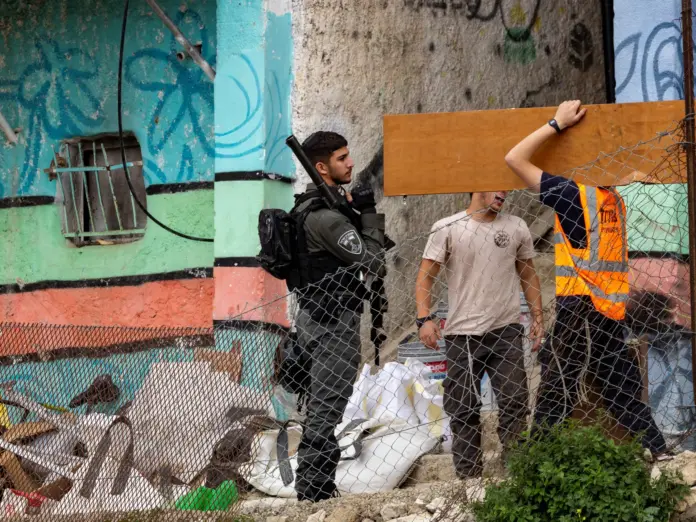
The evictions, documented by Israeli human rights organisation B’Tselem, were carried out under heavy police presence. Footage from the neighbourhood showed workers in orange reflective vests removing families’ belongings from their homes as officers stood guard. The displaced properties are expected to be transferred to Ateret Cohanim, an Israeli settler organisation with a track record of acquiring Palestinian homes in East Jerusalem, according to the Norwegian Refugee Council.
Batn al-Hawa sits just south of Jerusalem’s Old City and the Al-Aqsa Mosque compound — one of the most contested and symbolically charged locations in the Israeli-Palestinian conflict. Silwan, which hugs the ancient city walls, has endured years of sustained pressure from Israeli authorities and settler groups seeking to expand their foothold in the area.
The latest evictions follow a pivotal legal defeat for Palestinian residents. In early January, Israel’s Supreme Court rejected a final appeal lodged by more than two dozen Palestinian families in Batn al-Hawa who had challenged their looming removal. Prior to that ruling, Israeli settlers had already occupied the homes of at least six Palestinian families in the same neighbourhood. Israeli rights group Ir Amim has noted a sharp escalation in evictions in Batn al-Hawa in the period since.
The scale of displacement facing the area is significant. Approximately 90 families — around 700 people — in Batn al-Hawa alone face an imminent threat of forced removal. In the nearby al-Bustan area of Silwan, a further 150 families comprising roughly 1,500 people are at similar risk. Across East Jerusalem more broadly, the Norwegian Refugee Council warns that over 1,000 Palestinians face forced eviction.
Central to the legal architecture enabling these removals is a 1970 Israeli law that grants Jewish citizens exclusive rights to reclaim property allegedly owned before 1948 — the year of Israel’s founding and the mass displacement of Palestinians known as the Nakba. Palestinians are explicitly denied equivalent rights under the same legislation, a disparity that human rights organisations have long condemned as discriminatory and incompatible with international law.
The evictions in East Jerusalem are unfolding against a broader backdrop of intensifying violence and displacement across the West Bank. Since the outbreak of the war on Gaza in October 2023, tens of thousands of Palestinians have been displaced across the West Bank. United Nations figures show that at least 1,052 Palestinians were killed by Israeli settlers and troops in the West Bank between October 2023 and the end of January 2024 alone.
Rights groups argue that the combination of legal mechanisms, settler expansion, and military pressure amounts to a systematic effort to alter the demographic character of East Jerusalem and the surrounding territories — areas that Palestinians regard as the heart of any future state. Israel captured East Jerusalem during the 1967 war and subsequently annexed it in a move not recognised under international law.
The displacement of the 11 families in Batn al-Hawa represents the latest chapter in a decades-long struggle over land, identity, and sovereignty in one of the world’s most contested cities.