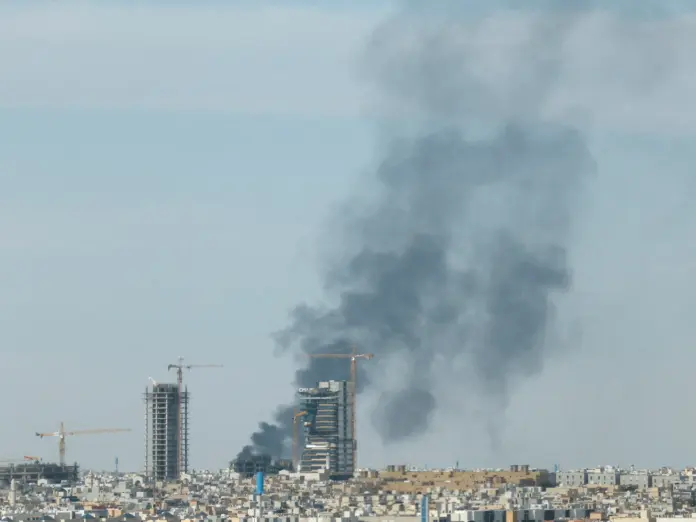
Iranian drone and missile barrages killed civilians and military personnel across the Gulf on Sunday, striking residential areas, fuel infrastructure, and water facilities as a war now in its ninth day spread its consequences far beyond the frontlines between Iran, the United States, and Israel.
In Al-Kharj, Saudi Arabia, a projectile struck a residential compound belonging to a maintenance and cleaning company, killing one Indian national and one Bangladeshi national and wounding twelve others. The Saudi Civil Defence announced the incident on X. The city is home to Prince Sultan Air Base, a facility used by US forces and one of the sites the Islamic Revolutionary Guard Corps (IRGC) said it had targeted with strikes on radar systems. Over the weekend, Saudi Arabia reported intercepting fifteen drones and nine additional drone attempts, with one reaching the eastern outskirts of Riyadh. An attempted drone attack also struck the capital’s diplomatic quarter.
The deadliest single event of the conflict occurred in Kuwait, where an Iranian missile killed six US servicemembers — the highest-casualty strike since hostilities began on February 28. Two Kuwaiti firefighters, Lieutenant Colonel Abdullah Emad al-Sharrah and Major Fahd Abdulaziz al-Mujammad, were also killed while performing safeguarding duties. Other Kuwaiti casualties included a young girl, two members of the armed forces, and two border guards. Since the conflict began, Kuwait has detected 234 missiles and 422 drones. A separate strike hit fuel tanks at Kuwait’s international airport.
In Bahrain, an Iranian drone attack on Sunday injured three people and caused material damage primarily in Muharraq, the island nation’s former capital. A university and a water desalination plant were among the structures damaged.
The United Arab Emirates also came under fire. A Pakistani driver was killed in Dubai when debris from an intercepted suspected Iranian drone crashed into his vehicle. The interception caused minor damage to the facade of a tower in the Dubai Marina area. On Saturday, fire and smoke were seen billowing from Dubai’s 23 Marina tower following a reported missile strike. The IRGC claimed it was targeting a location where US troops were stationed.
Israeli warplanes struck five oil facilities near the Iranian capital during the same period, with a state oil executive confirming several deaths. In response, an IRGC spokesperson warned that Iran would retaliate if US and Israeli attacks on its energy infrastructure continued, adding that Tehran possessed sufficient drone and missile stockpiles to sustain operations across the Middle East for up to six months. Iran’s Health Ministry reported at least 1,200 civilians killed and approximately 10,000 wounded since the US and Israel launched their campaign on February 28.
The breadth of the strikes drew sharp condemnation from regional bodies. Ahmed Aboul Gheit, secretary-general of the Arab League, described Iran’s attacks on member states as ‘reckless.’ Omani Foreign Minister Badr Albusaidi called for restraint on all sides, urging a ceasefire and an immediate return to diplomacy, while characterising the military operations against Iran as both immoral and illegal.
Diplomatic channels remained active despite the violence. Iranian Foreign Minister Abbas Araghchi said he had been in constant contact with his Saudi counterpart, and confirmed that Riyadh had assured Tehran it was fully committed to not allowing its territory, waters, or airspace to be used for attacks against Iran.
A potential off-ramp emerged when Iranian President Masoud Pezeshkian announced that Iran’s temporary leadership council had approved suspending attacks on neighbouring countries, provided those nations did not themselves serve as launchpads for strikes on Iran. US President Donald Trump dismissed the statement, characterising it as a form of surrender to Iran’s neighbours.
The human cost of the conflict extends well beyond combatants. The Gulf states host workers and residents from more than 200 nationalities, and the dead and wounded in Al-Kharj, Dubai, and Kuwait reflect how migrant labour communities have been caught in the crossfire. The United Arab Emirates, Kuwait, Qatar, Bahrain, and Saudi Arabia have all sustained sustained drone and missile fire over the past week, testing both their air defence systems and their diplomatic relationships with a Tehran that insists it is striking only at US military assets.