Iran War Diplomacy — Diplomatic activity surrounding the war on Iran reached a fever pitch this week, with competing signals from Washington, Beijing, and regional capitals underscoring the complexity of ending a conflict that has already claimed one of the most consequential figures in modern Middle Eastern history — Ayatollah Ali Khamenei, Iran’s former Supreme Leader, who was killed during the fighting.
US Vice President JD Vance stated that negotiations with Iran are making progress, yet the path to a settlement remains fraught. President Donald Trump, currently on a state visit to China where he met with President Xi Jinping in Beijing, has drawn a firm red line: any agreement must guarantee Iran will never acquire a nuclear weapon. Trump has already rejected Tehran’s latest proposal as unacceptable, leaving the two sides at an impasse even as back-channel contacts continue.
Secretary of State Marco Rubio added to the pressure, asserting that Iran has been building up its conventional military capabilities through expanded missile and drone programmes. That assessment was reinforced by Brigadier-General Mohammad Akrami Nia, who declared Iran’s armed forces are operating at their highest level of readiness — a pointed signal to Washington and its allies that Tehran is not negotiating from a position of weakness.
Recommended Reading
On Capitol Hill, US senators narrowly defeated a resolution that would have curtailed Trump’s authority to wage war against Iran, handing the White House a significant legislative victory and clearing the way for continued military operations without congressional constraint.
The Beijing summit introduced a new dimension to the crisis. Analysts warn that China could leverage Trump’s desire for Beijing’s help in pressuring Iran — potentially extracting concessions on Taiwan in return. Xi Jinping himself cautioned that Washington and Beijing risked coming into conflict if the Taiwan question is mishandled, a warning delivered even as Trump publicly insisted the United States does not need China’s assistance to end the Iran war or reopen the Strait of Hormuz.
Regional diplomacy has taken equally dramatic turns. Israeli Prime Minister Benjamin Netanyahu made a wartime visit to the United Arab Emirates, meeting with UAE President Sheikh Mohamed bin Zayed Al Nahyan — a striking development given the ongoing conflict. The UAE subsequently denied the visit took place, while simultaneously asserting that its ties with Israel under the Abraham Accords are public and not conducted in secrecy, a statement that only deepened the ambiguity surrounding the encounter.
Iranian Foreign Minister Abbas Araghchi issued a stark warning to any country cooperating with Israel against Tehran, stating such nations would be held to account. Araghchi then travelled to New Delhi to represent Iran at the BRICS foreign ministers’ meeting, signalling that Tehran is working to consolidate support among major non-Western powers even as it faces military and economic pressure.
Iran War Diplomacy: Regional Implications
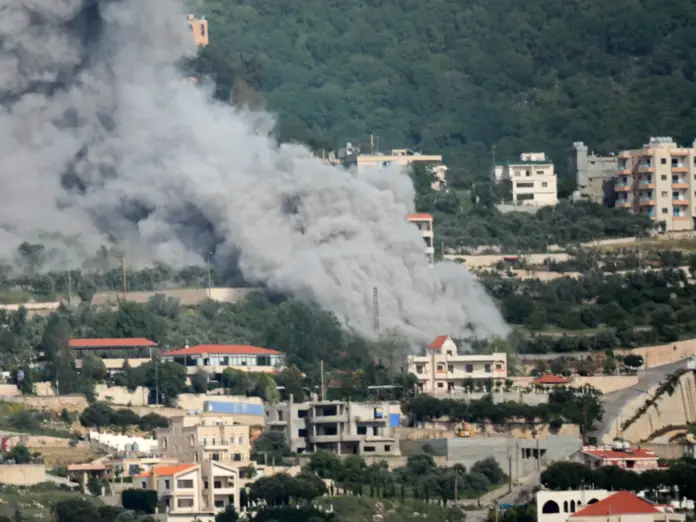
The conflict’s spillover into Lebanon continues to exact a devastating toll. Israeli strikes killed 12 people on Wednesday, the majority south of Beirut, according to Lebanon’s Ministry of Public Health. Overnight and early morning attacks struck multiple locations across southern Lebanon, even as a technically active ceasefire remains nominally in place. More than 10,000 homes have been damaged or destroyed since that ceasefire was declared. Hezbollah carried out several retaliatory attacks on Israeli army positions near the southern Lebanese town of Biyyada. Despite the violence, Lebanese and Israeli officials were scheduled to convene in Washington for peace negotiations — a fragile diplomatic thread amid daily bloodshed.
Inside Iran, a moment of rare public celebration offered a glimpse of civilian life beneath the pressures of war. Crowds filled Tehran’s Enghelab Square to cheer the national football team ahead of the 2026 World Cup. Iranian football federation president Mehdi Taj declared the squad would represent not only the Iranian people but also the country’s fighters, its leadership, and the nation itself — framing sport as an act of national solidarity in a country under siege.
The war’s trajectory now hinges on several converging variables: whether Trump’s Beijing meetings yield any Chinese pressure on Tehran, whether Iran’s military posture hardens or softens at the negotiating table, and whether the fragile diplomatic architecture in Lebanon can survive the daily reality of Israeli strikes. With Khamenei gone and Iran’s political future uncertain, the coming weeks may prove decisive in determining whether diplomacy or escalation defines the next chapter of this conflict.