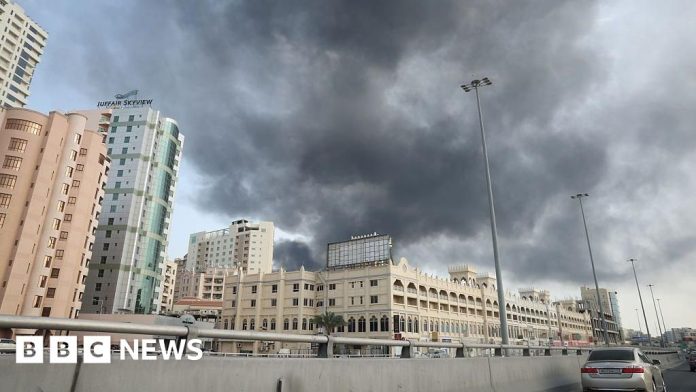
Bahrain — Iran fired missiles and drones at the US Navy’s Fifth Fleet headquarters in Bahrain, marking one of the most direct strikes against American military infrastructure in the Gulf in recent memory. Video footage circulating online showed projectiles impacting the vicinity of the base, including at least one Iranian Shahed drone that appeared to breach Bahraini air defences. No casualties were reported in the immediate aftermath of the attack.
The strike represents a significant escalation in the confrontation between Tehran and Washington, even as early assessments suggest Iran may have deliberately calibrated the scope of its response. Edmund Fitton-Brown, a senior fellow at the Foundation for Defense of Democracies, a Washington-based foreign policy research institute, noted that initial indicators point to a retaliation that was relatively restrained in scale — a signal, analysts suggest, that Iran may be testing American resolve without triggering a full-scale military exchange.
The use of Shahed drones as a primary strike platform reflects a broader strategic pattern. The same unmanned aerial vehicles have been exported to Russia, which is now producing thousands of them each month for deployment against Ukraine. In that conflict, the drones have proven vulnerable to relatively basic countermeasures — in some cases, Ukrainian forces have brought them down with high-calibre machine guns. Yet their sheer volume and low cost make them a persistent threat, capable of overwhelming air defence networks through saturation tactics.
The penetration of Bahrain’s air defences by even a single Shahed drone will raise serious questions about the layered protection surrounding one of America’s most strategically vital naval installations. Tom Sharpe, a former Royal Navy Commander, has previously highlighted the asymmetric challenge posed by cheap, mass-produced drones against expensive and finite defensive systems — a calculus that has become central to modern warfare from the Red Sea to Eastern Europe.
Washington moved swiftly to reinforce its regional posture ahead of and following the attack. The US deployed additional air defence assets to the Middle East, including THAAD and Patriot missile defence systems. For context, Ukraine — despite repeated appeals from President Volodymyr Zelensky, who has identified air defences as his foremost request to Western allies — currently operates fewer than ten Patriot batteries across the entire country.
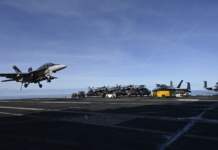
The American military footprint in the Gulf and eastern Mediterranean is formidable. Approximately a dozen Arleigh Burke-class destroyers are now operating in the region, alongside more than 100 fighter jets. Between 2024 and 2026, US naval forces intercepted nearly 400 Houthi drones and missiles in the Red Sea — a sustained air defence campaign that has tested both equipment and munitions stockpiles.
Iran’s offensive capabilities remain substantial despite ongoing pressure. Before recent strikes by US and Israeli forces targeting Iranian drone and missile production facilities and launch sites, Tehran maintained an arsenal estimated at around 2,000 short-range ballistic missiles. The country also possesses large stocks of anti-ship missiles and a fleet of small, fast, uncrewed attack boats — assets that could threaten commercial shipping and naval vessels throughout the strategically critical Strait of Hormuz.
The attack on Bahrain arrives against a backdrop of intensifying military activity across the region. US and Israeli operations have been systematically targeting Iranian drone and missile factories in an effort to degrade Tehran’s capacity for sustained strikes. Whether the Bahrain attack represents a one-off demonstration or the opening salvo of a broader Iranian campaign will depend in large part on how Washington chooses to respond — and how much further Tehran is willing to push a confrontation it has so far kept below the threshold of all-out war.
The episode draws uncomfortable parallels with the NATO-led bombing campaign against Libya in 2011, which demonstrated how sustained air operations could erode a state’s military infrastructure over time. Iran, aware of that precedent, faces a strategic dilemma: absorb the strikes and appear weak domestically, or escalate in ways that risk a devastating American military response.